
Homemade German Sauerkraut
Crunchy and tangy this homemade German sauerkraut recipe is easy to make in small batches on your kitchen counter!
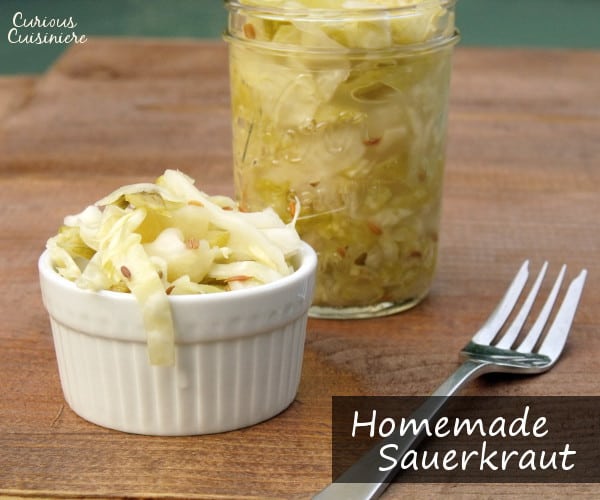 Homemade sauerkraut isn't like what you buy from the store. Yes, it still has that pleasantly tart/sour flavor. But, it's crunchy! That's the way sauerkraut is supposed to be!
Is Homemade Sauerkraut Difficult To Make?
NO!
We have put off making our own sauerkraut until now because we were under the impression that you needed a special crock to ferment the cabbage in, and we were afraid that one batch of sauerkraut would make enough to feed an army for the next year. Even though we're in Wisconsin, we can only go through so much at a time!
But, when we found out that you can make a small batch of sauerkraut in a mason jar. We were all in.
If we had realized just how easy sauerkraut is to make in small batches, I guarantee we would have been doing it sooner.
All you need is cabbage and salt. Yes. That's it. And, it's the perfect way to use up that quarter head of cabbage that we can never seem to finish before it goes bad.
How It Works
Sauerkraut (German for sour cabbage) is made by an age-old fermentation process called lactofermentation.
Lactobacillus is a good bacteria found on the surface of many fruits and vegetables, even in yogurt.
As the cabbage is submerged in a salt brine, the lactobacillus begins to convert the sugars of the cabbage to lactic acid, which is a natural preservative.
Healthy Homemade Sauerkraut
Not only is lactofermentation a great way to preserve the cabbage, since it is one of the same strains of beneficial bacteria that is found in yogurt, lactofermented cabbage also contains some of the beneficial probiotics that you find in yogurt.
As the lactobacilius multiply, they enhance the digestibility and nutrition of the food that is fermenting.
So, homemade sauerkraut is not only crunchy and tasty, it also provides your gut with extra healthy nutrients!
 Just Salt and Cabbage: A Simple Sauerkraut Recipe
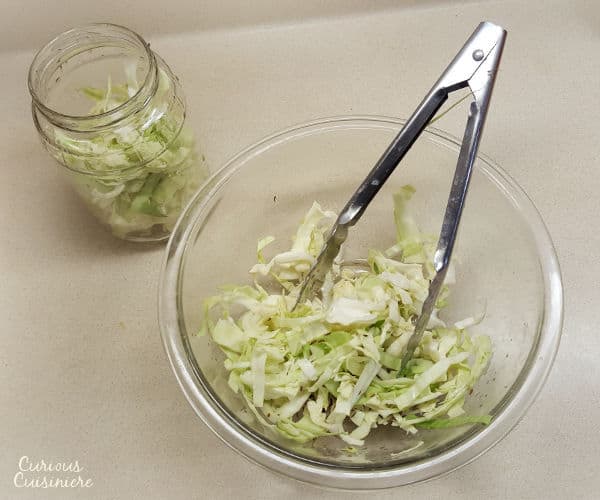 Just Salt and Cabbage: A Simple Sauerkraut Recipe
You really can't get more simple than the ingredients for this sauerkraut recipe.
Salt and cabbage!
As one of the two necessary ingredients, salt is an essential element in lactofermentation. It keeps unwanted bacteria from growing and helps the cabbage stay crisp, by drawing out moisture. As the salt starts to break down the cabbage, it creates the brine that will ferment the cabbage.
It is important to keep the cabbage completely submerged in its own juices during the fermentation process. Any cabbage bits that are exposed to air will be more likely to start to mold.
The Key to Successful Homemade Sauerkraut
The problem is, once the cabbage starts to release its juices, the little shredded bits like to float to the top. So, we need to put something on top of the cabbage to keep it submerged.
Some people like to do this by covering the shredded cabbage with one larger cabbage leaf, and then nestling a smaller jar inside the mouth of your fermentation jar.
While this way works well, we have found that an incredibly easy way to keep everything submerged is to insert a Ziploc bag into the jar over the shredded and salted cabbage. Then, we fill the bag with water. (Just be sure to test the bag first for any leaks!) The water filled bag acts as a weight and keeps everything well covered.
We typically don't have issues with mold in our sauerkraut. But, if you do find something forming on the top of your sauerkraut, take a look at it. If it's whiteish and thin you can scrape it off and continue fermenting. If it's fuzzy or colorful, then something went wrong with your batch. Throw it away and start over. (As always, use you best judgement on these things! All we can give is recommendations based on our experiences.)
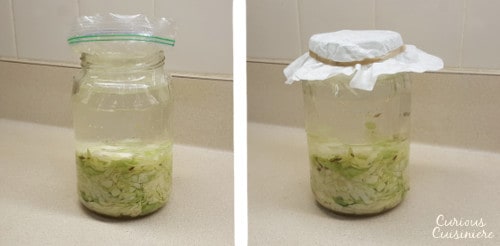
Finally, the whole jar needs to be covered so that we don't get any unwelcome visitors in our sauerkraut. This can be done with a clean towel, cheesecloth, or (our favorite method) a coffee filter.
How Long Does It Take To Make Our Homemade Sauerkraut Recipe?
It can take anywhere from 1-3 weeks to achieve a nice sour tartness in your sauerkraut.
In the cool temperatures of winter, it will take longer, and in the warm days of summer it will go more quickly.
Taste your sauerkraut every few days until it reaches your desired flavor. Once it gets there, remove the weights and cover the jar with an airtight lid and store it in the refrigerator.
How To Use Homemade Sauerkraut
It also makes a great filling for pierogi and goes great in a sausage and potato hash!
How do you like to serve sauerkraut?
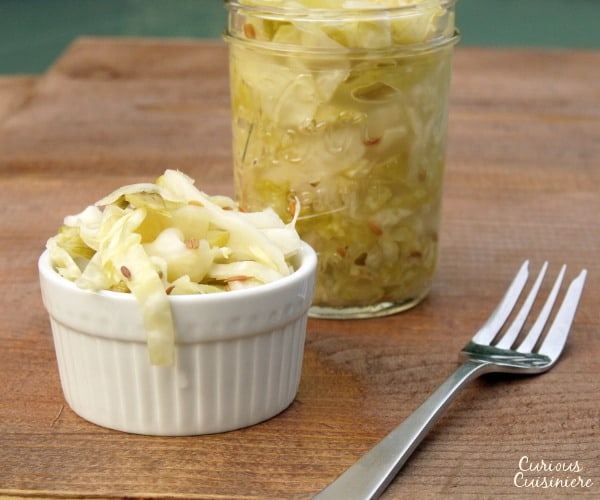
Homemade German Sauerkraut
Ingredients
- ½ small head cabbage, shredded (roughly 4 cups or 11 oz)
- 2 teaspoon Kosher salt
- 1 teaspoon caraway seeds, (optional)
Instructions
- In a large bowl, mix the shredded cabbage with the salt and caraway seeds (if using). Let the mixture rest for 15-20 minutes to let the salt start drawing moisture out of the cabbage. (To speed up the process, you can get in there with your hands and massage the cabbage and salt together for 5-10 minutes.)
- Wash a quart mason jar well with hot soapy water. Pack the salted cabbage mixture (and any juices) into the clean jar. Pound the cabbage with the back end of a wooden spoon to pack it tightly and remove any air pockets.
- Place a quart-sized Ziploc bag into the jar (use one that you know holds a tight seal). Fill the bag with water and seal the bag. This will act as a weight and help to keep all the cabbage submerged. Cover the jar with a towel, cheesecloth, or coffee filter.
- Check the sauerkraut after 24 hours. If the cabbage is not entirely submerged in brine, add a saltwater mixture of 1 teaspoon salt to 1 cup water to the cabbage, just until it is submerged.
- Place the jar somewhere out of the way, away from direct sunlight, to ferment. Fermentation can take 1-3 weeks, depending on the temperature and your desired flavor of sauerkraut. Taste your sauerkraut every few days, and once you like the flavor, remove the bag of water and cover it with an airtight lid. Store the sauerkraut in the refrigerator.
Notes
While the sauerkraut is fermenting, you may notice it bubbling and foaming. This is normal and can be skimmed off before you refrigerate your sauerkraut.
If at any point your sauerkraut starts to turn a strange color or get fuzzy, your preparation probably was not as clean as you thought. You'll need to throw away this batch and start over.
Nutrition Information:
Yield:
8Serving Size:
¼ cAmount Per Serving: Calories: 3

Sarah founded Curious in 2010 as a way to save her recipe creations and share culinary experiences. Her love for cultural cuisines was instilled early by her French Canadian Grandmother. Her experience in the kitchen and in recipe development comes from over 10 years working in professional kitchens. She has traveled extensively and enjoys bringing the flavors of her travels back to create easy-to-make recipes.




The first time I made this recipe it turned out great. Making it a 2nd time. It’s been fermenting about a week & the brine has gone cloudy. Any idea what the issue might be?
Hi Leigh. Sometimes the brine will go cloudy depending on the type of bacteria that's fermenting in there. (Often this happens if I ferment a sauerkraut too close to my sourdough.) It isn't a problem, but in my experience, the resulting kraut may be a bit yeasty tasting or smelling. You can continue fermenting as normal, or switch it to the fridge for the rest of the fermenting (activity will just slow down a bit). If you're not a fan of the yeasty flavor, you can always use the kraut in a cooked dish, like kapusta, and start the ferment again. As long as there isn't mold on the ferment though, it should be fine to eat. As always, use your best judgement, I can only give guidelines since I am not there to see it.
I want to try this recipe. What is the estimated expiration for a fresh batch of mason jar saurkraut?
Hi Isaac. If you refrigerate it after it reaches your desired flavor, it can last for months. We have had jars refrigerated for 2-3 months. It never lasts us longer than that!
This is great! We have our first jar fermenting away in the basement. I think it needs another week to get the right tang. Thanks for sharing this! This is going to be great on brats.
Hope you enjoy it!
Tomorrow will be one week with my saurkraut in the jar. It's not foaming or anuthing like that, but it doesn't taste like saurkraut. And it smells like saline, which I'm sue is because of the salt. Is there anything else I need to do? It's just sitting on my kitchen counter.
Hi Tammy. Did you ever notice bubbling? Is it in a cold place (<70F)? You should have noticed some bubbling/foaming within the first week, unless it was in a cool place. If our kitchen is warm our sauerkraut typically takes 2 weeks to develop the flavor that we prefer. If our kitchen is cooler, like in winter, it may take 3-4 weeks. I would say test it after another week and check back with us.
I have tried various loose lid methods. This year, I tamped down the kraut (cabbage, beet, peppers, daikon radish, cuke, or what have you) filled brine TO THE BRIM, (leaving trapped air bubbles within the kraut), and screwed the lid down as hard as I could.
Wow. There was some leakage on a very few jars. All the lids bulged. Two lids (out of 64) have actually bent a bit. When I first open them, it is VERY slowly, in the sink. There is some spectacular spray because of the pressure build up.
The advantage - absolutely zero mould problem, and no fiddling. Just set it and forget it.
Try it! ymmv.
How interesting! Thanks for sharing!
FWIW, if you want to make large batches for social events, parties, etc, get yourself a fermenting bucket with grommeted lid and an air lock. You can find these at any home brewing supply store and many retain liquor warehouses fairly cheap.
Thanks for sharing Ross!
I made this recipe today. I have made others before. I screw the lid on loosely and set the jar in a bowl to catch the liquid as it rises. Works well for me.
Great tip! Glad you enjoyed the sauerkraut recipe!
How long does it last in the fridge?
Hi Shelly. The sauerkraut should keep 2-3 months in the fridge.
4 to 6 months
I made this sauerkraut following your directions precisely. I used 4 cups packed green cabbage to 2 tsp non-iodide salt and a sprinkling of caraway seeds. I massaged the cabbage mixture for about 10 minutes and then packed it down tightly with the released juices in a mason jar. I used a ziploc bag with water to weigh it all down under the juice. Started it on Sept. 1st 2019. Put it in a cabinet. Happy to say, IT CAME OUT PERFECT AFTER 3 weeks fermenting. I have another jar I’m allowing to go a little longer. Thank you for posting!!
So glad you're enjoying the sauerkraut!
Can I use Napa cabbage for the kraut? I have almost a whole head of Napa cabbage (I only used a few leaves for stir fry) and I would hate for it to go to waste.
Hi Ashley. While we've never tried it, I don't see any reason why you couldn't use Napa cabbage to make kraut. It might have a slightly different flavor than is traditional, but I don't think that would be a bad thing at all. If you give it a try, let us know how it turns out for you!
Thank you for sharing your knowledge. If you cook the kraut are you killing all of the good probiotics?
Yes, cooking the kraut will kill the probiotics. When we use it in a warm dish, we try to add it near the end of cooking, so it just warms up but isn't fully cooked (aka not brought to boiling or searing temps). Enjoy!
Can you just use the mason jar and just fill it up to the top and then seal it? That way there is no headspace in the jar. Or does it need to breathe with the outside air?
Hi Daryll, If you use a mason jar and seal it, you will need to open the jar every day or so to let out the carbon dioxide. This is called 'burping'. You don't want the gasses from the fermentation to build up. So, ideally, you would have a little space for those gasses to escape.
I never get enough brine. What should I do?
Hi Gina. Add 1 tsp of salt to 1 cup of water. Mix until the salt is dissolved. You can then add as much of this extra brine as you need to adequately cover your cabbage. Enjoy!