German Beef Rouladen
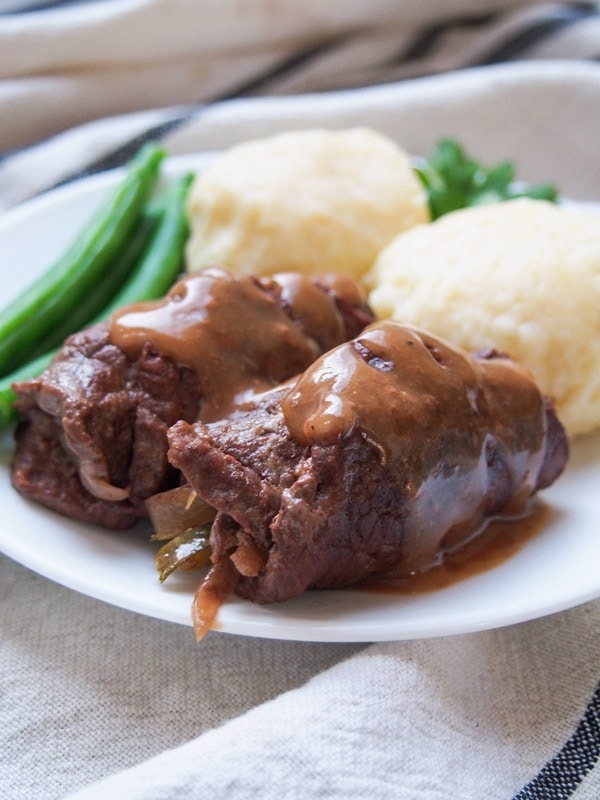
Beef rouladen is a classic German dish that is comforting and full of flavor. These beef rolls are filled with bacon, onion, pickles and mustard and, after a slow braise, they are topped with a gravy made from their cooking sauce.
If you are familiar with German food, you are probably aware that the main meat of choice is pork.
You'll find it in many forms at pretty much every meal, whether that's as ham, salami, sausages or the huge range of sausages across the country. You find many cuts used in classic dishes such as Schweinshaxe (roasted pork knuckle), Schwenkbraten (grilled pork chops), Schweinebraten (roast pork) and Schnitzel (breaded pork cutlets).
However, you will also find a few popular dishes that use beef. Quite a few of them use lesser cuts and braise them to produce tender, flavorful meals.
Being more economical, these were originally peasant dishes but many like Sauerbraten (a kind of pot roast with a rich sauce) and these rouladen are now trendy and considered more of a special occasion dish.
This is probably in part because they take a little time, but they are definitely worth the effort.
What cut of meat is used to make German rouladen?
The cut of beef used to make rouladen is a thin steak, most commonly from the top round (also called topside).
Another thin steak, like flank steak, also works well for this preparation.
Where are rouladen from?
The origins of this dish are not completely clear though the name at least comes from the French "roulade".
"Rouler" in French means "to roll", and a French roulade can apply to a range of things from meat dishes to desserts like a Swiss roll.
Although it may have a French-derived name, this dish is pretty consistently considered German.
Variations of rouladen
In Germany, you will find just a few forms of rouladen.
This beef version is also called "rinderrouladen" to distinguish it, and it is probably the most popular throughout the country.
In the Berlin area, cabbage rolls or "kohlrouladen" are also popular.
How to make this traditional German dish
As with many traditional dishes, you will find a few variations in how it is prepared.
Some cooks don't use pickles, and some will pre-cook the onions. Some mix the bacon with ham.
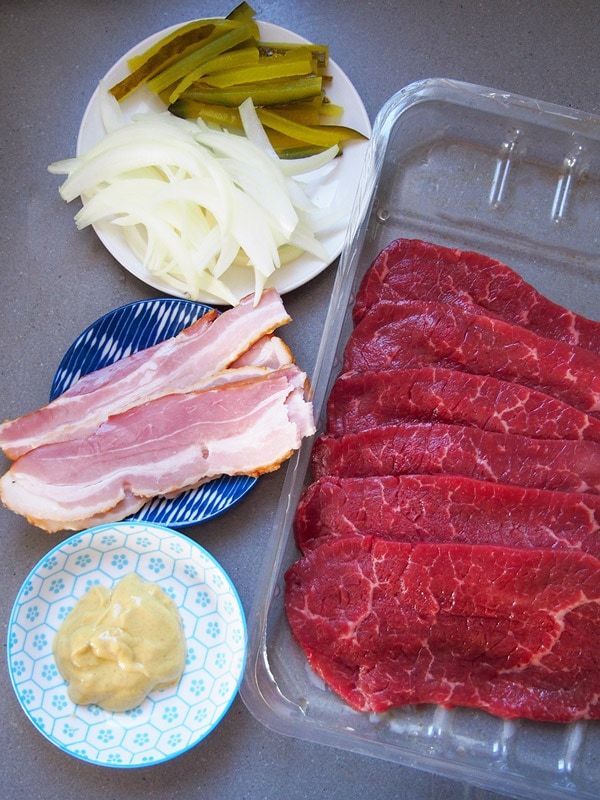
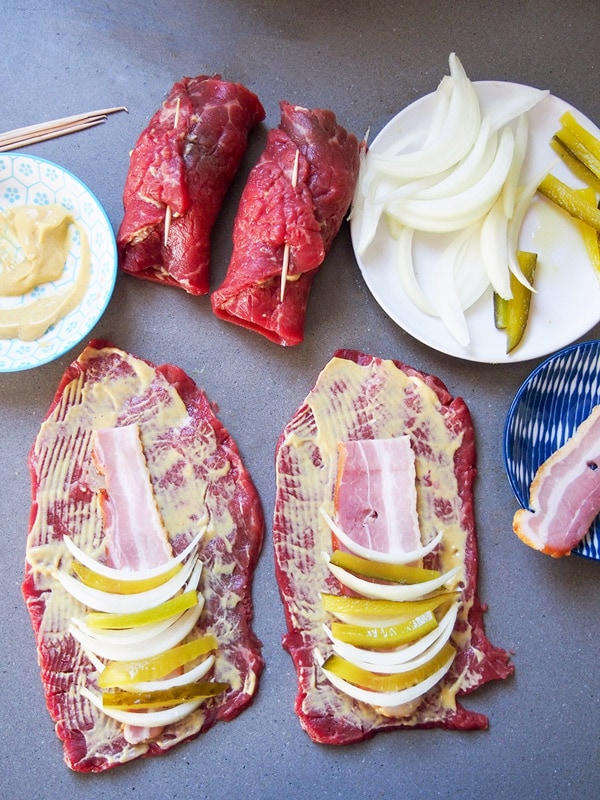
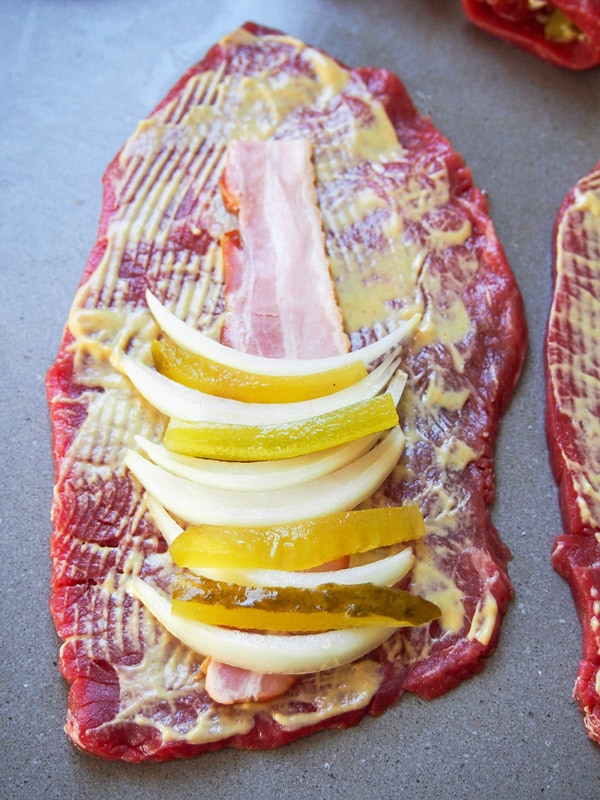
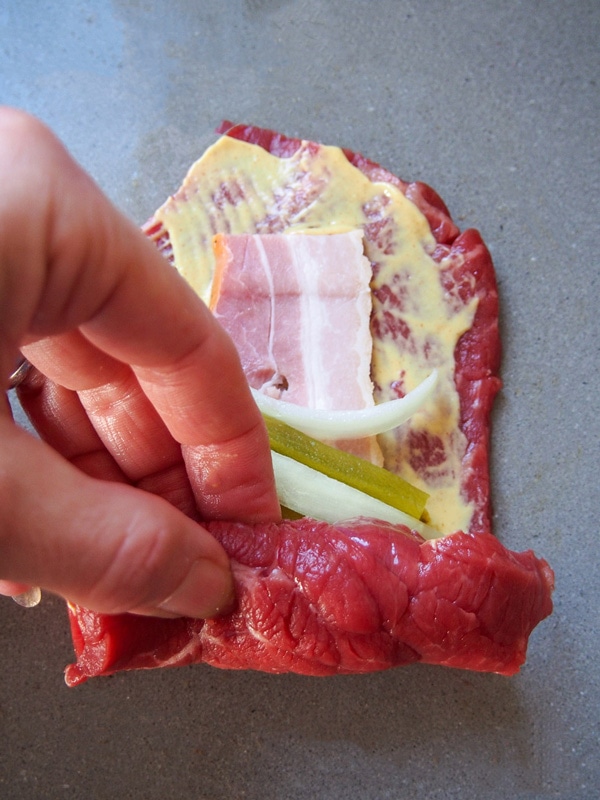
The most popular way to prepare rouladen is to use very thin, long slices of beef. First, spread them with a layer of mustard. Then top this with bacon, thinly sliced onions, and chopped up pickles.
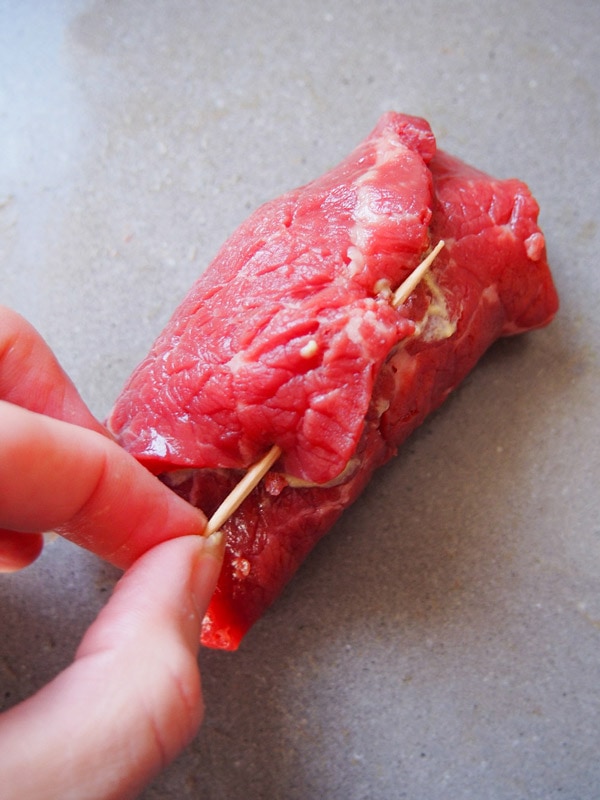
Roll the beef up with all the fillings inside and then either pin it together with a cocktail stick (toothpick) or tie it with twine.
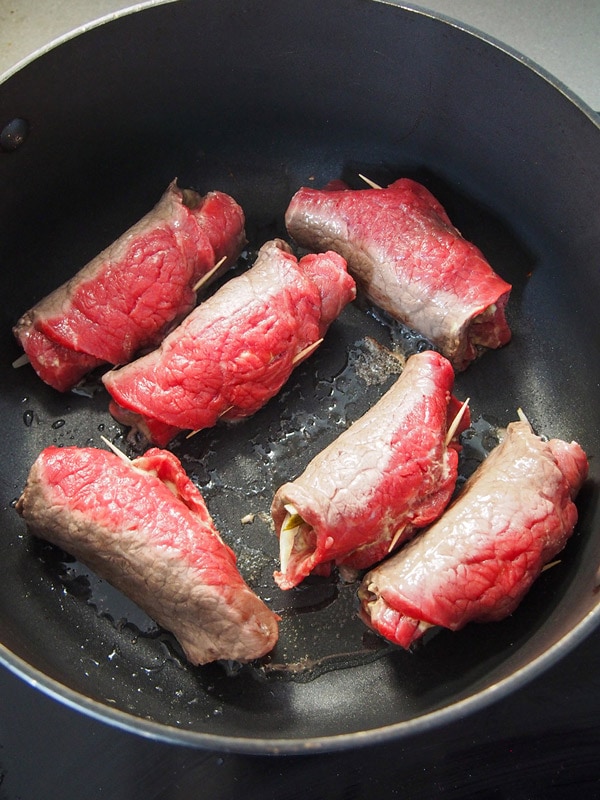
After this, you brown the beef rolls on all sides.
Then, deglaze the pan and add liquid that you will braise the beef in, low and slow.
Once cooked, you thicken the cooking liquid to form the gravy.
In terms of the cooking liquid, some add vegetables to make it richer, while others simply use water that absorbs the flavor from the beef. Some recipes add a few herbs as well, although this is less typical.
Here, I have used a little red wine to deglaze the pan and add some flavor and then simple used water or beef stock, as you prefer.
This combination is easy, yet provides plenty of flavor to the end gravy.
How to serve beef rouladen
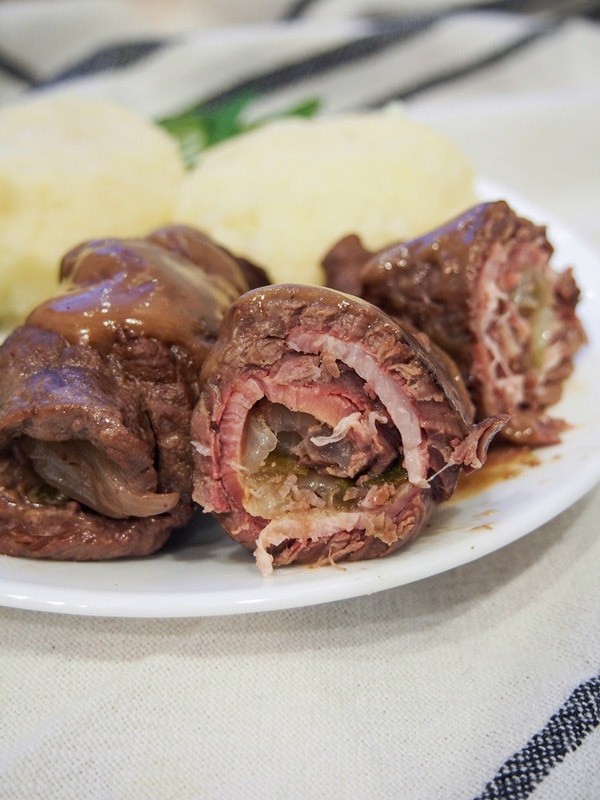
Being such a comforting dish, and particularly with that lovely gravy, you typically serve this with a side that is equally comforting and good at mopping up gravy.
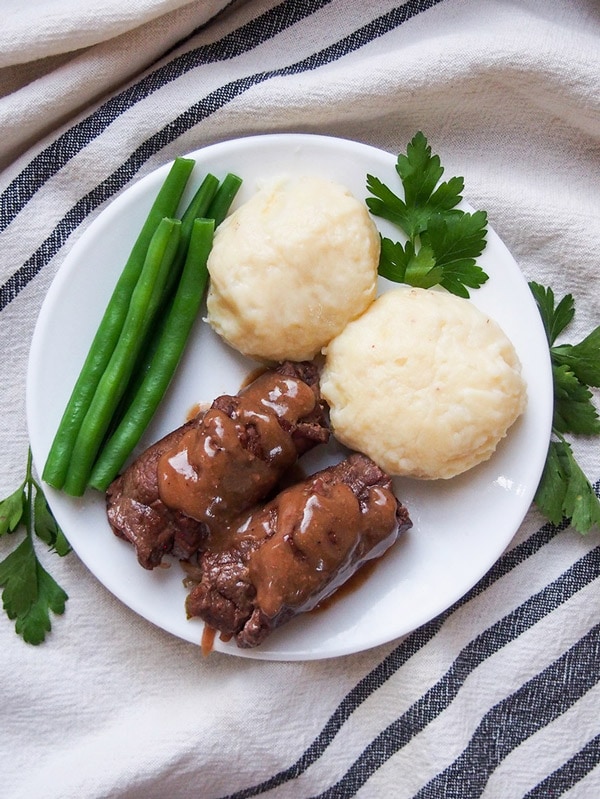
One of the most popular choices is potato dumplings (kartofelknödel or kartoffelklöße) as well as spaetzle (a kind of small dumpling/pasta) or mashed potato.
In terms of vegetable side, braised red cabbage would be a popular choice, or roasted root vegetables in the winter. Green beans are also always a popular choice in Germany and add some color.
Rouladen make a wonderfully flavorful, comforting meal and would be perfect to serve for Oktoberfest, or any occasion you choose.
They are easier to prepare than you might think, and while they take a little effort, the time involved is mainly hands-off cooking time that is most certainly worth the wait.
German Beef Rouladen
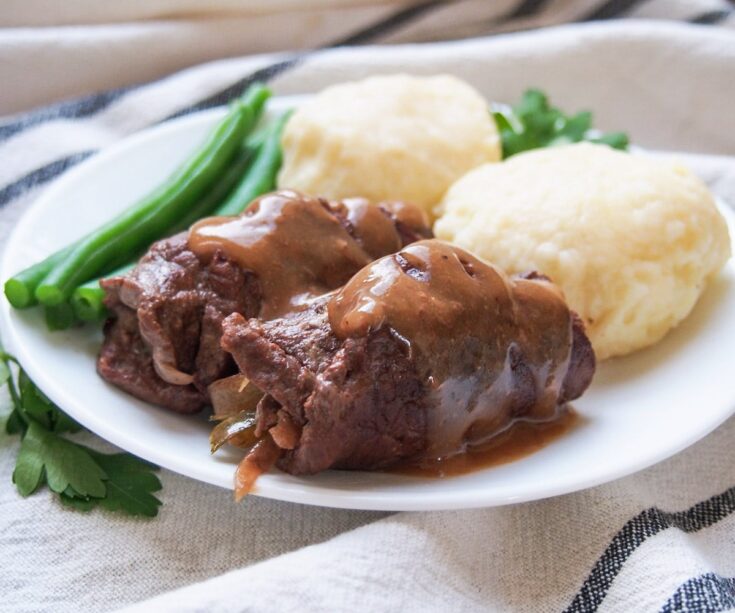
Beef rouladen is a classic German dish of beef rolls filled with bacon, onion, pickles and mustard, slow braised and served with creamy pan gravy.
Ingredients
- 6 thin slices of beef topside (top round steak) or flank steak, around ¼ inch thick, approx 14oz/400g in total (min 4x6in)*
- 2 tablespoon mustard (either Dijon or, for a slightly sharper flavor, a sharp German mustard)
- 6 slices smoked bacon (or less if the slices are large)
- ½ onion
- 3 dill pickle spears
- 1 ½ tablespoon butter
- ¼ cup red wine
- 1 ½ cups water or stock (approx)
- 1 tablespoon cornstarch
- salt and pepper
Instructions
- Pound the beef slices lightly to tenderize.
- Cut the pieces of bacon, if needed, to be a little shorter than the long length of the pieces of beef.
- Thinly slice the onion and cut the pickles into matchstick lengths.
- Spread each of the slices of beef with a thin layer of mustard. Top each with a slice of bacon then place a few pieces of onion and pickle towards one end.

- From the end with the onion and pickles, roll up the beef tightly so all of the fillings stay inside then secure the end with a cocktail stick (toothpick) or tie two loops of twine around the roll.
- Preheat the oven to 325F/165C.
- Warm the butter in a Dutch oven (or other ovenproof dish with a lid that is large enough to hold all of the rouladen in a single layer), over a medium-high heat. Brown the beef rolls on all sides well, turning as needed to brown the other sides. If your pan doesn't have a lot of space, brown in batches. Remove the beef rolls from the pan once done and set aside.
- Deglaze the pan with the the red wine, scraping any of the browned bits from the bottom (they help add flavor). As it starts to simmer, add most of the water (or stock) and warm through. As it starts to simmer, add back the beef rolls, and sprinkle in a little salt and pepper. Cover the dish with the lid and place in the oven.
- Cook the rouladen in the oven for around 90 minutes, removing from the oven to turn the rolls every now and then so they don't become dry on any one side. If the liquid becomes too low, top it up slightly with more water (or stock).**
- Once cooked, remove the beef rolls from the cooking liquid and set them aside to keep warm. Mix the cornstarch with a tablespoon of water and add to the cooking liquid in the pan. Warm on the stove over a low heat and stir to thicken the sauce into a gravy, then remove from the heat.
- Remove the cocktail sticks (or twine) from the rouladen before serving and then drizzle the gravy over the rolls.
Notes
Nutrition Information:
Yield:
3Serving Size:
2 rollsAmount Per Serving: Calories: 766

Caroline lived and traveled various places before settling in Cambridge, MA. She still fits in some travel with her family, but often settles for traveling through food instead. She shares her recipes at CarolinesCooking.com, where there's plenty of international inspiration using seasonal ingredients, as well as creative recipes for all to enjoy. Caroline is originally from Scotland, where she grew up hiking and skiing, both things she still loves to do when her two young boys give her a chance. You can follow along with her cooking adventures on Facebook, Instagram, Twitter, and Pinterest.
Is there any chance you have the recipe for the version of rouladen with a filling that's kind of like a stuffing?? It's my favorite version, especially since I don't like cooked pickles, mustard, or lots of onion! It's what was served in the local castle restaurant near where I was stationed in Germany many moons ago! lol Like around 34 years ago. There was another version we found while traveling around, it had caramelized onions, but again I don't like a lot of onions so I didn't like it much. If you can help me out, I'd be so grateful. I've looked at so many recipes, all with the pickles and mustard. I'm getting tired of looking.
Hi Edwina. I was able to find this one that is from Bavaria. Hopefully it is similar to what you remember?
This looks like a less-messy way to make rouladine than my Oma and mother taught me. We always diced up the filling ingredients, so we had to make sure both open ends of each roulade were “tucked in” so the fulling didn’t all come out.
It looks like I’ll be utilizing some of your prep tips on what is almost the exact recipe that I was taught from my mom and Oma. Pretty sure it will pass muster. Thanks for sharing your recipe!
Wonderful! Happy cooking!