Brazo de Reina (Chilean Dulce de Leche Cake)
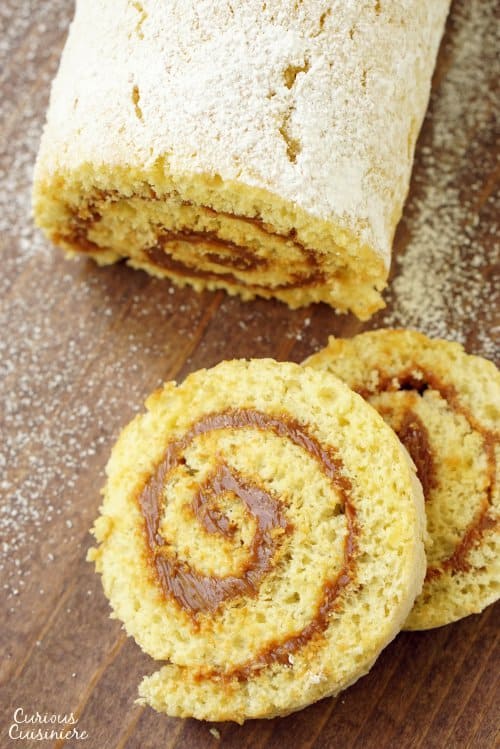
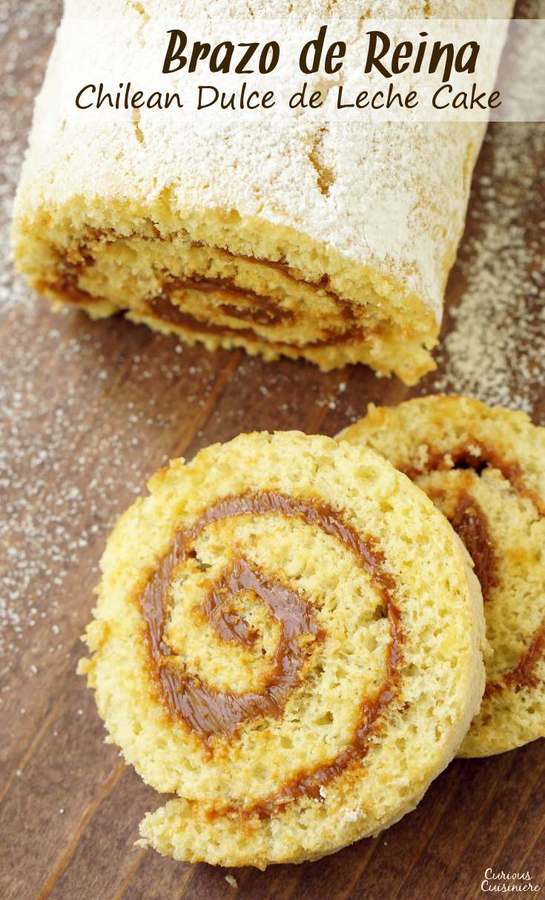
Chilean Brazo de Reina is a simple rolled Dulce de Leche Cake that brings a soft sponge cake together with creamy milk caramel filling for one addicting treat!
 Chilean Brazo de Reina
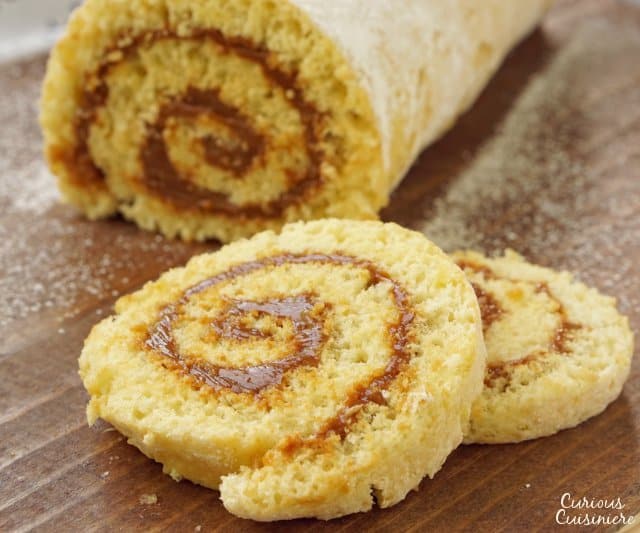
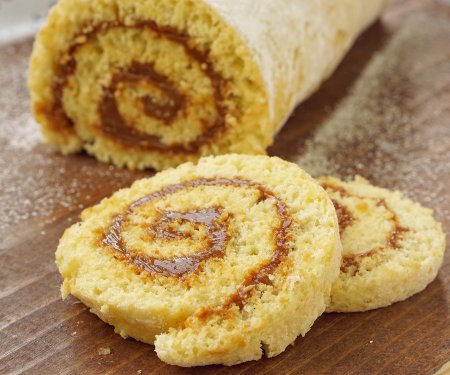
Brazo de Reina is a Chielan version of a Swiss roll cake that is filled with creamy, caramel-y dulce de leche.
It is a very simple, yet elegant dessert that is most commonly served with the traditional 5 pm snack in Chile (also called elevenses).
The name brazo de reina literally translates to "queen's arm". We're not sure what queen the cake was named after, but she must have enjoyed elegant desserts!
Making A Dulce De Leche Cake
What really makes brazo de reina stand out from other Swiss roll cakes is the filling. It is traditionally filled with Manjar blanco, also known as dulce de leche.
Dulce de leche is a sweet and nutty milk caramel that is delicious with any sweet treat!
You can find cans of dulce de leche in you local Hispanic market. But making homemade dulce de leche is as simple as getting a can of sweetened condensed milk and boiling some water.
So, check out our recipe and give it a try!
How To Make An Easy Swiss Roll: Preparing the Pan and Batter
A Swiss roll cake is a simple sponge cake that is made in a large baking sheet so it is very thin and can be rolled easily.
Swiss rolls are impressive cakes to serve, but once you know the basic technique for rolling a Swiss roll cake, like our dulce de leche cake today, you'll want to be rolling cakes all the time!
The first important parts of making a good Swiss roll happen before it goes into the oven. You should grease your baking sheet and line it with parchment paper. Then, grease the parchment paper.
All this greasing ensures that when we go to get the cake out of the pan it won't stick.
Second, the batter for this dulce de leche cake is very light and airy. It needs to be spread onto your parchment paper very gently, but quickly. As you spread the batter, make sure you get it as even as you can. The more even the batter is spread, the more even your cake layer will be.
How To Make An Easy Swiss Roll: Making Sure The Cake Doesn't Tear
Finally, the MOST important part of rolling a Swiss roll is what happens when you take the cake out of the oven. The cake should be springy yet firm to the touch, and once the cake has cooled slightly, but is still warm, you need to invert it onto a powdered sugar-dusted tea towel.
This is probably the trickiest part of making a Swiss roll, and we like to do it by dusting the top of the cake with powdered sugar, laying our towel over the cake, and then laying a cooling rack, upside down, over the towel. Then we can flip the cake (without getting powdered sugar everywhere) and gently remove the warm pan and parchment paper from the cake.
Now, the cake gets rolled up from the short end in the towel to cool. By rolling the cake while it is warm, it is still nice and pliable, so it won't tear. Letting the cake cool in the rolled shape trains it to want to hold that shape (without tearing) after it has been filled.
It might sound complicated, but the only way to learn how to make a Swiss roll cake is to try it! Even if your first brazo de reina doesn't turn out perfectly, you'll still have a delicious combination of creamy dulce de leche and tender sponge cake, so you really don't have anything to lose!
Brazo de Reina (Chilean Dulce de Leche Cake)
Ingredients
For The Cake
- 5 large eggs, at room temperature*, separated
- ½ teaspoon salt
- ¾ ccup sugar
- 1 teaspoon pure vanilla extract
- 1 scant cup sifted unbleached all-purpose flour (roughly 3.5 oz of flour)**
- 2 teaspoon baking powder
For The Filling
- 1 (13.4 oz) can dulce de leche
Instructions
- Preheat your oven to 350F.
- Grease a 13x18 inch baking sheet (half sheet size) and line it with parchment paper. Grease the parchment paper.
- Place the egg whites in a large bowl. With an electric hand mixer, beat the egg whites until foamy. Add the salt and continue beating until you have stiff peaks when you turn off the mixer and lift out the beaters. Set aside.
- In another large bowl, beat the egg yolks until pale. Gradually add the sugar and vanilla extract.
- In a small bowl sift together your 1 cup of already sifted flour and baking powder. (Sifting them together will incorporate the baking powder into the flour without packing it down. This flour mixture needs to be very light and airy when it gets mixed with the egg yolks).
- Add the flour mixture to the egg yolks and gently mix with a spatula. (Your batter will be a bit stiff at this point.)
- Gently fold the beaten egg whites into the flour and egg yolk mixture, adding ¼ of the beaten egg whites at a time and folding until each addition is just incorporated. (It is normal for the batter to become a little lumpy as you first introduce the beaten egg whites, just continue gently folding to mix the two together until the batter is uniform.)
- Spread the batter evenly over the parchment paper lined baking sheet.
- Bake for 9-12 minutes, until the cake is springy to the touch and lightly golden. (This cake can over-bake quickly, so keep a good eye on it towards the end of baking time.)
- Remove the cake from the oven and let cool for 5 minutes.
- Gently loosen the edges of the cake that might be stuck to the baking sheet. Dust the cake with powdered sugar and place a clean tea towel over the cake, so you have some extra towel hanging off of one of the short ends of the cake. Place a second cooling rack, upside down, on top of the tea towel and invert the cake onto the second cooling rack (and tea towel). Remove the baking sheet and gently un-peel the parchment paper from the cake.
- Flip the extra towel over the short end of the cake and gently roll the cake up from the short end.
- Place the towel-wrapped, rolled cake on a wire rack to cool completely (1-2 hours).
- Once the cake is cool, carefully unroll it.
- Spread the dulce de leche over the cake. Re-roll the cake and place it on a serving platter.
- Dust the finished cake with powdered sugar, if desired, immediately before serving.
Notes

Sarah founded Curious in 2010 as a way to save her recipe creations and share culinary experiences. Her love for cultural cuisines was instilled early by her French Canadian Grandmother. Her experience in the kitchen and in recipe development comes from over 10 years working in professional kitchens. She has traveled extensively and enjoys bringing the flavors of her travels back to create easy-to-make recipes.

I’m wanting to make this cake but need to make it the day before we eat it will it be okay and should I refrigerate it.
Thanks
Lori
Hi Lori. You can make this cake the day before. I store it wrapped it in plastic wrap and in a sealed container in the refrigerator.
This is a very good recipe and creates a cake very similar to the ones I've had many times in Chile. One difference, however, is that many of the cakes in Chile are also rolled in toasted coconut.
Thank you for sharing John!
Success depends on proper technique. Worth the trouble.
Glad you enjoyed it Jeff!
I love your recipe! My roll turned out perfect! It tasted soooo good too!
So glad you enjoyed the cake Elaine!
Great recipy and very well explained. I know it’s not easy to get a brazo de reina good, very tricky... but following the steps very carefully really worked. It was delicious. Gracias!
Hi Laura. Thank you! So glad you enjoyed it!
Hello, I tried this recipe for the first time and I definitely did something wrong. By reading some of the other posts I know I did not weigh my flour and baking powder mix ?. But my biggest problem was when I mixed the beaten white eggs into the yolk flour mixture, there was alot of liquid and the mix was very watery prior to putting it in the oven. My final product look more like a square crepe then the cake, it did not rise at all. Any comments or tips to fix this?
Hi Gloria. We're sorry you're having trouble with this cake. It can be a bit touchy. Did you possibly use extra large eggs, rather than large? Or possibly your whites were not beaten to stiff peaks before incorporating them into the yolk mixture? It is also very likely that you didn't have enough flour, which would explain the lack of rising. The batter should be thin, but spreadable, and definitely not watery. Hopefully you get a chance to try it again!
This was easy and excellent. As a chilean myself- I was floored by how good this came out. Thank you!
So glad you enjoyed it!
Hi there,
I seemed to have the opposite problem, my cake came out too sticky and I couldn't get it off the paper properly and then later again it stuck to the towel and ripped. Any ideas as to what I may have done wrong?
Hi Emily. If you couldn't get the paper off of the cake, with the instructions in step 10 and 11 (let the cake cook 5 minutes then invert the cake first onto a towel and then peeling the paper off of the cake), then you may not have baked it for long enough (or your oven could have been too cool). If the cake stuck to the towel, then again it could have been a baking issue, or you may not have used enough powdered sugar before inverting the cake. Rolling sponge cake like this can be a bit tricky to get the hang of. I hope you get a chance to give it another try!
This cake turned out very well for me. I brought it to a party and received several positive comments. After reading Lorena's comment I was very careful with measuring and mixing the ingredients. The egg yolks were well beaten prior to adding the flour mixture. The flour was sifted prior to measuring, and my 1 cup sifted flour weighed less than 4 oz. I then re-sifted the flour along with the baking powder. Having a gentle hand in folding the flour mixture into the egg yolk is needed and crucial for the next step of folding the egg whites into the yolk batter. I would suggest lightly folding in only 1/4 of the egg whites at a time. To the commentors who talk about a dry cake, I would suggest reducing your sifted flour to 3 1/2 oz. Also, check your oven temperature for accuracy and do not over-bake. Ovens vary in temperature and this cake has to be closely monitored when baking, start checking at 8-9 minutes.
Glad you enjoyed the cake Janet! And thank you for your detailed notes! We have adjusted our recipe instructions to include some of your suggestions because they are quite helpful.
I had the same problem as Lorena. I used large eggs and the yolk mixture was too dry and had the consistency of shortbread dough. When I went to incorporate the whipped whites with the dough it became lumpy, which required a lot of mixing, which made the final cake very dry. I tried to fix the dryness with a glaze, with little success. I would not recommend this recipe.
Hi Josia. We're very sorry you had trouble with this recipe. Was your 1 cup of flour sifted flour? If you use a scooped cup of flour (or worse, a packed cup) it will definitely be too much and create a dry batter. We have updated the recipe instructions to explicitly reiterate this. If the cake turned out dry, it is also possible that your oven runs a bit hot. This cake does over-bake quickly and should be taken from the oven once it is lightly springy to the touch.
The name of this dessert is "Brazo Gitano", (Gypsy Arm) is an Spanish dessert (Spain) no chilean
Hi Nuna. Yes, there is a version of the Swiss roll cake from Spain that is called Brazo Gitano. The Chilean version probably did originate from this Spanish version. But, even the Spanish version isn't the original, as the origin of the Swiss roll style cake is thought to be from somewhere in central Europe, possibly Germany, Hungary, or Austria. What makes the Chilean version unique is the dulce de leche filling. Guava is another classic filling for this dessert.
Hi Sarah,
Just as a side comment,
We don’t use guava on anything.
The only type of brazo the reina available in Chile Is with manjar. A thicker and denser version of dulce de leche.
Thanks for clarifying Fran.
@Sarah Ozimek, delicious! I grew up eating brazo de reina - my grandma and mom used to make it all the time. I'm from Colombia and we have brazo de reina filled with manjar blanco or arequipe, also with fresh cream and strawberries or with guava. There are other flavours now like passion fruit - all delicious 😋 brazo de reina is always my choice instead of birthday cake!
Thanks for sharing! Those sound delicious!
This was a horrible receipe! Maybe it was not translated properly or something! When adding the flour to the egg yolks it creates a hard dough!!!! Step 5.
Wasted all my ingredients very disappointed.
Hi Lorena. We're so sorry this recipe didn't turn out for you. We had a professional cake baker re-test this recipe for us, just to be sure there are no errors in it, and it turned out fine for her. Her suspicion is that you either used small or medium sized eggs, which would have contributed to not enough moisture, or you packed your flour, thus adding too much flour to the batter. We have tweaked the recipe for these specifications, to hopefully make it more error proof. We do hope you get a chance to give it a try again.