
Homemade German Sauerkraut
Crunchy and tangy this homemade German sauerkraut recipe is easy to make in small batches on your kitchen counter!
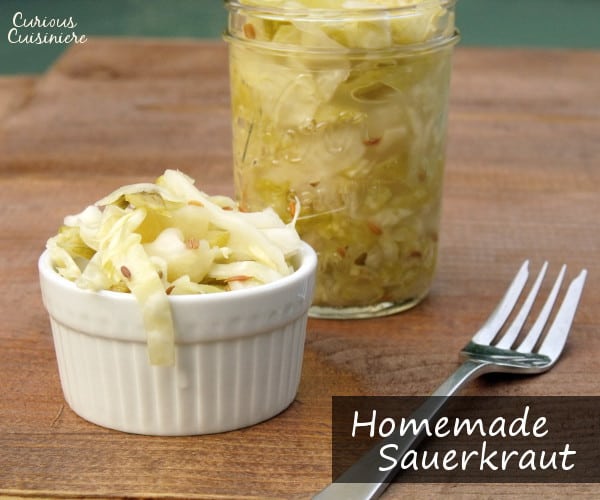 Homemade sauerkraut isn't like what you buy from the store. Yes, it still has that pleasantly tart/sour flavor. But, it's crunchy! That's the way sauerkraut is supposed to be!
Is Homemade Sauerkraut Difficult To Make?
NO!
We have put off making our own sauerkraut until now because we were under the impression that you needed a special crock to ferment the cabbage in, and we were afraid that one batch of sauerkraut would make enough to feed an army for the next year. Even though we're in Wisconsin, we can only go through so much at a time!
But, when we found out that you can make a small batch of sauerkraut in a mason jar. We were all in.
If we had realized just how easy sauerkraut is to make in small batches, I guarantee we would have been doing it sooner.
All you need is cabbage and salt. Yes. That's it. And, it's the perfect way to use up that quarter head of cabbage that we can never seem to finish before it goes bad.
How It Works
Sauerkraut (German for sour cabbage) is made by an age-old fermentation process called lactofermentation.
Lactobacillus is a good bacteria found on the surface of many fruits and vegetables, even in yogurt.
As the cabbage is submerged in a salt brine, the lactobacillus begins to convert the sugars of the cabbage to lactic acid, which is a natural preservative.
Healthy Homemade Sauerkraut
Not only is lactofermentation a great way to preserve the cabbage, since it is one of the same strains of beneficial bacteria that is found in yogurt, lactofermented cabbage also contains some of the beneficial probiotics that you find in yogurt.
As the lactobacilius multiply, they enhance the digestibility and nutrition of the food that is fermenting.
So, homemade sauerkraut is not only crunchy and tasty, it also provides your gut with extra healthy nutrients!
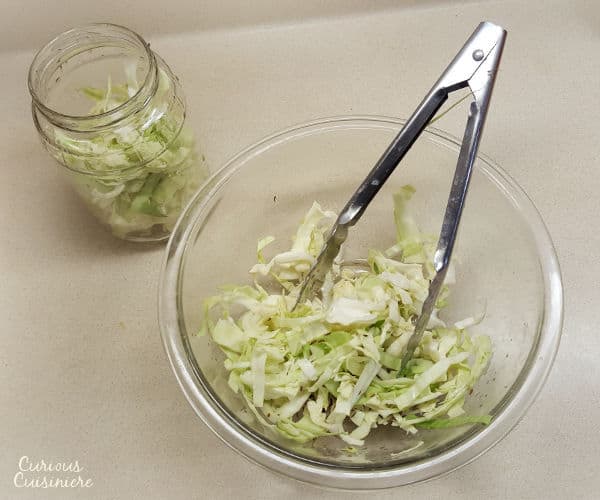 Just Salt and Cabbage: A Simple Sauerkraut Recipe
You really can't get more simple than the ingredients for this sauerkraut recipe.
Salt and cabbage!
As one of the two necessary ingredients, salt is an essential element in lactofermentation. It keeps unwanted bacteria from growing and helps the cabbage stay crisp, by drawing out moisture. As the salt starts to break down the cabbage, it creates the brine that will ferment the cabbage.
It is important to keep the cabbage completely submerged in its own juices during the fermentation process. Any cabbage bits that are exposed to air will be more likely to start to mold.
The Key to Successful Homemade Sauerkraut
The problem is, once the cabbage starts to release its juices, the little shredded bits like to float to the top. So, we need to put something on top of the cabbage to keep it submerged.
Some people like to do this by covering the shredded cabbage with one larger cabbage leaf, and then nestling a smaller jar inside the mouth of your fermentation jar.
While this way works well, we have found that an incredibly easy way to keep everything submerged is to insert a Ziploc bag into the jar over the shredded and salted cabbage. Then, we fill the bag with water. (Just be sure to test the bag first for any leaks!) The water filled bag acts as a weight and keeps everything well covered.
We typically don't have issues with mold in our sauerkraut. But, if you do find something forming on the top of your sauerkraut, take a look at it. If it's whiteish and thin you can scrape it off and continue fermenting. If it's fuzzy or colorful, then something went wrong with your batch. Throw it away and start over. (As always, use you best judgement on these things! All we can give is recommendations based on our experiences.)
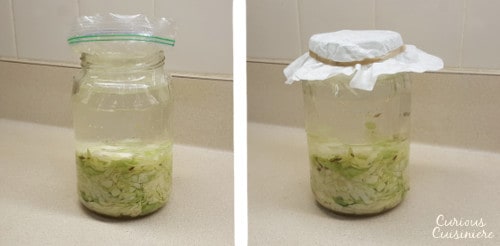
Finally, the whole jar needs to be covered so that we don't get any unwelcome visitors in our sauerkraut. This can be done with a clean towel, cheesecloth, or (our favorite method) a coffee filter.
How Long Does It Take To Make Our Homemade Sauerkraut Recipe?
It can take anywhere from 1-3 weeks to achieve a nice sour tartness in your sauerkraut.
In the cool temperatures of winter, it will take longer, and in the warm days of summer it will go more quickly.
Taste your sauerkraut every few days until it reaches your desired flavor. Once it gets there, remove the weights and cover the jar with an airtight lid and store it in the refrigerator.
How To Use Homemade Sauerkraut
It also makes a great filling for pierogi and goes great in a sausage and potato hash!
How do you like to serve sauerkraut?
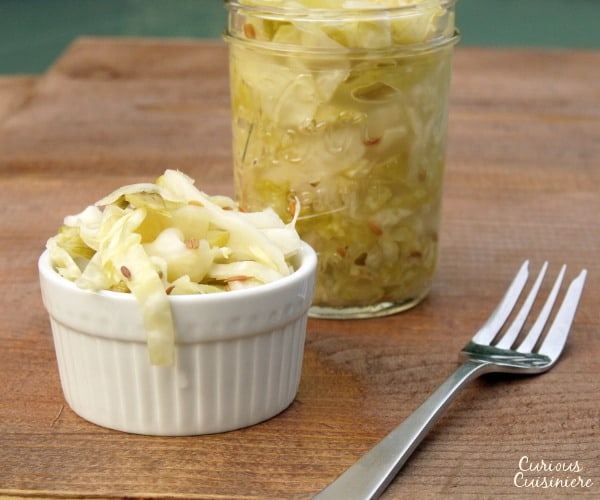
Homemade German Sauerkraut
Ingredients
- ½ small head cabbage, shredded (roughly 4 cups or 11 oz)
- 2 teaspoon Kosher salt
- 1 teaspoon caraway seeds, (optional)
Instructions
- In a large bowl, mix the shredded cabbage with the salt and caraway seeds (if using). Let the mixture rest for 15-20 minutes to let the salt start drawing moisture out of the cabbage. (To speed up the process, you can get in there with your hands and massage the cabbage and salt together for 5-10 minutes.)
- Wash a quart mason jar well with hot soapy water. Pack the salted cabbage mixture (and any juices) into the clean jar. Pound the cabbage with the back end of a wooden spoon to pack it tightly and remove any air pockets.
- Place a quart-sized Ziploc bag into the jar (use one that you know holds a tight seal). Fill the bag with water and seal the bag. This will act as a weight and help to keep all the cabbage submerged. Cover the jar with a towel, cheesecloth, or coffee filter.
- Check the sauerkraut after 24 hours. If the cabbage is not entirely submerged in brine, add a saltwater mixture of 1 teaspoon salt to 1 cup water to the cabbage, just until it is submerged.
- Place the jar somewhere out of the way, away from direct sunlight, to ferment. Fermentation can take 1-3 weeks, depending on the temperature and your desired flavor of sauerkraut. Taste your sauerkraut every few days, and once you like the flavor, remove the bag of water and cover it with an airtight lid. Store the sauerkraut in the refrigerator.
Notes
While the sauerkraut is fermenting, you may notice it bubbling and foaming. This is normal and can be skimmed off before you refrigerate your sauerkraut.
If at any point your sauerkraut starts to turn a strange color or get fuzzy, your preparation probably was not as clean as you thought. You'll need to throw away this batch and start over.
Nutrition Information:
Yield:
8Serving Size:
¼ cAmount Per Serving: Calories: 3

Sarah founded Curious in 2010 as a way to save her recipe creations and share culinary experiences. Her love for cultural cuisines was instilled early by her French Canadian Grandmother. Her experience in the kitchen and in recipe development comes from over 10 years working in professional kitchens. She has traveled extensively and enjoys bringing the flavors of her travels back to create easy-to-make recipes.




i use a metal straw to vent air from my one gallon jar and use a balloon to hold the cabbage down. blow it up and tie it off and reshape it to go in and the straw vents so that the balloon will go in and vent till the water comes up to the rim, thus allowing the balloon to seal and only water at the top.
looks like a baby bottle with a nipple on it.
What a great set up! Thanks for sharing!
I have to watch the salt that goes on body, but l love sauerkraut, how can I make my sauerkraut. I love doing homemade food.
Hi Kathie., While we haven't tried it ourselves, we've heard that you can make sauerkraut with less salt (or even no salt). Salt does help to preserve the cabbage while it ferments, so if using less (or no) salt, you will want to make sure your fermenting cabbage stays at or below 65F to prevent spoilage. Also, since the salt helps to pull moisture from the cabbage, you may have to add a little distilled water to make sure the cabbage is covered in liquid. And, without salt, I would definitely recommend adding the caraway seeds for flavor. If you give it a try, do stop back by and let us know how it turns out for you!
I noticed that the only covering other than the water bag is a coffee filter or cheese cloth for the recipe. Do I not want to cover as well with the mason jar lid? Thanks look forward to trying it!
Hi Steven. When you are fermenting vegetables, they need to be able to let gasses escape. This is why we use a coffee filter, because it keeps any bugs out, but still lets the kraut breathe. If you'd prefer, you can cover the jar with the mason jar lid, but you will need to open the jar once a day to let any built-up gasses escape (called "burping" in the fermenting world). Enjoy!
Awww makes sense now. Thanks!
You're welcome! Enjoy!
We enjoyed a fresh kraut in Germany on a recent trip. It was not sour and was served under a salad. It was obviously awesome as we have been scouring the web to find recipes. If this version doesn't ferment for the whole 3 weeks, is it less sour and considered "fresh kraut"?
Thanks!
Hi Karen. I would think so. I'd say just taste the kraut every couple of days and refrigerate it once it hits a flavor that is to your liking. Hopefully this comes close to what you tasted on your trip! Enjoy!
Thank you for this recipe! Have you ever thought about making it spicy? How would that work?
That would be a great idea! You could definitely do that by simply adding some chopped fresh hot peppers to the cabbage before you salt it. The number and type of peppers you use would depend on how spicy you would want it. If you give it a try, let us know how it turns out!
I add a pinch of red pepper flakes to batch.
What a great idea! We'll have to give that a try on our next batch!
I look foreward to trying your recipes!!!
We hope you enjoy it!
will this make a crispy kraut , and can I use a canner to preserve to kraut, instead of refrigerator
Hi Shiela, Yes. This kraut is nice and crispy! As for canning, we never have. But if we were to can it, I would raw pack the finished kraut, making sure the cabbage was covered in the jar by the brine. Water process quarts for 25 minutes and pints for 20 (as recommended by Ball). If you give it a try, do stop back and let us know how it turned out for you!
hi sarah
so the liquid from the cabbage extracted by the salt rub goes back into the fermenting jar with the cabbage?
Cheers
Paul
Yes it does. The salt rub just speeds up the juicing process and those juices are what you need to keep your cabbage covered and fermenting properly. Enjoy!
Just like my Czech and German grandmas used to make it! I can't wait to give it a try! For the poster who had the "fresh kraut" - what you had is usually called krautsalat and is not brined, just seasoned cabbage. It's very popular in the summertime for the cool, refreshing crunch it adds to a meal. I have it in the brauhauses in Koln on every trip.
Hope you enjoy the recipe! And thanks for your explanation of fresh kraut. It sounds like a delicious dish that we need to explore!
I've made sauerkraut using just coarse sea salt and Filderkraut Cabbage. I'm curious about the caraway seeds. What does this do to improve or change the flavor or texture of the sauerkraut?
Hi Sandra, The caraway seeds are simply for flavor. Some people like their sauerkraut with a bit of caraway flavor, others prefer it without.
Hi, I would like to sell fermented veg at my local farmers market. How do you stop the fermentation process? You mention putting it in the fridge, but lugging jars to market, means that they will heat up to ambient temp. Burping the jars continuously means that they can't be sealed properly for hygenic resale resale. Cooking/heating, I know will stop the fermentation, but all the beneficial bacteria will be lost.
Hi Lianne. That is a very good question. At our local farmer's market the vendors who sell sauerkraut, kimchi, and other fermented items keep their jars in a cooler and instruct you to store your purchased jars in the fridge as soon as you get home. This is probably why. And, we'd think that this would probably be the best bet for any market situation. Good luck!
This looks great! Is there anything in particular that makes this sauerkraut 'German'? Or can we considerevery sauerkraut to be German because it originated from Germany? That is the question! This looks like a great recipe and I am excited to try making my own sauerkraut at home. Thank you!
Hi Billy, We have labeled this as a German sauerkraut, simply because it it a basic sauerkraut recipe, the type that has been made in Germany for ages. We hope you enjoy it!
Sarah, what size mason jar (oz) do you use for this recipe?
Hi Arnold. I like to do this in a quart sized mason jar. The packed kraut only fills the jar halfway (so a pint size could work), but using a quart jar gives you plenty of head room in case the brine level rises, so you don't get unexpected spill-overs. Enjoy!
question
SAUERKRAUT INTIALLY THE SALT ALONE WILL BRINE THE CABBAGE.......OVER TIME?
Yes Patt, To make sauerkraut you start with just cabbage and salt. The salt pulls moisture out of the cabbage and creates the brine. If you pack your cabbage well, you should see brine appearing within 24 hours.
We love sauerkraut I even like it raw yum yum yum thank you for the recipe
You are welcome Adriana! We love sauerkraut too!
looks good. will try. only quibble. "sauerkraut" is SOUR HERB. not sour caggage. up north. they call it sauerkohl. kohl is cabbage. kraeuter are herbs, plural.
Thanks Christopher! This is good to know. We've updated our post to reflect the correct translation.
Tastey
Thanks Cindy! Nothing beats the crunch and flavor of homemade kraut!