
Khao Niao Mamuang (Thai Mango Sticky Rice)
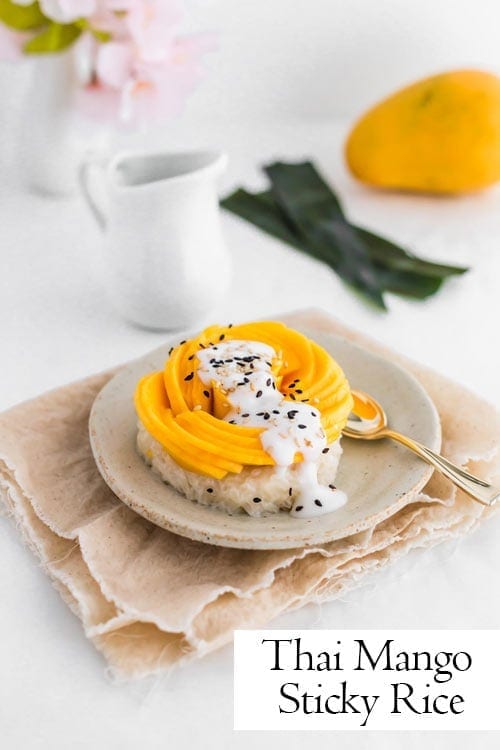
Thai Mango Sticky Rice is a tropical summertime dessert that is a unique way to enjoy fresh mangoes!
 DISCLOSURE: This article contains affiliate links. These links are provided to help you find some of the more specialty products we mention in the recipe. If you make any purchase after clicking through one of our links, we receive a small commission, at no extra cost to you. Thank you for supporting Curious Cuisiniere!
The wonderful thing about food is that it transcends generations. And if there was a dessert that was the epitome of my grandpa's childhood, it would be this Thai Mango Sticky Rice. My 90-year old grandpa grew up in Thailand, and his grandma would get this wonderful sweet treat for him.
Today, I'm exploring this traditional Thai dessert, made with glutinous rice and tropical fresh mangoes.
INGREDIENTS IN THAI MANGO STICKY RICE
This Thai dessert is comprised of glutinous rice, coconut milk, sugar, salt, and mangoes.
In Thailand, it is eaten during the summer months of mango season (April - May) with a spoon or sometimes with your hands. It is commonly found as street food.
Sweet, creamy, salty, and tangy -- it's a decadent dessert that encompasses all your taste buds.
DIFFERENCES BETWEEN TYPES OF RICE
There are differences between glutinous rice (also known as sticky rice) and other types of rice, such as long-grain rice.
The kernel of long-grain rice is slim and when cooked it is fluffy.
Glutinous rice is sticky when cooked and can be short-grained (Japanese sushi rice) or long-grained (Thai sticky rice). Today, we're using the long-grained, Thai version.
The stickiness in the rice grain comes from a compound called amylopectin. The higher the amylopectin, the stickier the rice.
TOOLS FOR THIS MANGO STICKY RICE RECIPE
Steamer
You'll need a steamer for this recipe. You can use a stainless steel steamer or bamboo steamer if you have it.
If you don't have one, an easy way to create a steamer is to use a splatter guard (the one you would use to cover splatters from frying food).
Place the steamer into a larger pot and fill with enough water, about 2-3" high, making sure that there's enough room between the steamer and the top of the waterline.
Cloth or cheesecloth
Place a cloth or cheesecloth onto the prepared steamer.
When you're ready to steam the rice, drain the soaked rice and place it in a flat layer onto the clean cloth or cheesecloth in the steamer. This will ensure the rice will cook evenly.
HOW TO PREPARE MANGO STICKY RICE
The glutinous rice requires a wash and soak overnight, so you'll need to prepare for this the day before you want to make it.
Give the rice a good wash (the easiest way to do this is to place the rice into a sieve and place it under running water, gently swishing the rice around with your hands). Next, place the washed rice into a large basin and fill with fresh, clean water to cover. Set aside to soak overnight.
Pandan leaves are an optional ingredient. If you're able to find them, add them to the rice prior to steaming. It will give the rice an aromatic fragrance that complements the coconut milk.
Coconut milk is mixed with a little sugar and salt to give this dish its characteristic sweet and salty flavour. This mixture is warmed up gently over the stove, and when the glutinous rice is finished cooking, the coconut milk is poured over the top of the rice and mixed in. The grains of rice will swell and glisten when the coconut milk is fully absorbed, leading to something akin to sweet rice porridge, except that it won't be as runny.
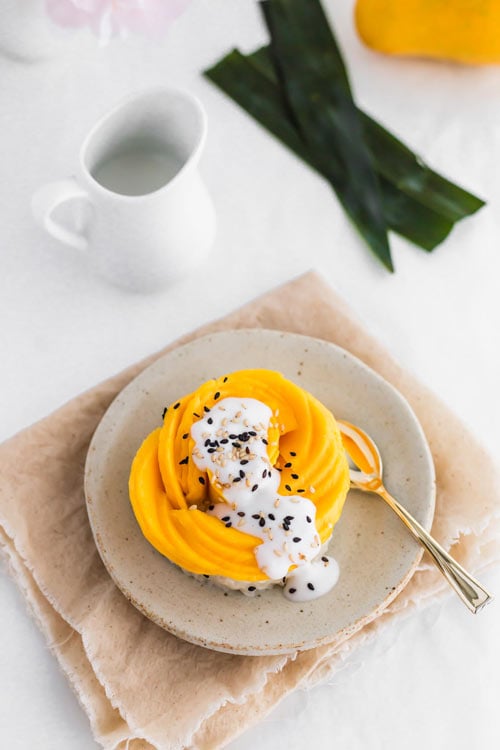
A second, thicker, coconut cream is made with coconut milk and tapioca or corn starch, which will be drizzled on top of the Thai Mango Sticky Rice prior to serving.
Thick, sweet, tropical and tangy -- Thai Mango Sticky Rice is a summertime staple that should be in your dessert repertoire. It's a great way to use those fresh mangoes that appear for such a short window of time.
More recipes using mango from around the world
If you love mangoes, you'll want to try these other summer mango desserts:
- Mexican mango paletas (popsicles)
- Indian mango lassi
- Brazilian mango flambe
- Mango Pomelo Sago Pudding
Khao Niao Mamuang (Thai Mango Sticky Rice)
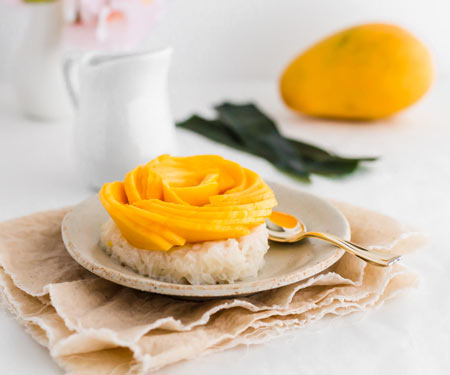
Thai Mango Sticky Rice is a tropical summertime dessert that is a unique way to enjoy fresh mangoes!
Ingredients
For the Rice
- 1 c glutinous rice
- 4 pandan leaves (optional), cut into 2" lengths
- 200 ml coconut milk (canned)
- 50 g sugar
- ¼ teaspoon sea salt
For the Sauce
- 150 ml coconut milk (canned)
- 1 tablespoon granulated sugar
- 1 tablespoon cold water
- ¾ teaspoon tapioca starch (or corn starch)
- pinch of salt
To Top
- 2 ripe mangoes, cut
- white and black sesame seeds, for garnish (optional)
Instructions
- The night before you want to make Thai Mango Sticky Rice, measure and wash the glutinous rice. Place the rice into a sieve and put it under running water to wash away any excess starch.
- Drain the rice and place into a large container. Pour enough fresh, clean water to cover. Let it soak overnight.
- In the morning, drain the water from the rice.
- Prepare the steamer with a cloth/cheesecloth and place the washed rice in a flat layer on top of the cloth. Add pandan leaves (if using).
- Cover the steamer with a lid and heat over medium high heat. Steam for 15-20 minutes, until the rice is cooked. The rice will be very sticky.
- Meanwhile, in a small saucepan, add in coconut milk, sugar, and sea salt. Stir the mixture so that the sugar and salt is dissolved. Bring to a low simmer and remove from heat.
- When the rice is cooked, carefully remove from the steamer and place into a large glass bowl.
- Gradually pour in the warmed coconut milk over the rice, and gently mix with a rice paddle. Let the rice absorb most of the coconut milk before adding more coconut milk. It may seem like a lot of milk, but don't worry, the rice will absorb all of it.
- Cover the rice with a plate (or plastic wrap). (It's important to cover it to not let the rice dry up or it will be hard).
- In the same saucepan, add in the remaining coconut milk, sugar, and salt and bring to a simmer. In a small bowl, combine the cold water with the tapioca starch (or cornstarch) . Stir to dissolve and pour into the coconut milk. Whisk the coconut milk mixture, bring to a simmer and remove from heat.
- Pour this thickened coconut cream into a separate bowl.
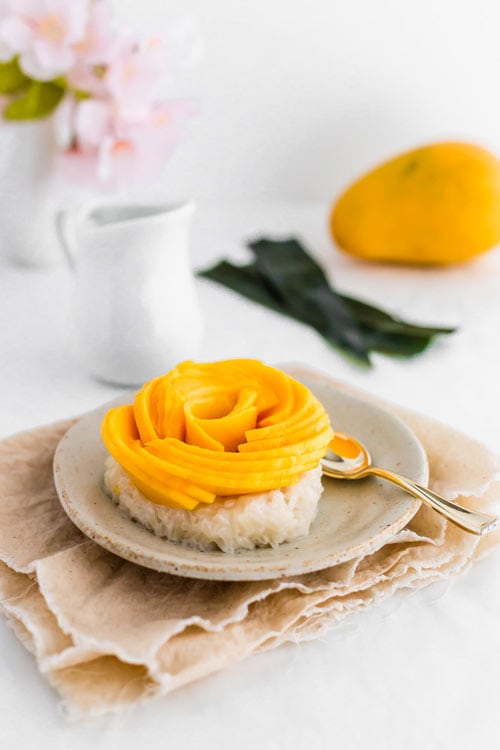
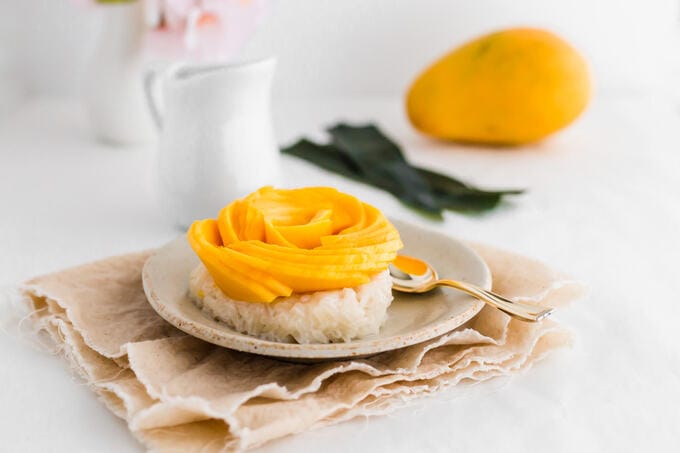
- To assemble, place a scoop of the sticky rice onto a serving bowl or plate, layer some mangoes on top, and pour the thick coconut cream over top. Garnish with sesame seeds if desired. Enjoy immediately.
Notes
This dessert is best enjoyed on the same day, preferably within a few hours of when it is made. Glutinous rice will become hard overnight, and especially when stored in the refrigerator. However, if you do have leftovers, you can store them in the refrigerator. When you're ready to eat, place the rice into a heat-proof container and steam over low-medium heat for 10-15 minutes, until softened. You may add additional coconut cream to help loosen the rice a little.
Recommended Products
As an Amazon Associate and member of other affiliate programs, We earn from qualifying purchases.


Nutrition Information:
Yield:
4Amount Per Serving: Calories: 412

Michelle enjoys learning and discovering different foods from around the world and recreating them in her own kitchen. She is an avid matcha lover and believes that the best food is made from scratch. Michelle develops and photographs recipes at her blog SiftAndSimmer.com.

The coconut to put on top of rice should not add tapioca because it will change the coconut taste.
Corn starch can also be used if you are worried about it the flavor.
Can dried Pandan leaves be used? I'm so excited to try this.
Thank you!
Rene'
Hi Rene. Yes, dried pandan leaves should be able to be used. Enjoy!
Could any other kind of rice be substituted for the sticky rice....i.e. Arborio rice....or.....??
I personally haven't tried Arborio rice so I can't say if it would be a good substitution. If you don't have sweet sticky rice on hand, you could try using a short-grained sushi rice instead.