Polish White Borscht (Bialy Barszcz)
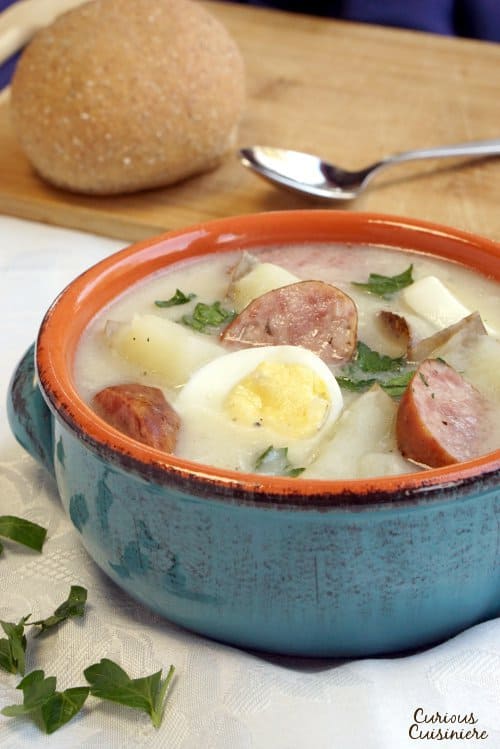
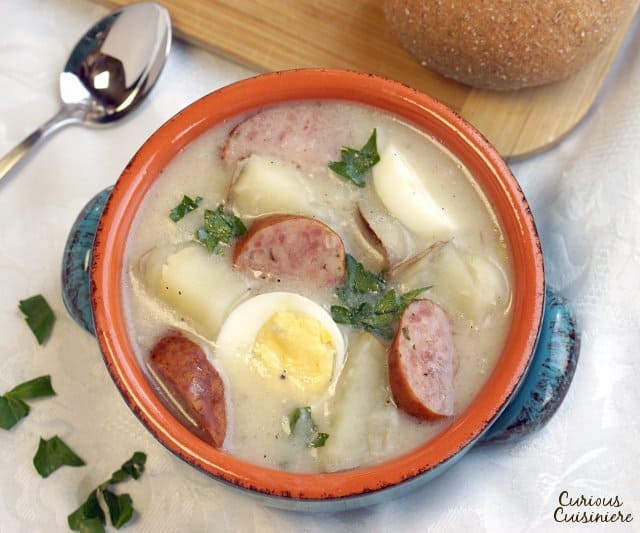
White Borscht is a tasty Polish Easter soup that is full of sausage, eggs, potatoes, and other ingredients that bring a lot of religious symbolism to each bite of this delicious soup.
 White Borscht: A Polish Easter Soup
White borscht (or Bialy Barszcz in Polish) is a classic Polish dish eaten on Easter Sunday morning.
Traditionally, this soup is made with items in the basket of food that Polish families take to Church to have blessed on Holy Saturday.
The History Of Easter Baskets
We never realized that blessing baskets of food on Holy Saturday is a tradition in many cultures.
In the States, we're used to Easter baskets for the kids on Easter morning, but this tradition has long standing roots in the baskets that families would bring to Church to have blessed on Holy Saturday.
These Easter baskets were filled with things that symbolized every part of life, and their blessing was considered a sign of blessing for a bountiful year ahead.
Polish Easter Baskets
In Poland, the practice of blessing Easter baskets dates back to the early 15th century.
Each family brings a large basket to church on Holy Saturday. These baskets (called Święconka) are lined and covered with a white linen cloth, representing the shroud of Christ. And, each of the foods in the Easter basket has a special significance.
- Bacon is a symbol of the abundance of God's mercy.
- Easter bread symbolizes Christ, the Bread of Life.
- Butter or other dairy products celebrate the end of Lent and the richness of salvation.
- A candle, while not edible, symbolizes Jesus, the light of the World.
- Cheese reminds Christians of moderation.
- Hard cooked eggs are signs of hope in new life.
- Ham or other meats symbolize the abundance of the celebration of the Resurrection.
- Sausage links represent the chains of death that were broken by Christ's resurrection.
- Horseradish is a reminder of the bitterness of the Passion and the sour wine given to Christ at the Crucifixion.
- Salt preserves us from corruption and speaks to the Bible passage "You are the salt of the earth."
Now, that's a lot of food!
Ingredients for the Family Meal
Not every basket has to contain all of these items, but the important things is that every family member has a bite of blessed food from the basket.
So, Polish mothers typically include foods that they will be using at Easter breakfast or dinner, and a few daily staples.
You will notice that a few of the basket items appear in this soup:
- sausage
- butter
- hard cooked eggs
- salt
It's almost as if this soup was designed to be a soup made from the blessed ingredients!
Ingredients in white borscht do vary greatly by region and family.
With meats ranging from Polish sausage, to ham and bacon; and add ins including sour cream, buttermilk, vinegar and sugar.
The two elements that do not change are the sausage-water base and some type of sour (kwas) used to flavor the soup.
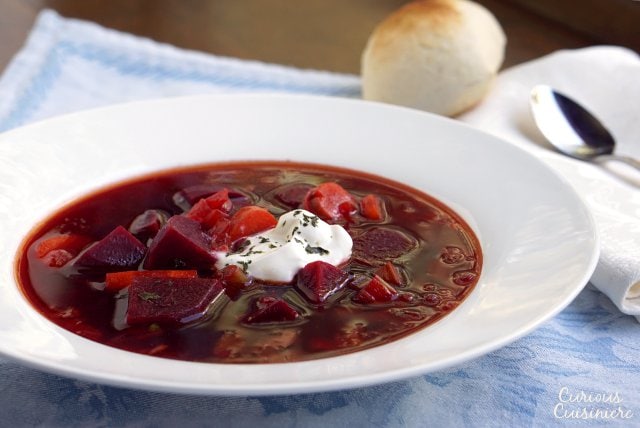
What's The Difference Between Red Borscht And White Borscht?
In a word: EVERYTHING.
Well, maybe not everything.
But it would be easier to talk about what characteristic these two, seemingly VERY different, soups share.
The one thing that these two soups have in common is that they are both considered sour soups.
Red borscht uses a splash of apple cider vinegar near the end of cooking time to give a slight sour brightness.
White borscht uses a sour starter (kwas) as a base, which gives the soup an underlying taste that is similar to sour cream.
What Is Polish Sour Starter?
Kwas (pronounced kvas) is a sour starter (similar to a sourdough starter) that is traditionally made by fermenting bread. This fermentation technique is actually quite popular in many Slavic countries.
In Poland, you will find another soup, very similar to bialy barszcz, called zur or zurek. The only difference is that zurek uses the kwas rye sour starter, while the bialy barszcz uses a wheat starter.
Our White Borscht Recipe
Tim was a bit skeptical about using fermented bread as a base for the soup, so we went a more non-traditional route and used a mixture of sour cream and flour to give a sour taste and thickness to our soup.
The resulting soup is creamy with a mildly sour flavor.
While flavor of this soup is slightly different than if you would use the traditional sour bread starter, we found the flavors to be incredibly similar to the bialy barszcz that we tasted during our trip to Poland. It made us happy to discover that sour cream does work quite well as an easy adaptation to stand in for the more traditional ingredients!
We've made it numerous times since our trip, and love the way the flavors of this soup transport us right back to Krakow.
Polish White Borscht (Bialy Barszcz)
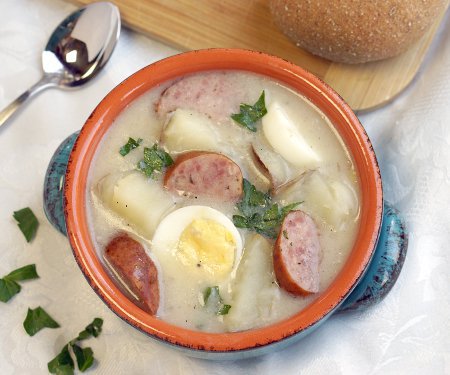
White Borscht is a tasty Polish Easter soup that is full of ingredients carrying religious symbolism.
Ingredients
- 4 hard boiled eggs*
- 1 lb Polish kielbasa, (smoked)
- 6 c water
- 1 teaspoon salted butter
- 4 garlic cloves, diced
- 1 onion, diced
- 2 lbs potatoes, diced
- 1 bay leaf
- ¾ teaspoon salt
- ¼ teaspoon pepper
- 1 c sour cream
- ¼ c unbleached all-purpose flour
Instructions
- Bring keilbassa and water to a boil in a large dutch oven or heavy bottomed soup pot. Reduce heat slightly and boil for 25 minutes. Remove keilbassa to a plate and set aside. Leave the broth in the dutch oven.
- In a medium, non-stick skillet, saute garlic and onion with a teaspoon of butter until soft, 5 min.
- Add onion mixture to kielbassa broth. Add diced potatoes, bay, salt, and pepper. Cook until potatoes are tender, 15-20 min.
- In a small bowl, whisk flour and sour cream together until smooth. Add ½ c of the soup broth to the sour cream mixture and whisk until smooth and thin. Pour mixture into the soup, stirring constantly. Simmer, stirring often, until thickened, 10 min.
- Cut the kielbasas into ½ inch slices, chop the hard boiled eggs. Add both to the soup. Taste the soup and adjust the salt an pepper as desired. Cook 1-2 minutes to heat through.
Notes
*To hard boil eggs: Place eggs in a medium pot. Cover with water and add 1 tablespoon salt (to make peeling the eggs easier). Bring the pot to a boil over medium heat (20 mintues). Turn off the heat and let the eggs stand in the hot water for 3-5 minutes, depending on how firm you like your eggs. Remove the eggs and place them in a bowl of ice water to cool.
Nutrition Information:
Yield:
5Serving Size:
2 cupsAmount Per Serving: Calories: 460
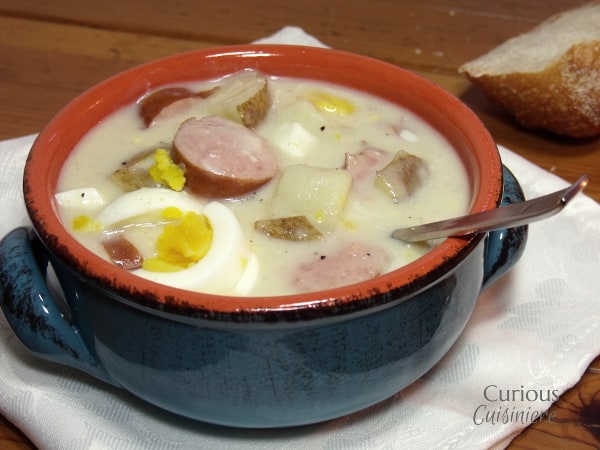
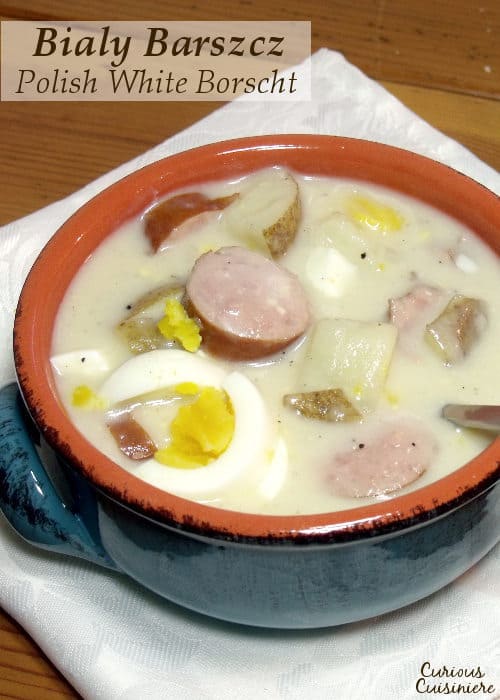
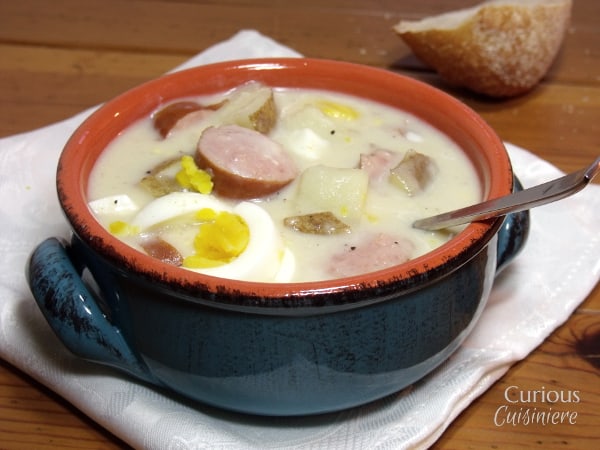
This is one of the recipes from the early days of Curious Cuisiniere. We've updated our pictures since we first shared it, but we've left some originals here, in case you've found us in the past and are looking for that old, familiar image.

Sarah founded Curious in 2010 as a way to save her recipe creations and share culinary experiences. Her love for cultural cuisines was instilled early by her French Canadian Grandmother. Her experience in the kitchen and in recipe development comes from over 10 years working in professional kitchens. She has traveled extensively and enjoys bringing the flavors of her travels back to create easy-to-make recipes.

My polish grandmother always made this for our Easter dinner, but used buttermilk in place of sour cream for the tangy taste.
Thanks for sharing Sharon!
We have had the fermented rye Verdi of this as a standing tradition for Easter since before I was born. We use rye bread, seedless, and oatmeal as the starter, it's fermented for one week, the broth drained and used as a base. Our recipe calls for salt pork and dill, no potatoes or bay leaf. It is delicious. We use mushrooms as well, the ham, horseradish and hardboiled eggs and sausage are added at the table, along with rye bread. It's the highlight of Easter, we also add sour salt to taste.
That sounds delicious! Thank you for sharing!
What is sour rye starter and how is it made?
Hi Nina. It is similar to the starter you would use to make sourdough rye bread: simply fermented rye flour and water (some cooks add spices if they are just using it for the soup). You can find a recipe here: https://www.polishyourkitchen.com/sour-rye-soup-starter/.
Forgot over years how this was made… me and fiancé made it , at dinner tasting it brought tears to my eyes remembering Easter with my granny… thank you for this…
So glad we could bring back memories.
I prefer fresh polish sausage and also add vinegar, horseradish and torn rye bread
Thanks for sharing!
In our Easter Basket for the blessing, we always included vinegar. The Blessed Vinegar was used in the Bialy White Borscht. But that cut glass beautiful bottle came out for every bump, bruise and even small cuts too!
Thank you for sharing!
My family has been making this every Easter since before I was born. My great grandparents came from Poland with their 2 daughters and moved to Chicago where they had my grandpa. I’ll never forget walking into my grandpa little kitchen with him at the tiny stove making it. He taught my older brother and older cousin how to make it to keep the tradition going. We don’t use potatoes in ours, just sausage, eggs, horseradish and fried onions. Thank you for this, usually you only see the beet kind.
Thank you so much for sharing Delisa!
I thought a small chicken bouillon cube added some depth and found this can easily be adjusted to a crock pot. I thought it was interesting that I was tempted to add some mushrooms and then saw people suggesting mushroom soup. I served with rye bread, cheese, pickles, and a pale ale. Nice easy quick hearty meal for a cold night.
So glad you enjoyed it!
I went on a trip to Krakow with my school in 2019. My favorite part of the whole adventure was a little "milk bar" right outside of the main square. I tried zurek for the first time there and got it a few more times while I was there. Very excited to try this recipe and see if it compares.
There was also another dish I loved there, goulash over potato dumplings. Haven't been able to find a recipe similar to that one yet, however.
Thank you for sharing your memories Alex! We will have to keep our eyes out for a recipe for goulash over dumplings!
I was so happy to see your recipe and explanation of the soups tradition. I've been making my mother's version for years. I make it similarly but with a few more ingredients. My grandma did ferment it in a crock but I only ever heard that. My mom used a small amount of bacon with the onion and add it to the water with the potato as you did. We also added sliced mushrooms and a can of cream of mushroom soup. Instead of rye flour with sour cream we sometimes break up rye bread and then add the sour cream. A couple tablespoons of lemon juice and a beef and chicken bouillon for additional flavor.. we cut up our kielbasa hard boiled egg and rye bread cubes and serve that in a separate bowl so that people can put that in the bottom of the soup bowl and pour the soup over it. But it looks so much like yours. Thank you for sharing.
Thanks so much for sharing Mary Ann!
It's all usually called ZUREK in Polish. The letter "z" has a dot over it in the Polish alphabet, imparting a pronunciation not like a "z", but like the French "j". As in "je suis" or the name "Jean".
I am impressed that you included the authentic Polish word "barszcz" for the soup, not the Russian "borscht". For me though barszcz is the red one, beet based. Perhaps the other colors have been devised for other cultures, to help non-Polish people think of colors and to make it easier to remember?
BTW, the sour tasting, green looking soup made from sorrel leaves is Szczaw ... of course unpronouncable for most, LOL ! (= zupa szczawiowa) , but I have seen it called "green borscht" ... Yikes!
Keep up the good work, Sarah 🌞 !
AK.
Hi Aniela. It is my understanding that Zurek is this soup made using a sour rye starter, where as bialy barszcz uses a sour wheat starter. Thanks for sharing! So interesting about "green borscht"!
Made this for Easter this year. Used fresh kielbasa and substituted a can of cream of mushroom soup for the sour cream and flour, as my mom always did. It brought back wonderful memories of my childhood Easters.
So glad you enjoyed the recipe and it brought back memories!
@Deb Steines, that sounds similar to my mom's but I do the sour cream as well as the mushroom soup.
When I put the 1/4 cup of flour like it said in the recipe the soup was too thick.
Hi Mary. If it is too thick for your liking, you can add more water or a light broth to get it to your desired consistency.
My family always made fresh kielbasa, and so in our house, this soup was made with fresh, not smoked sausage! It’s my favorite Easter Sunday food.
Sounds lovely!
My mother made Easter beet soup with beets, beet juice, sour cream, polish sausage and hard boiled eggs. We all remember certain things about it but no one knows the recipe. Can anyone help me?
Hi Bernadette. We haven't but can do some looking and in the mean-time, let's see if any readers have a lead for you.
@Bernadette, there is a similar beet based soup, served cold in hot summers, technically called CHLODNIK, based on boiled young beets (with their tops) and some type of buttermilk, yogurt or preferably the real kefir. Its color imparted by the beets and the white dairy is an incredible hot pink, fuchsia. It is served with hard boiled eggs and favorite Polish herbs : chopped dill weed and chopped chives: all fresh for best taste.
Seems to me the soup you refer to is a combo of a traditional Polish red barszcz and the chlodnik (which means "cooler" in Polish).
I think they are all good and any combo of them would work too. You could certainly check into it by googling for recipes. Smacznego!= Bon appetit !
AK.
Here is our Chlodnik recipe, Bernadette, if you want to take a look and see if it helps you come up with the recipe you're looking for. https://www.curiouscuisiniere.com/chilled-beet-soup-chlodnik/