Polish White Borscht (Bialy Barszcz)
White Borscht is a tasty Polish Easter soup that is full of sausage, eggs, potatoes, and other ingredients that bring a lot of religious symbolism to each bite of this delicious soup.
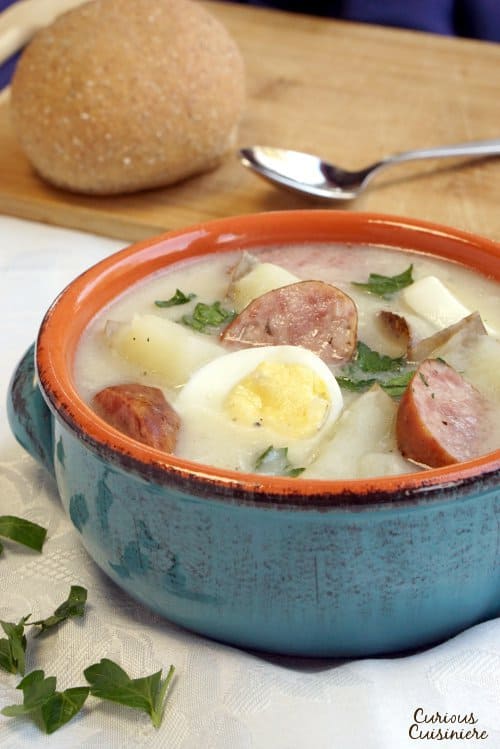 White Borscht: A Polish Easter Soup
White borscht (or Bialy Barszcz in Polish) is a classic Polish dish eaten on Easter Sunday morning.
Traditionally, this soup is made with items in the basket of food that Polish families take to Church to have blessed on Holy Saturday.
The History Of Easter Baskets
We never realized that blessing baskets of food on Holy Saturday is a tradition in many cultures.
In the States, we're used to Easter baskets for the kids on Easter morning, but this tradition has long standing roots in the baskets that families would bring to Church to have blessed on Holy Saturday.
These Easter baskets were filled with things that symbolized every part of life, and their blessing was considered a sign of blessing for a bountiful year ahead.
Polish Easter Baskets
In Poland, the practice of blessing Easter baskets dates back to the early 15th century.
Each family brings a large basket to church on Holy Saturday. These baskets (called Święconka) are lined and covered with a white linen cloth, representing the shroud of Christ. And, each of the foods in the Easter basket has a special significance.
- Bacon is a symbol of the abundance of God's mercy.
- Easter bread symbolizes Christ, the Bread of Life.
- Butter or other dairy products celebrate the end of Lent and the richness of salvation.
- A candle, while not edible, symbolizes Jesus, the light of the World.
- Cheese reminds Christians of moderation.
- Hard cooked eggs are signs of hope in new life.
- Ham or other meats symbolize the abundance of the celebration of the Resurrection.
- Sausage links represent the chains of death that were broken by Christ's resurrection.
- Horseradish is a reminder of the bitterness of the Passion and the sour wine given to Christ at the Crucifixion.
- Salt preserves us from corruption and speaks to the Bible passage "You are the salt of the earth."
Now, that's a lot of food!
Ingredients for the Family Meal
Not every basket has to contain all of these items, but the important things is that every family member has a bite of blessed food from the basket.
So, Polish mothers typically include foods that they will be using at Easter breakfast or dinner, and a few daily staples.
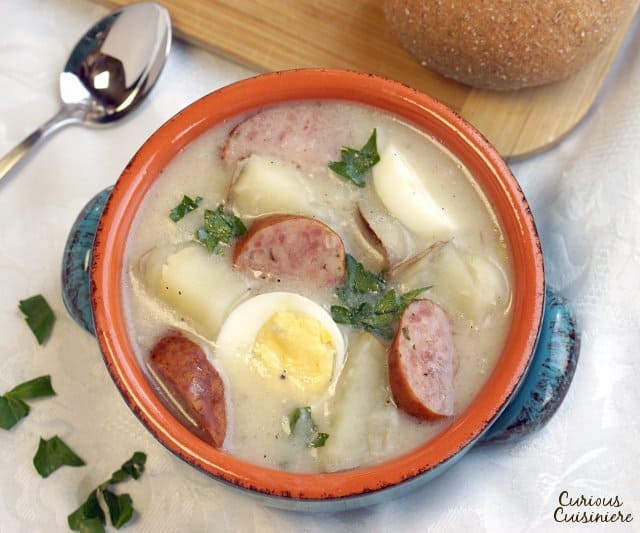
You will notice that a few of the basket items appear in this soup:
- sausage
- butter
- hard cooked eggs
- salt
It's almost as if this soup was designed to be a soup made from the blessed ingredients!
Ingredients in white borscht do vary greatly by region and family.
With meats ranging from Polish sausage, to ham and bacon; and add ins including sour cream, buttermilk, vinegar and sugar.
The two elements that do not change are the sausage-water base and some type of sour (kwas) used to flavor the soup.
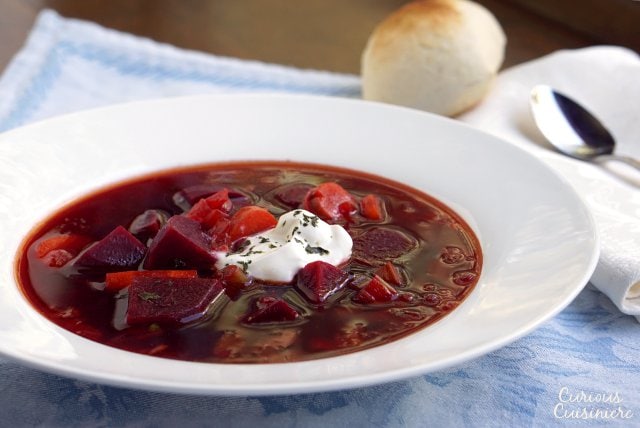
What's The Difference Between Red Borscht And White Borscht?
In a word: EVERYTHING.
Well, maybe not everything.
But it would be easier to talk about what characteristic these two, seemingly VERY different, soups share.
The one thing that these two soups have in common is that they are both considered sour soups.
Red borscht uses a splash of apple cider vinegar near the end of cooking time to give a slight sour brightness.
White borscht uses a sour starter (kwas) as a base, which gives the soup an underlying taste that is similar to sour cream.
What Is Polish Sour Starter?
Kwas (pronounced kvas) is a sour starter (similar to a sourdough starter) that is traditionally made by fermenting bread. This fermentation technique is actually quite popular in many Slavic countries.
In Poland, you will find another soup, very similar to bialy barszcz, called zur or zurek. The only difference is that zurek uses the kwas rye sour starter, while the bialy barszcz uses a wheat starter.
Our White Borscht Recipe
Tim was a bit skeptical about using fermented bread as a base for the soup, so we went a more non-traditional route and used a mixture of sour cream and flour to give a sour taste and thickness to our soup.
The resulting soup is creamy with a mildly sour flavor.
While flavor of this soup is slightly different than if you would use the traditional sour bread starter, we found the flavors to be incredibly similar to the bialy barszcz that we tasted during our trip to Poland. It made us happy to discover that sour cream does work quite well as an easy adaptation to stand in for the more traditional ingredients!
We've made it numerous times since our trip, and love the way the flavors of this soup transport us right back to Krakow.
Polish White Borscht (Bialy Barszcz)
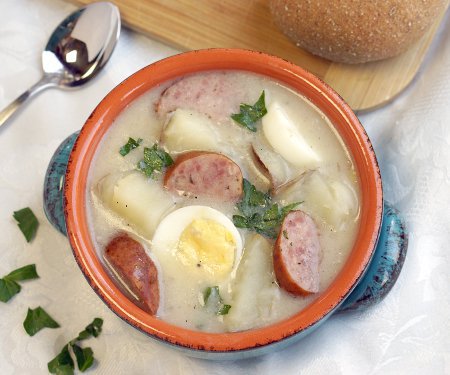
White Borscht is a tasty Polish Easter soup that is full of ingredients carrying religious symbolism.
Ingredients
- 4 hard boiled eggs*
- 1 lb Polish kielbasa, (smoked)
- 6 c water
- 1 teaspoon salted butter
- 4 garlic cloves, diced
- 1 onion, diced
- 2 lbs potatoes, diced
- 1 bay leaf
- ¾ teaspoon salt
- ¼ teaspoon pepper
- 1 c sour cream
- ¼ c unbleached all-purpose flour
Instructions
- Bring keilbassa and water to a boil in a large dutch oven or heavy bottomed soup pot. Reduce heat slightly and boil for 25 minutes. Remove keilbassa to a plate and set aside. Leave the broth in the dutch oven.
- In a medium, non-stick skillet, saute garlic and onion with a teaspoon of butter until soft, 5 min.
- Add onion mixture to kielbassa broth. Add diced potatoes, bay, salt, and pepper. Cook until potatoes are tender, 15-20 min.
- In a small bowl, whisk flour and sour cream together until smooth. Add ½ c of the soup broth to the sour cream mixture and whisk until smooth and thin. Pour mixture into the soup, stirring constantly. Simmer, stirring often, until thickened, 10 min.
- Cut the kielbasas into ½ inch slices, chop the hard boiled eggs. Add both to the soup. Taste the soup and adjust the salt an pepper as desired. Cook 1-2 minutes to heat through.
Notes
*To hard boil eggs: Place eggs in a medium pot. Cover with water and add 1 tablespoon salt (to make peeling the eggs easier). Bring the pot to a boil over medium heat (20 mintues). Turn off the heat and let the eggs stand in the hot water for 3-5 minutes, depending on how firm you like your eggs. Remove the eggs and place them in a bowl of ice water to cool.
Nutrition Information:
Yield:
5Serving Size:
2 cupsAmount Per Serving: Calories: 460
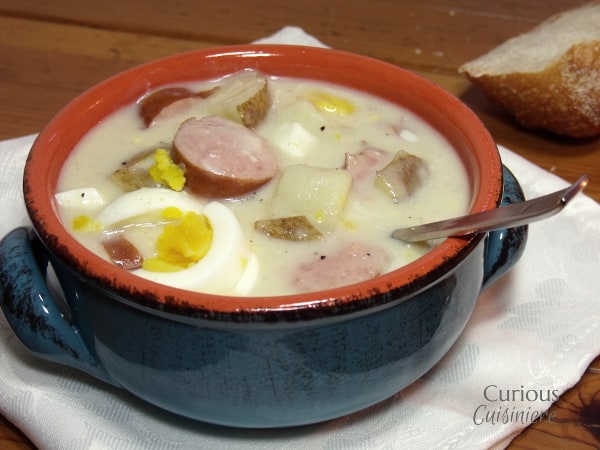
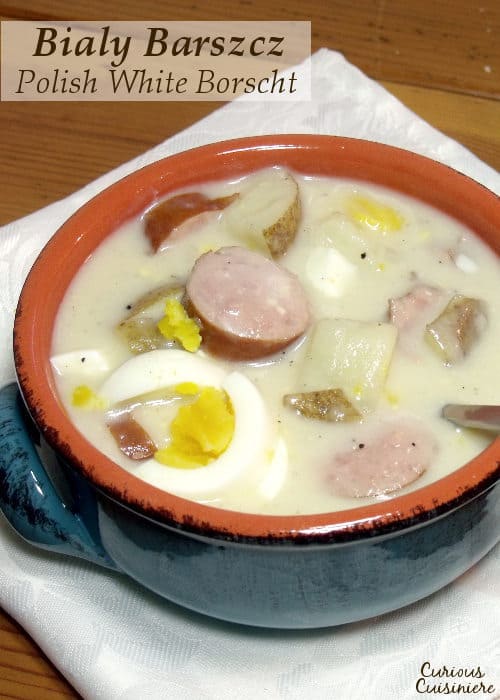
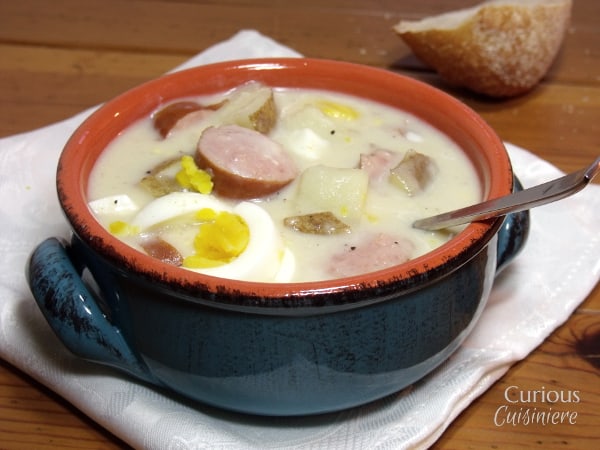
This is one of the recipes from the early days of Curious Cuisiniere. We've updated our pictures since we first shared it, but we've left some originals here, in case you've found us in the past and are looking for that old, familiar image.

Sarah founded Curious in 2010 as a way to save her recipe creations and share culinary experiences. Her love for cultural cuisines was instilled early by her French Canadian Grandmother. Her experience in the kitchen and in recipe development comes from over 10 years working in professional kitchens. She has traveled extensively and enjoys bringing the flavors of her travels back to create easy-to-make recipes.

I will make this for dinner with my family for Easter. However, my family prefers fresh kielbasa instead of smoked so that is what I will use. I hope they like it. I am the only person in my family who eats Buraki Soup (beet soup). My grandmother's recipe is what I use and is somewhat different from others I have seen....but I love it.
Hope everyone enjoys it!
My friend’s mother would make this without potatoes and with horseradish. I loved her soup. Does anyone know the name or how I could adjust this recipe? Thank you.
Hi Terry. There are so many family variations of this soup. Definitely play around with omitting the potatoes and adding in horseradish to find a flavor that suits your memories!
My grandmother from Poland also made this soup without potatoes. Sarah O is right; there are a million variations. It's also a very forgiving soup. Everything is to taste. I grew up using fresh mild kielbasa. We made a vat of broth with the sausage cooking water. Then you put a dollop of horseradish in your bowl. The meat (sausage & ham) and eggs were on the table separately. You put as much of them as you wanted in your bowl and covered it with broth. Rye bread on the side.
You would cry if you saw her recipe; not a single measurement. I am here trying to get an idea of proportions for my daughter who wants to make it for Easter (she lives abroad & weighs everything when she cooks).
@Sarah Ozimek,
Thank you all for sharing your Easter stories and recipe variations. My experience is the traditional slice of rye bread with oatmeal for the fermentation.
My husband said it smells so this year I'm attempting a less smelly version.
Happy Easter to all!
Thank you for sharing Selina!
You don't know how to make hard boiled eggs. Take your eggs put in pot fill pot with water. Put on stove and bring to a boil. Let boil for one minute cover pot with proper sealing cover remove from heat. In 15 minutes pulls eggs out of water let cool. Remove shell and slice open you will find perfect yellowed center ever time. Your recipe will create green over cooked eggs while my recipe is much less work.
Hi Allen. Our eggs never turn out green, but there are many methods for cooking hard boiled eggs. I'm sure yours works just great too!
have you ever come across an egg recipe poached in vinegar with sour cream named kracken after the second largest city in poland
Hi Leonard. I haven't come across a recipe like that, and I don't see on in my Polish cookbooks either. Maybe one of our readers can chime in!
https://www.wheatfreemeatfree.com/eggs-poached-in-sour-cream-sauce/
Above is a link for EGGS KRAKOW. I don’t think Kraken and eggs would go well together.
I thought everyone poached eggs in vinegar. Growing up, a winter breakfast would often be semi-hard boiled eggs that we’d rough chop with our spoon, adding generous spoonfuls of sour cream and mixing. With a slab of rye bread and hot Ovaltine on the side, it was satisfy and warming. We weren’t Polish, but close enough- Lithuanian.
@leonard monson, the second largest city in Poland is Krakow... but what you wrote sounds more German. Maybe it's an Austrian or German specialty?
Love this soup, I grew up in a Polish/German house, we ate a lot of traditional meals, potato soups were always good, I loved the potatoes & boiled eggs but it took years for me to enjoy the sausages. The family made their own. I was not allowed in the kitchen, it was like a sterile laboratory, everyone wearing hair nets, gloves & aprons, speaking foreign languages. I was afraid of my grandfathers German dialect! He always sounded angry. The region they were from was originally Poland, before Germany took it over. Our menu was a mix of both traditions, but heavy in the Polish persuasion! Lol!
I made the soup for dinner tonight, but without the eggs - my husbands preference, who is just starting to explore other cultural traditions. He was impressed, Loved the flavors,,, requested extra sausage & said he would like to have it again! I will definitely make it for him, but in the Easter tradition next time!
What memories! So glad you enjoyed our soup. How fun to be introducing your husband to your heritage!
3/4cup rye flour, 1-1/2 or 2 c. of warm water, 2 cloves of garlic, All in jar, leave in warm place for a week or so , when you taste it and sour flavor, it's ready to use. Easy and makes your soup taste good. Nothing wrong with using just flour, but that will only thicken soup with no distinctive flavor. Good luck
Thanks for sharing Barbara!
@Barbara, thank you, this is fantastic and simple!
@Sarah Ozimek, just look what you started, ha, ha! Sarah, everyone pouring in with their memories and STORIES! How fun!
Over the years I'd noticed there has been a great lack of Polish restaurants and of knowledge about Polish food in the US and elsewhere, despite so many waves of Polish immigration... I tried to remedy this a little- by supporting the occasional eateries, and many years ago, writing a large article about it, with pics, recipes in the Denver Post. Thought of writing a cookbook, but life was too busy, so it never came to fruition.
It's been most heartening to see many young people now, (Millenials?) with Polish roots taking up the torch, using the internet, etc. with great success. KUDOS you guys!
I am the grandma generation, happy to add, explain, etc. But so happy to see you and many others online do so well and filling a need that is certainly out there.
All the best to you !
AK.
Thank you Aniela! We love when our recipes bring back memories and encourage others to share their experiences and family traditions! And thank you for sharing your wisdom!
My MIL used to make this on Easter Sunday every year but with vinegar or lemon juice & without potatoes. The cold ingredients, sausage, eggs, cubed ham, fresh horseradish, and other things from the blessings basket were added to the bowl & the hot soup was ladled on top to warm them & cool the soup. It was served with a crusty bread & unsalted butter. Delicious.
Yum! Thank you for sharing your family tradition!
When my grandmother made this Easter morning meal,for some reason I remember that she would use pickle juice in her soup. Have you ever heard of a version with this use?
Hi David. I believe some of our readers have commented about the use of pickle juice in their family recipes. You may try searching through past comments. You could definitely try adding pickle juice to this recipe to taste.
@David Franckowiak, yes, very much so : I add some pickle juice to many things, soups, stir fries. Very nice with beef stew 🙂 . It adds a little aroma, a little touch if sour, delicious!
Definitely not how my 100% polish grandma made it.
Gonna make grand2s version today. No dill no fermentation no potatoes and her story was different.
Hi Rebecca. As you can see from the many comments, each person’s grandmother makes white borscht slightly differently. Enjoy!
My grandpa has always made this on every Easter. When we were little we’d go over to his house and have this. As we got older it was hard to fit everyone there because my family had 6 children and I had 4 cousins. So we started coming in shifts. My grandpa taught my brother and oldest cousin the recipe to keep the tradition going. Nowadays we rent out a banquet hall and we all come with our families because that’s the only thing that can fit all of us. My grandpas recipe uses vinegar to get that sour taste. They also put horseradish and fried onions on it. I’m going to miss it this year. Thank you for this!
What fun memories! Happy Easter!
We made the Polish White Borscht today.....and it was wonderful!!! Thanks so much .......Happy Easter!!!
Glad you enjoyed it! Happy Easter!
Just finished making this borscht and it brought back many fond memories of cooking with my Busia in Chicago in the late 1950s. Busia would be proud if me. I did alter your recipe a bit by adding a little more sour cream and a tablespoon of vinegar to replicate the tart/sour taste from my grandmother's borscht that had no written recipe. She always went by "taste and feel".
Hi Diane. So glad this brought back good memories for you! Thanks for sharing what you did!
I really recommend add to żurek , horseradish full jar
Its my fave taste from poland my homelamd
Some people add mushrooms and its brown soup
Horseradish does add such a good flavor. Thanks for sharing!
@magdalena szaturska, Yes!
My husbands grandparents were from Poland and he grow up eating Borscht for Easter brunch but he says the Borscht he had, had a dill pickle soup or sauce do you have a recipe for this type of Borscht. I would like to make this for him for Easter. I only had it 2 or 3 time and it was about 45 yr ago I don't remember to much about it if you could send me the recipe I would really appreciate it thank you Pamela Kuc
Hi Pamela. In one of our Polish cookbooks there is a recipe for Dill Pickle Soup, which may be what your husband is referring to. Here it is: 3 large dill pickles, sliced and sautéed in 3 Tbsp butter. Mix in 2 Tbsp flour until moistened and the pickles are wilted. Add some (the recipe doesn’t say how much, but I’d assume 1-2 cups depending on how thin you want the sauce) meat or vegetable stock and simmer slowly for 30 minutes. Strain. Add 1 c sour cream.
Hope this is what you are looking for!
hard boiled eggs Wasn,t my favorite maybe because of the hard boiled eggs.Thx for posting I had forgot all about it.My Dad on Easter Saturday after we would bring the bless foods from church would make a goulash from kielbasa,ham ,boiled eggs ther was some horsradish and vinegar in it.All items were chopped up and mixed and then put in fridge overnight and served with pumpernickle bread and butter for breakfast.Wish someone could give me a recipe for this.It was called the Polish name for Blessed Foods.Thanks for sharing.SYLVIA
Thanks for sharing Sylvia! We’ll take a look into the dish you described.
My Mom also made this soup adding the ham bone from the Easter ham to add even more flavor. She also added sauerkraut to it, which gave it a wonderfully tangy flavor. The potatoes were cooked on the side and mashed, and then the soup was ladled over a scoop of the potatoes in the bowl....result is super creamy! I'm going to have to make some soon....
This sounds delicious! We’ll have to give it a try this way. Thanks for sharing!
I made this because it reminded me of my grandma Helen. I don’t think that she ever made it, but, the ingredients were staples of there diet. It was good and as I expected kinda plain. The sausage gives it’s flavor. I feel it needed to be a little thicker.
Hi Janette. Thanks for sharing! Yes, the sausage does give a lot of the flavor to this soup, so choosing a good quality one is essential.
Can corn starch be used in place of flour to make gluten free?
Hi Eileen. I would suggest using a good quality gluten free flour blend that you trust for baking. While cornstarch would probably work in a pinch to thicken the soup, I'm hesitant to recommend it without trying it myself first, since cornstarch thickens to a different texture than flour. If you do give either a try, definitely stop back by to let us know what you do and how things turn out for you.