Pane di Pasqua (Italian Easter Bread)
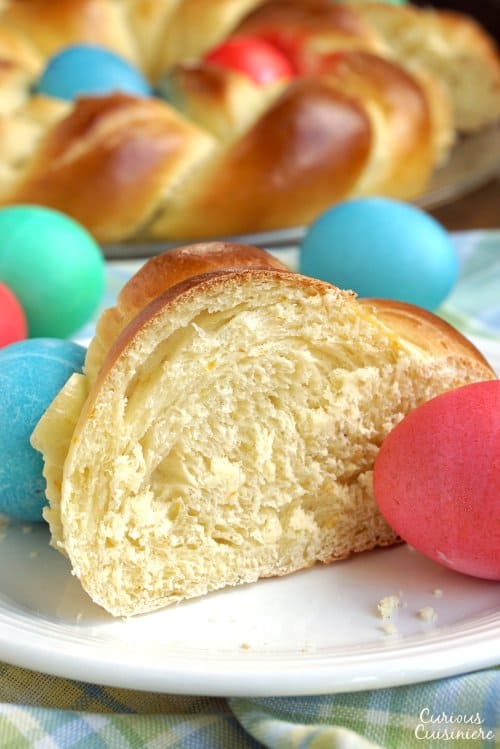
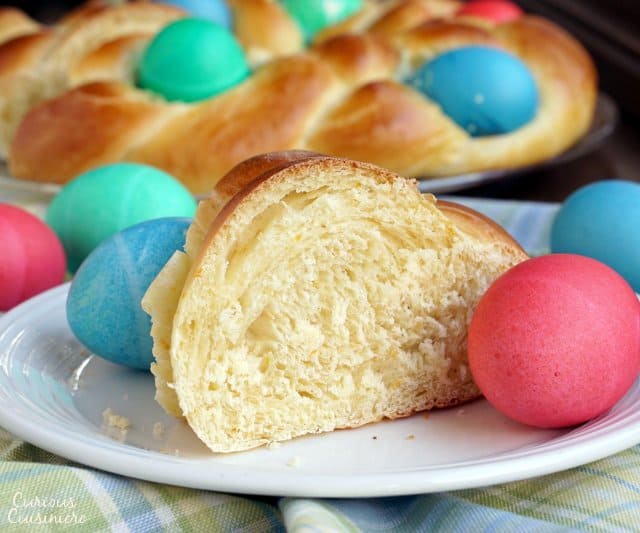
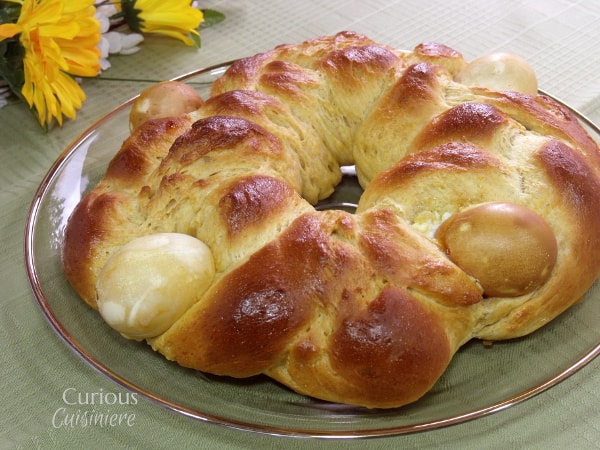
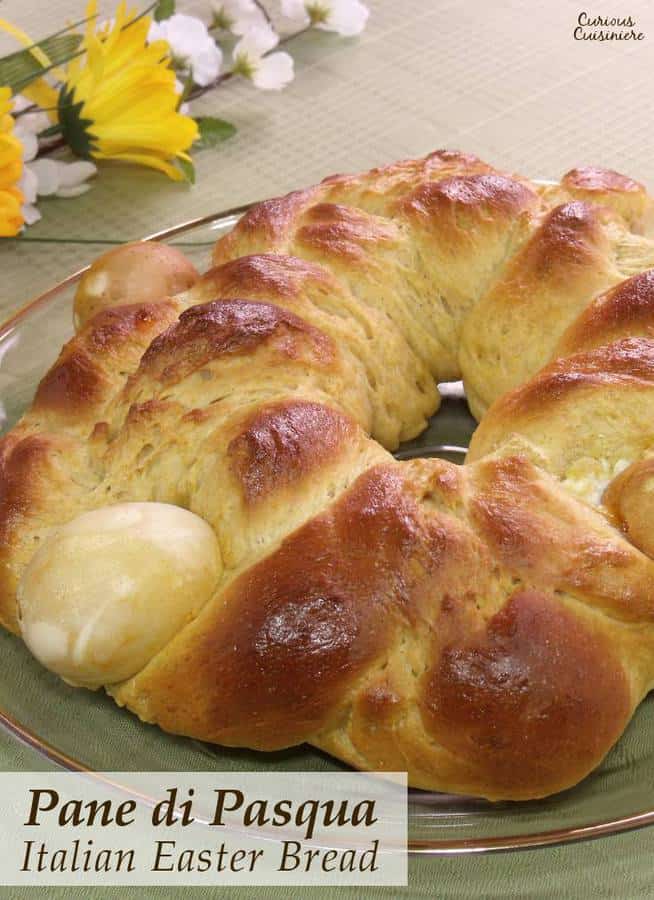
This fluffy and eggy Italian Easter Bread, Pane di Pasqua, is slightly sweet and bursting the with flavors of citrus and anise.
 Pane di Pasqua: A Symbolic Italian Easter Bread
It is no surprise that bread has incredible significance around many cultures' Easter tables.
Just as bread for centuries has been the prime source of bodily sustenance for daily life, Christ, whose resurrection Christians celebrate on Easter, is considered "the bread of life," (John 6:35), in whom believers will find their daily, spiritual sustenance.
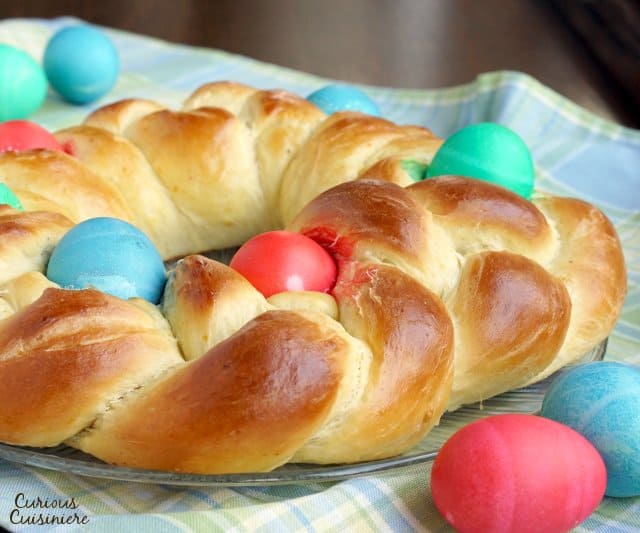
This Italian Easter bread is braided with eggs, which also hold incredible Easter significance as signs from nature of new life, just as we are celebrating new life in the risen Christ.
Due to the ending of the fast of Lent, where households would traditionally refrain from rich and sweet dishes, Easter breads are often rich, eggy breads that can range in sweetness, and sometimes are studded with dried fruit, which at one time was a luxury item. (Like this Romanian Easter Bread or Hot Cross Buns).
These are truly celebration breads that each household adapts to their own definition and means of celebrating.
Flavoring Pane di Pasqua
Pane di Pasqua is this oh so fluffy and ever so slightly sweet. This is the perfect background for the light and bright, springy flavors of citrus and anise.
Orange juice and anise are the main flavoring agents in this fluffy bread, and they mingle together quite well, with neither over powering the other as you enjoy each bite.
In order to really brighten the flavor of the bread, we use the zest and juice from the orange.
And, while ½ teaspoon of anise may seem like a lot, particularly if you're not an anise lover, the flavor really mellows as the bread cooks, leaving just a hint of spice in the finished loaf.
What can I substitute for anise?
We have gotten a lot of questions from people who want to make this Easter bread, but aren't a fan of the flavor of anise.
If you're looking for a substitute for anise in this bread, let us first say that the anise flavor in the finished bread is quite subtle. It is more of a light spice flavor than a quintessential anise/licorice flavor. So if you're on the fence, go ahead and give it a try.
That being said, if anise really isn't your thing (or you don't have it on hand), you can definitely leave it out of the bread and it will be just fine.
Other substitutions could be adding some cinnamon or nutmeg in the amount of ground anise we call for in the recipe (½ tsp). Still another option would be to replace the anise with 1 teaspoon of vanilla extract.
Whatever you decide to substitute the anise for, remember that it needs to pair nicely with orange, which is the other prominent flavor in the bread.
How To Make Braided Italian Easter Bread
While this loaf is quite impressive (as is fitting an Easter celebration table) and does contain a number of steps, it it definitely a bread that is worth your time to make.
- Make your dough: The dough for Pane di Pasqua should be soft and slightly tacky, but not sticky. It takes a little kneading by hand to reach a smooth consistency, but you can always use your stand mixer, if you desire.
- Shape your dough: After the first rise, the dough is divided into three sections. Each section is rolled into a rope and the three are braided into a nice long braid that is pinched together into a circle on your baking sheet.
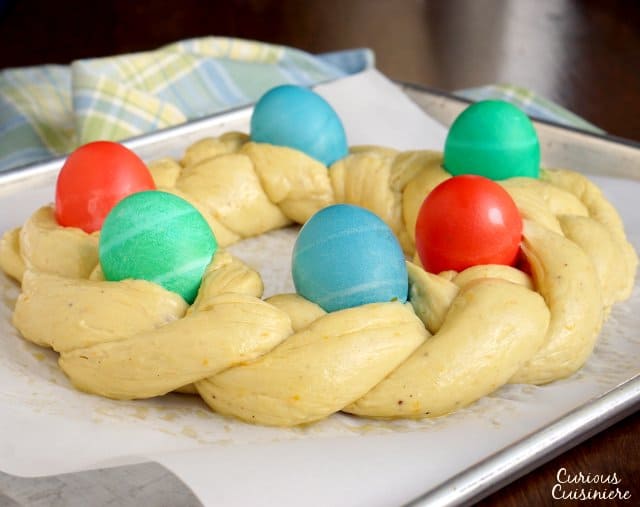
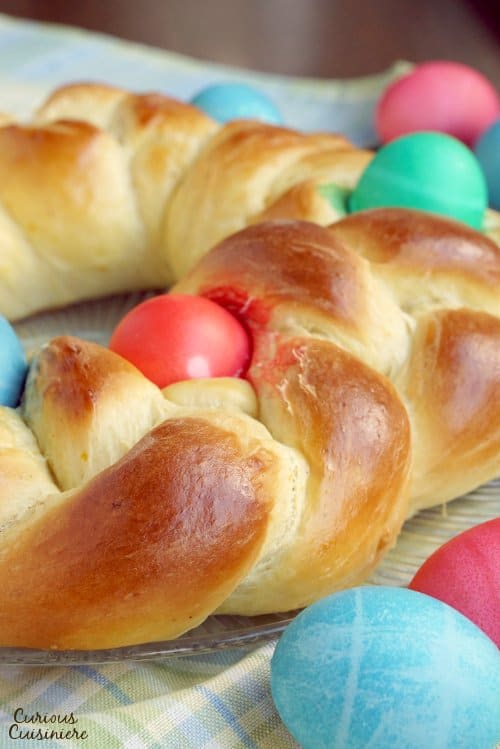
- Add the eggs: Colorful dyed eggs are then tucked into the braid. As the dough rises they settle into place.
- Bake your bread: After the final rise, it's time to bake the bread! Like magic, the bread puffs up around the eggs and turns a beautiful golden brown.
- Let it cool: While it may be tempting to dive right into the fresh from the oven bread, the hot bread is fragile and it's best to let it cool for at least 5-10 minutes on the baking sheet before trying to move it.
Baking Eggs In The Oven
What makes this bread even more unique is that raw, dyed eggs are braided right into the dough before it is baked.
Don't worry about those raw eggs though, because the eggs cook as the bread bakes.
So not only do you have an Easter bread, you end up with dyed, hard-cooked eggs too!
Just be very careful as you're dying your raw eggs. You don't want to break them before they get cooked!
Maybe that's not the best task for the little kiddos.
We'll save the hard boiled eggs for them and let you have fun dying the raw ones!
Our Easy Italian Easter Bread Recipe
The dough for this Italian Easter bread is a very rich dough, containing milk, eggs, and butter.
This makes it very moist and slightly sticky as it comes together. But, after a bit of kneading, it becomes silky smooth and very easy to work with.
After one rise, this fragrant dough gets divided into three pieces and rolled into ropes that will be braided. If you find that the dough springs back on itself as you try to roll it into your 24 inch strand, stop rolling and let the strand rest for 5 minutes (covered with your damp tea towel). This will relax the gluten proteins and make it much easier to continue rolling your strand.
After you shape your bread into a circle and pinch your ends together, it's time to tuck the eggs into the braided dough.
This part can get a little tricky. Just gently separate the strands of the braid and tuck the egg in.
The most important thing here is to keep the eggs on top of the braid, or even a little towards the center of the circle. If you place them too close to the outer edge of the circle, they tend to roll further outwards as the bread rises.
No matter how the dough chooses to rise around your eggs, the result will be a very impressive loaf.
The beautifully colored eggs and the lovely golden loaf are the perfect recipe for an Easter table centerpiece.
Can I Substitute Fresh Yeast for Active Dry Yeast?
Recently we have been getting a lot of questions about substitutions for the active dry yeast in this bread. While we haven't tried using fresh yeast in place of the active dry yeast, it should work.
For this recipe you will need ⅔oz (19g) of fresh yeast in place of the 2 ¼ teaspoon of active dry yeast.
Fresh yeast will not need as long in the hydrating step #1 of the recipe instructions. It also may cause your bread to rise more quickly, so be sure to check it often during proofing.
Can I Substitute Instant Yeast For Active Dry Yeast?
Yes, you should be able to substitute instant yeast for the active dry yeast in this recipe as well. Use the same amount of instant yeast as we call for in active dry yeast.
If using instant yeast, you can skip the hydrating step (step #1) and simply add the yeast to the dry ingredients in step #2. (Don't forget to add the sugar and the milk to the wet ingredients in step #3.) Then, continue with the instructions as listed.
Note that the dough might rise faster on you, so keep an eye on it as it proofs.
Other Easter Breads
If you love the idea of Easter bread, you'll want to give Hot Cross Buns and Romanian Easter Bread a try too!
Pane di Pasqua (Italian Easter Bread)
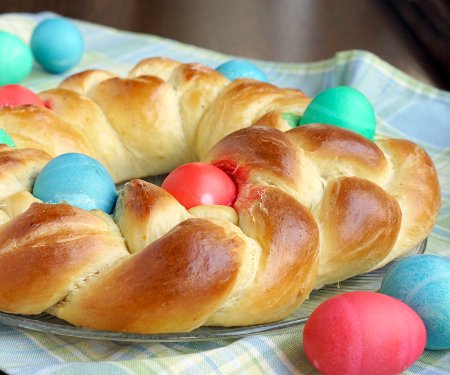
This light and eggy Italian Easter Bread, Pane di Pasqua, bread is slightly sweet and bursting the with the flavors of citrus and anise.
Ingredients
For the Bread
- ½ c (118 ml) milk, warmed to 80-90F
- ¼ c (50 g) sugar
- 2 ¼ teaspoon (7 g) active dry yeast, (1 packet)
- 4 - 5 c (480-600 g) unbleached all-purpose flour, divided
- 1 teaspoon salt
- 1 orange, zested and juiced (roughly ½ c (118 ml) juice)
- 2 eggs, lightly beaten
- ¼ c (57 g) unsalted butter, melted and cooled
- ½ teaspoon ground anise, or pure anise extract
For the Braid
- 6 raw eggs, dyed if desired
- 1 egg, beaten with 1 teaspoon water
Instructions
Making The Dough
- In a small bowl, mix the warm milk with the sugar, until dissolved. Add the yeast and set the mixture aside until it begins to foam slightly, 5-10 min.
- While the yeast is hydrating, in a large bowl, mix together 3 c all-purpose flour and the salt. Set aside.
- In a medium bowl, whisk together the orange juice and zest, the beaten eggs, melted butter, and anise. Set aside.
- Add the yeast mixture and orange juice mixture to the flour, stirring until moistened. Add the remaining flour to the dough, a little at a time, mixing until the dough comes together.
- Turn the dough out onto a lightly floured surface and knead for 5-10 minutes, until soft and smooth.
- Place the dough in a clean, oiled bowl, turning to coat the dough with oil. Cover the dough with plastic wrap or a damp tea towel, and set in a warm (70-75F), draft-free place to rise until puffy and doubled, 1-2 hours.*
Shaping the Ring
- Once the dough has doubled turn it out onto a lightly floured surface.
- Divide the dough into 3 equal pieces and gently roll each into an 24” rope. (If the dough springs back on you, cover the ropes with a damp towel and let rest for 5-10 minutes to relax the gluten. Then try rolling them out again.)
- Pinch one end of all three ropes together and braid the strands loosely. Shape the braid into a ring on a parchment-lined baking sheet.
- Gently tuck the dyed, raw eggs into the braid. (Be sure to place them on top, or slightly closer to the center of the ring, as opposed to near the outer edge, as the eggs tend to roll to the outer edge of the ring during the final rising time.)
- Gently brush the ring with the beaten egg and water egg wash, being careful around the dyed eggs (the moisture from the egg wash tends to make the dye run).
- Let the ring rise until puffy and nearly doubled, 45 minutes - 1 hour.*
Baking The Bread
- Near the end of your rising time, preheat the oven to 350F.
- Bake the bread for 25 minutes, until the ring is golden and sounds hollow when tapped gently.
- Let the bread cool on the baking sheet for at least 10 minutes before transferring to a wire rack to cool completely.
Notes
*Since this is a rich dough, rise time may be longer depending on your kitchen and your dough. If it doesn't get puffy and nearly double in the time listed, just give it some patience and more time.
This recipe from 2014 was updated March 2018. We made the bread dough even easier to work with. Enjoy!
Nutrition Information:
Yield:
12Serving Size:
12 peopleAmount Per Serving: Calories: 155Saturated Fat: 1.1gCholesterol: 44mgSodium: 222mgCarbohydrates: 28gFiber: 1.9gSugar: 6.4gProtein: 5.3g
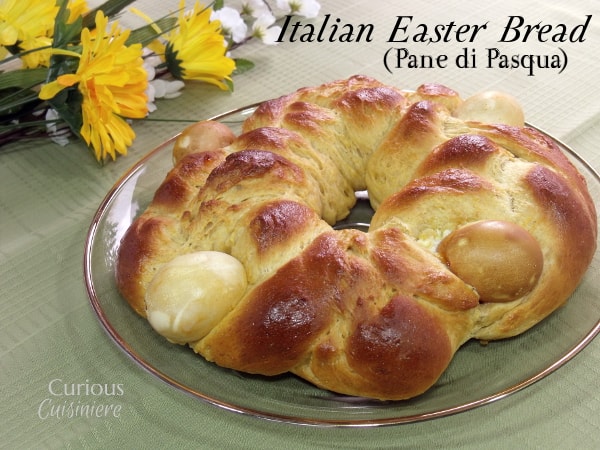
This is one of the recipes from the early days of Curious Cuisiniere. We've updated our pictures since we first shared it, but we've left some originals here, in case you've found us in the past and are looking for that old, familiar image.

Sarah founded Curious in 2010 as a way to save her recipe creations and share culinary experiences. Her love for cultural cuisines was instilled early by her French Canadian Grandmother. Her experience in the kitchen and in recipe development comes from over 10 years working in professional kitchens. She has traveled extensively and enjoys bringing the flavors of her travels back to create easy-to-make recipes.
So what is the difference between Greek Easter Bread and Italian Easter Bread? In all my years of living in Italy, I've never seen Italian Easter Bread like this, I've only seen the colomba di pasqua.
What region were you in in Italy? From what we can tell, Pane di Pasqua like this recipe seems to be more common among southern Italian families and American Italians. Colomba di pasqua, while more popular, seems to hail from the norther regions of the country.
Greek Easter bread is quite similar in concept to this bread, except that it may or may not be flavored with citrus and is traditionally flavored with mastic and mahlab, two local seasonings. Greek Easter bread also only uses red eggs to symbolize rebirth in the blood of Christ.
this bread turned out absolutely amazing. I was questioning the Anise and the orange juice but followed the recipe and my husband who never eats any of the Easter bread I make went back for seconds and thirds. Our neighbor next-door wants to know when I’m going to make it again. This might be a monthly bread that I need to make regardless of a holiday. Thank you so much
We’re so glad to hear it was a hit! The orange and anice is a bit of a unique combo, but as you found out, it works together so well! Thanks for letting us know how it turned out for you!
Beautiful bread - just beautiful. Remines me of my Italian grandmother! Can wait to try the recipe. Thanks for sharing.
Thank you! We hope you enjoy it!
I just made this with my kids today! We had a lot of fun making the bread. My kids loved rolling the dough into "snakes" and we have fun placing the dyed eggs on the bread. Ive always wanted to make this yummy/ colorful looking bread! This is an awesome recipe, we used orange juice and only 4 cups of flour. I married into an Italian family.. so we'll see how it goes at Easter Brunch! Thanks for this lovely recipe, hoping to make it a tradition each year 🙂
Happy Easter
God bless.
So glad you could get your kids involved in the kitchen! Hope you all enjoy the bread! Happy Easter!
Is it possible to make the dough ahead of time?
Hi Danielle. Yes, you can! Refrigerate it, covered after a short rise time until you are ready to use it. You’ll want to give it 2-3 hours out of the fridge to come to room temperature before continuing with shaping and baking. Enjoy!
So easy to make,
Loved it. Delicious. Make sure 1/2. C orange juice. Used only almost 4 cups all purpose Flour. Came out fantastic. I also make a confectionery sugar topping and then sprinkle the colored sprinkles on it. Looks beautiful. Thank you for this recipe. I have others and have made many, but this is an easy recipe. Thank you again.
So glad you enjoyed the Easter bread recipe Arline!
How long will this bread stay fresh for Easter? Should I make it a day before or will it be ok to make two days in advance?
Hi Danielle. I would advise making it the day before. Rich breads like this are best as soon as possible after baking. Enjoy!
Can this be made in a bread machine without the eggs? I don't need it to be braided either.
Hi Christy. I assume you mean the decoration eggs on top? (Not the eggs in the bread dough.) I would think you could do this in the bread machine. This is a bit of a softer dough, so you might have to keep an eye on it and add a bit more flour to get it to come together nicely in the bread machine. If you give it a try, stop back by and let us know how it turns out for you!
I prepared it this morning and found the dough to be extra dry even after kneading it never got to the right consistency. I put it aside and made one from another site that I had previously made. The ratio of 4 + cups of flour to liquid doesn’t seem right. The other recipe was 2 1/2 cups flour to total of 2/3 cup liquid; yours was 4 + cups flour to total of 1 cup.
Hi Toni. Did you perhaps miss the eggs and melted butter? With those ingredients (plus the milk and orange juice) you are at around 1 3/4 c of liquid, which should be sufficient for 4 cups of flour.
I made this bread and it was beautiful. Loved this recipe, thank you!
So glad you enjoyed it Anna!
Great recipe. Tastes just like my grandma’s did. One thing though: 4-5 cups was wayyyyy too much flour when i tried this recipe the first time. Had to make a second batch of dough and used 3 cups and added a little more as i kneaded.
Thanks for your feedback Gina. Based on your (and other) comments, we have updated the recipe to reflect the 3 cup starting point. So glad you gave it a second go and enjoyed it!
Thanks for the rescipe. I misplaced my Grandmother's and this sounds like the one she used. Mary Oratorio - Wilmington Delaware.
We hope you enjoy the bread Mary!
This is stunning!
Very pretty, they eggs really add a lovely touch!
As an Italian-American, you have prepared this traditional Easter Bread so perfectly, golden on the edges, and filled with eggs. Delightful! Saving this for next year! I hope that you had a Buona Pasqua (Happy Easter)!
Roz
Thanks so much!
Wow. I loved that you shared some of the history behind this bread. Very cool!