
Bauernbrot (German Farmer's Bread)
If you love hearty bread, Bauernbrot is for you! This German rye bread brings authentic flavor and texture together in one easy-to-make loaf.
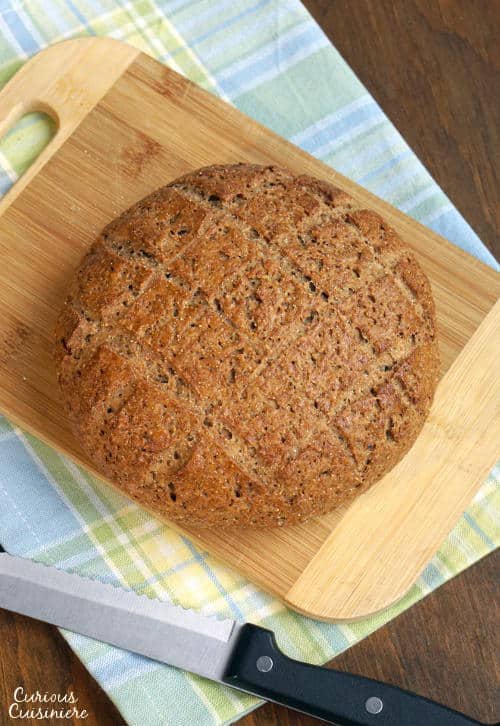
German Bread
Germans love their bread dense and hearty.
Rye flour is a common addition to their loaves, giving them a darker color and very heavy texture.
In fact, rye is such a common bread ingredient that German breads are classified by the amount of rye content they contain.
- Weizenbrote - "wheat bread" - at least 90% wheat
- Weizenmischbrote - "mixed wheat bread" - wheat and rye bread with 50-89% wheat
- Roggenbrote - "rye bread" - at least 90% rye
- Roggenmischbrote - "mixed rye bread" - rye and wheat with 50-89% rye
- Vollkornbrote - "whole grain bread" - breads made with ground whole grains
(Information from GermanFoodGuide.com.)
Since we're big fans of hearty bread, we really love the fact that there's no wimpy bread when it comes to traditional German bread.
Forget American white bread!
In fact, Germans sometimes refer to their wheat bread (weizenbrote) as "white bread", since it is so much lighter in color and flavor than the rye breads.
When we traveled in Germany, we were often offered the choice between white or brown bread for breakfast or with lunch. We typically went with brown bread, since we love hearty bread, and we thought that "white bread" would be what we think of as white bread here in the States.
Imagine our surprise when we decided to try something different for one meal and ordered "white bread". What we received was still a golden brown, grainy wheat, just not quite as dense and heavy as the rye breads that we had been eating!
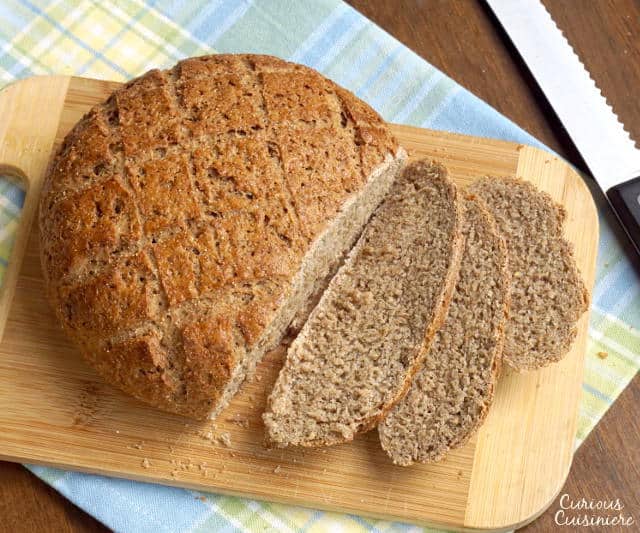
German Farmer's Rye Bread
Bauernbrot means "farmer's bread", and, as the name implies, it is more common to find this kind of bread on farms. It is a bit heartier than a standard landbrot (or "country bread") because farmers need a bread that will stick with them!
We found that farmer's bread tends to fall in the Roggenbrote or Roggenmischbrote categories, meaning that it is so hearty because it is over 50% rye.
And, like many German breads, it uses a sourdough starter to give the bread rise and develop a beautiful, lightly sour, flavor.
As if rye and sourdough don't pack enough flavor, many of these breads are also seasoned with one or a mixture of spices known as "German bread spice".
What is German Bread Spice?
One thing you will notice when eating German rye bread is that it has a very characteristic flavor. Many of the recipes we found called for "German bread spice", which seemed to be key to creating that authentic German flavor.
German bread spice is a mixture of spices that typically includes caraway, anise, fennel, and coriander. The sweet, yet savory flavor of these spices adds a wonderful depth and sweetness to the rye bread.
In addition to adding flavor, they are wonderful medicinal spices that aid in digestion.
Rye bread packs a lot of fiber, and mixing these spices right into the bread gives your digestive system a little extra help breaking all that fiber down.
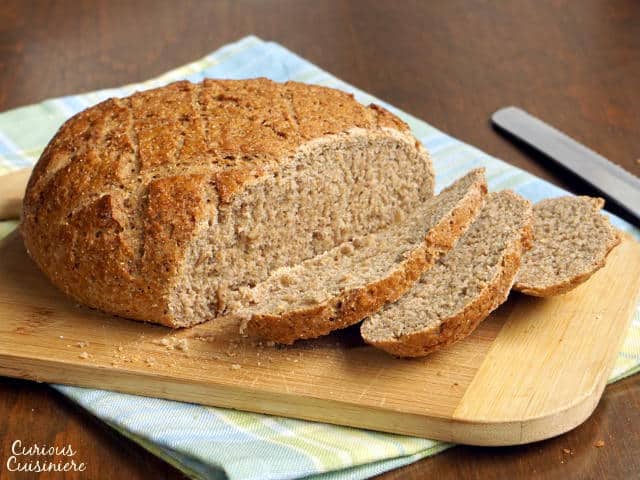
Our Bauernbrot Recipe
In Germany, breads can differ drastically based on region, meaning that a bauernbrot from one area's farms won't necessarily taste like a bauernbrot from another region's farms.
Our bauernbrot recipe creates a dense and hearty bread that is heavy on the rye but has enough wheat flour mixed in to create a balanced, hearty bread. And, of course, we included German bread spice to give the full effect of authentic German flavor.
We do use a sourdough starter for this bread, as is quite traditional in German bread making, but if you're not used to working with sourdough, don't worry. Our recipe walks you through making the simple sourdough starter, and this starter only needs to rest for 24 hours before making the bread.
That means no multiple days of feeding and care before you can finally get your bread into the oven!
If you love hearty bread that is perfect for winter soups or spreading with creamy cheese spreads, then we are confident that you will love this German rye bread recipe!
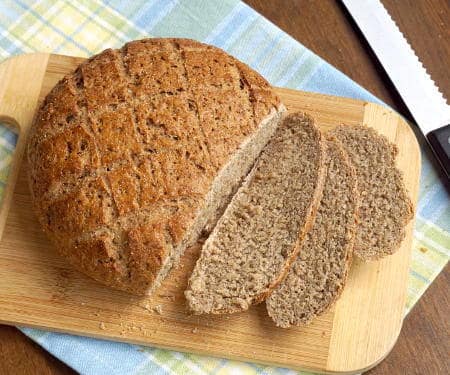
Bauernbrot (German Farmer's Bread)
Ingredients
For the Starter
- 1 c (115 g) unbleached all purpose flour
- 1 c (120 g) rye flour
- 1 tablespoon honey
- 1 c water, warmed to 80F
- 1 teaspoon active dry yeast
For the Dough
- 1 c (120 g) rye flour
- ½ - ¾ c (57 - 86 g) unbleached all purpose flour
- ½ teaspoon whole caraway seeds
- ½ teaspoon ground anise
- ½ teaspoon whole fennel seeds
- ½ teaspoon ground coriander seeds
- 1 ½ teaspoon salt
For baking
- 1 egg white beaten with 1 tablespoon water (for the egg wash)
- Cornmeal (to dust the baking sheet)
Instructions
- Mix all starter ingredients in a large bowl. Cover the starter with plastic wrap and let it rest on the counter for 24 hours, until very bubbly.
- Using a stand mixer fitted with a dough hook, add all the dough ingredients to the starter, starting with ½ c all purpose flour. Add the remaining all purpose flour as needed to help the dough come together. Knead on the mixer for 1-2 minutes, until a soft and slightly sticky ball of dough forms.* (Alternately, turn the dough out onto a lightly floured surface and knead by hand for 5-7 minutes.)
- Shape the kneaded dough into a ball. Cover it with a damp tea towel and let it rise in a warm, draft-free place for roughly 2 hours, until puffy and nearly doubled.
- Knead the dough a couple of times (using added flour on your hands has needed) and shape it into its final round shape, pressing to flatten the round slightly. Place the shaped dough onto a cornmeal-dusted baking sheet. Brush the top of the dough with a little of the egg white mixture and cut a few slices in the top of the dough, using a serrated knife. Let the shaped dough rise in a warm, draft-free place for 40-50 minutes, until puffy.
- Near the end of the final rising time, preheat your oven to 425F.
- Bake the bread at 425F for 20-30 minutes, until the bread sounds hollow when tapped or a thermometer inserted into the center of the bread registers 180-185F.
- Remove the bread from the baking sheet, and let it cool at least 10-15 minutes on a wire rack before cutting and serving.
Notes

Sarah founded Curious in 2010 as a way to save her recipe creations and share culinary experiences. Her love for cultural cuisines was instilled early by her French Canadian Grandmother. Her experience in the kitchen and in recipe development comes from over 10 years working in professional kitchens. She has traveled extensively and enjoys bringing the flavors of her travels back to create easy-to-make recipes.



Would it be possible to use a bread making machine?
Hi Mary. I think this would be possible to make in a bread machine. You may need to play with adding more water or flour to get the dough to the right consistency. I would also just use the bread machine's dough setting (and bake in your oven), as this dough takes a longer rise than most bread machines will give. If you give it a try, let us know what you do and how it turns out for you!
Does it matter if you leave the starter developing longer than 24hours as I have a run around day and won't be back in time to continue with the receipe
Hi Brenda. That depends on how much longer you think you'll be leaving it. I wouldn't leave it too much longer than 24 hours. 1-2 hours more probably won't be a problem. Any more than that, I would put the starter in a cooler environment to slow down the fermentation and make sure the yeast doesn't run out of food while you're away. If you'll just be a few hours, your basement (or somewhere else that is around 50-60F) would be fine. But, if you're looking at another 6-12 hours, I would put it in the refrigerator. Just make sure that it comes to room temperature for a few hours before you start the bread again. Enjoy!
I'm newer to bread making, but I wanted to give this recipe a try. I've always loved full flavor breads. The bread turned out quite dense. Is this normal? I used a Bob's Red Mill bread flour and Hodgson Mill rye flour (whole grain). It seemed to rise decent for the first 2 hour period, but very little during the 45 minute period. Should I try using more bread flour? Any other suggestions?
Hi Joshua. Yes, this is a very dense bread due to the high amount of rye flour. If you would like it to be lighter, you can definitely increase the amount of bread flour and decrease the amount of rye flour in your dough.
Hi! I was wondering if I should soak the seeds in a liquid such as milk, buttermilk, or water in order to soften them before adding them to this recipe. Or, will the seeds soften as they bake? I am so eager to try this recipe! Thanks!
Hi CJ, We did not find soaking the seeds to be necessary. For our tastes, they softened enough as the loaf bakes. (If you are very sensitive to the texture of seeds, you definitely could soak them in some water to soften before adding them to the dough though. Just be sure to drain them thoroughly.) Enjoy!
If I already have a rye sourdough starter, what’s the total volume/weight I need to add to the rest of the dough ingredients? In other words, what’s the measured yield of your sourdough starter?
Hi Kellen, I don't have a weight on our starter at this point, the next time we make it, I'll be sure to take one. At this point, I would just go by the 1 c AP flour, 1 c rye flour, and 1 c water, which would give you (very) roughly 16 oz of starter. Do make sure the hydration of your starter is similar to the starter in the recipe. (See my comment to other readers below for more elaboration on using your own starter.)
My grandmother used to make an unleavened bread that she wrapped around a Christmas ham. She called it grusmadil (spelled phonetically) and I remember her saying it was a German tradition.
Are you familiar with anything like that? It was so good. It was crispy and we dipped it in the ham drippings.
My cousin said that he remembers our great-grandmother making it. He said that she used flour and water and a little bit of baking powder.
I love to hear from anyone who knows about this.
Thank you.
Hi Terri, Thank you so much for sharing. This sounds delicious! We have have seen a few things similar to what you're describing, but we will definitely have to look into it in more detail! In the meantime, hopefully some readers can chime in!
Hi,
I FOUND THIS:
https://12tomatoes.com/easter-recipe-osterschinken-or-ham-in-a-bread-blanket/
RAY
HI do you add all the starter dough mix together with the rest of the recipe? At what stage do you mix it in? Thank you so much ?
Hi Nicky, Yes, you add the dough ingredients to all of the starter in the stand mixer in step 2. Enjoy!
Hey there!
What do you think about steam baking? Would putting a pan of water in the bottom of the oven be beneficial for this bread, or not so much since it's gonna be a pretty dense loaf?
Hi Christopher. Putting a pan of water in the oven is typically a technique used to develop a good, thick, crisp crust. You could definitely give it a try for this bread if you're a fan of a good crust. It is a pretty heavy loaf already though, so adding the extra crust might be a little too much. Personally, I'd probably skip the pan of water for this bread, but if you give it a try, definitely stop back by and let us know how it turns out for you!
Can the bread in this recipe be made in a loaf pan?
Hi Minna. Yes, you definitely could make this loaf in a loaf pan. Enjoy!
Delicious ! can you give me some bread recipes
Thanks Raj! You can find more of our bread recipes here: https://www.curiouscuisiniere.com/food/bread-recipe/.
So what do you do when the dough does not combine together do you add water
If the dough is not coming together for you, perhaps you added too much all purpose flour. But it is easily fixed. Go ahead and add a little more water until the dough comes together.
Hi! Thanks so much for this recipe, it looks great! I was a little confused by your use of rye and wheat ratios in the blog post, but then rye and white flour in the recipe. By wheat, do you just mean flours made from wheat? Sorry, I'm just getting into bread baking and I don't know all the details yet!
Hi Hannah, Thanks for your note and sorry for the confusion. Yes. By "wheat" we are referring to any flour made from wheat. We use all purpose flour in the recipe to balance out the heartiness of the rye flour. Enjoy and happy baking!
While i have sourdough starter I chose to follow your recipe. My dough raised good in 2 hours rest before cooking but it stayed as it was after 42 minutes cooking. It didn't rise enough. any idea why?
Hi Mojtaba. After the 2 hour rise, did you punch down the dough and give the bread a secondary rise of 40 minutes before baking? If you put the bread straight into the oven after the 2 hour rise, it was probably over-proofed, and had no more rise left in it. That would explain why it didn't rise any more in the oven.
This Bauernbrot looks heavenly! In answer to Aiyana's question, yes! What you would do is use all the starter ingredients in the recipe omitting the yeast. Add in 2T of your existing active sourdough starter and proof over night , preferably at 72 room temp.
Thank you Susan! And thank you for adding your expertise on working with an active starter!
Hello,
I was looking for German bread recipe's and found yours. I was wondering if the recipe can be adapted to use an existing sourdough starter?
Thank you
Hi Aiyana. Great question! I'm sure there is a way you could adapt this bread to use an existing starter, but I am hesitant to recommend it. It is hard to be sure that your starter and the starter created by our recipe have the same hydration levels. Different hydration levels in the starter would drastically change the resulting loaf. If you are very familiar with making bread, then maybe you could play around with using about a pound of your starter for the dough of this bread, but, as I said, depending on the hydration levels of your starter, you might have some adjustments to make to the flour quantities in the dough.
We intentionally made this sourdough a "quick starter" that only takes 24 hours to ferment and used it all in the bread in hopes of simplifying the process. But, I completely understand your desire to use your own starter! You've worked hard for that guy!
Do be sure to let us know what you decide to do and how it turns out for you!
Yes, I made it with my regular sourdough starter, improvising method and timing and ingredients slightly to adjust the sourness-to-sweetness balance and the evolving texture. My dough was stickier since I used a full 2 cups of 100% hydrated starter instead of one cup water and one cup white flour, just adding the cup of rye and the honey to ferment overnight. Next day I added the other ingredients but happened to already have a pre-ground mixture of equal parts aniseed/coriander/brown sugar so I added a little more extra of that but the extra sweetness balanced the sourness of all my starter. It turned out just delicious all around, and I baked it in a dutch oven. Thank you for this recipe. I shall make it again and again.
*Didn't knead but "turned" the dough 3 times during the initial bowl rising, rested it and let it continue to rise while refrigerated, shaped it into a round, set it covered in a plastic bag for refrigerated final rise, then baked!
Sounds wonderful! Thanks for sharing Kathryn!