
Bauernbrot (German Farmer's Bread)
If you love hearty bread, Bauernbrot is for you! This German rye bread brings authentic flavor and texture together in one easy-to-make loaf.
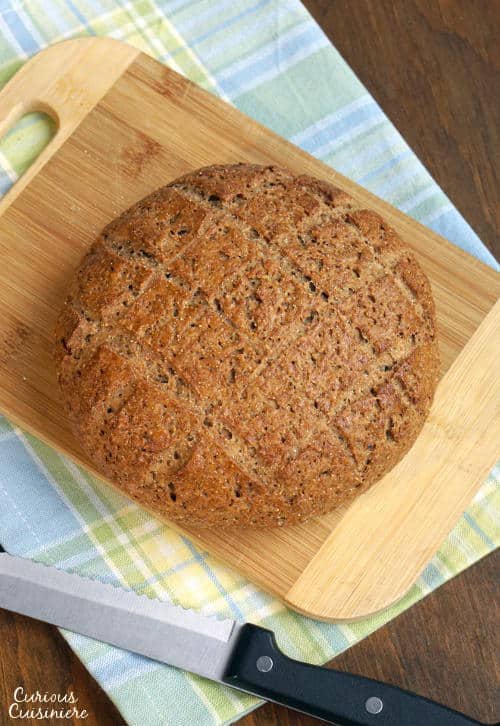
German Bread
Germans love their bread dense and hearty.
Rye flour is a common addition to their loaves, giving them a darker color and very heavy texture.
In fact, rye is such a common bread ingredient that German breads are classified by the amount of rye content they contain.
- Weizenbrote - "wheat bread" - at least 90% wheat
- Weizenmischbrote - "mixed wheat bread" - wheat and rye bread with 50-89% wheat
- Roggenbrote - "rye bread" - at least 90% rye
- Roggenmischbrote - "mixed rye bread" - rye and wheat with 50-89% rye
- Vollkornbrote - "whole grain bread" - breads made with ground whole grains
(Information from GermanFoodGuide.com.)
Since we're big fans of hearty bread, we really love the fact that there's no wimpy bread when it comes to traditional German bread.
Forget American white bread!
In fact, Germans sometimes refer to their wheat bread (weizenbrote) as "white bread", since it is so much lighter in color and flavor than the rye breads.
When we traveled in Germany, we were often offered the choice between white or brown bread for breakfast or with lunch. We typically went with brown bread, since we love hearty bread, and we thought that "white bread" would be what we think of as white bread here in the States.
Imagine our surprise when we decided to try something different for one meal and ordered "white bread". What we received was still a golden brown, grainy wheat, just not quite as dense and heavy as the rye breads that we had been eating!
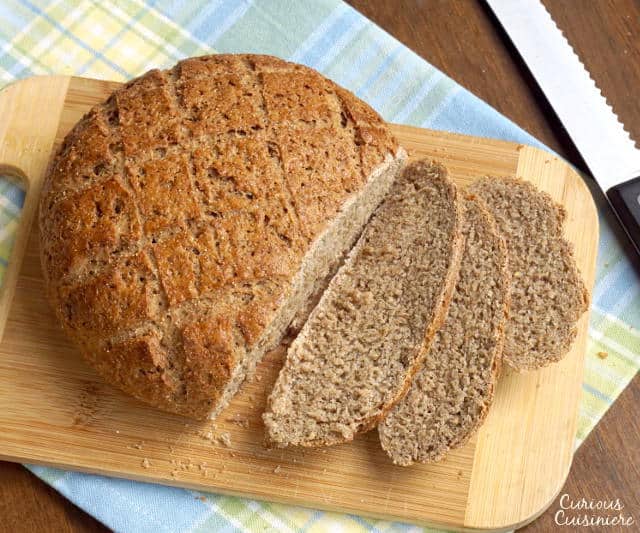
German Farmer's Rye Bread
Bauernbrot means "farmer's bread", and, as the name implies, it is more common to find this kind of bread on farms. It is a bit heartier than a standard landbrot (or "country bread") because farmers need a bread that will stick with them!
We found that farmer's bread tends to fall in the Roggenbrote or Roggenmischbrote categories, meaning that it is so hearty because it is over 50% rye.
And, like many German breads, it uses a sourdough starter to give the bread rise and develop a beautiful, lightly sour, flavor.
As if rye and sourdough don't pack enough flavor, many of these breads are also seasoned with one or a mixture of spices known as "German bread spice".
What is German Bread Spice?
One thing you will notice when eating German rye bread is that it has a very characteristic flavor. Many of the recipes we found called for "German bread spice", which seemed to be key to creating that authentic German flavor.
German bread spice is a mixture of spices that typically includes caraway, anise, fennel, and coriander. The sweet, yet savory flavor of these spices adds a wonderful depth and sweetness to the rye bread.
In addition to adding flavor, they are wonderful medicinal spices that aid in digestion.
Rye bread packs a lot of fiber, and mixing these spices right into the bread gives your digestive system a little extra help breaking all that fiber down.
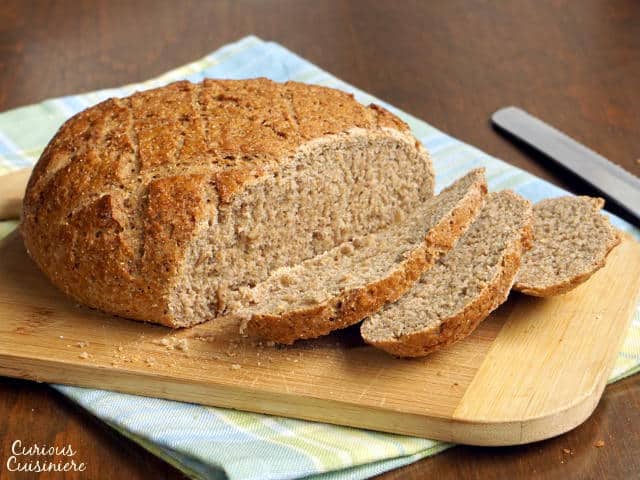
Our Bauernbrot Recipe
In Germany, breads can differ drastically based on region, meaning that a bauernbrot from one area's farms won't necessarily taste like a bauernbrot from another region's farms.
Our bauernbrot recipe creates a dense and hearty bread that is heavy on the rye but has enough wheat flour mixed in to create a balanced, hearty bread. And, of course, we included German bread spice to give the full effect of authentic German flavor.
We do use a sourdough starter for this bread, as is quite traditional in German bread making, but if you're not used to working with sourdough, don't worry. Our recipe walks you through making the simple sourdough starter, and this starter only needs to rest for 24 hours before making the bread.
That means no multiple days of feeding and care before you can finally get your bread into the oven!
If you love hearty bread that is perfect for winter soups or spreading with creamy cheese spreads, then we are confident that you will love this German rye bread recipe!
Bauernbrot (German Farmer's Bread)
Ingredients
For the Starter
- 1 c (115 g) unbleached all purpose flour
- 1 c (120 g) rye flour
- 1 tablespoon honey
- 1 c water, warmed to 80F
- 1 teaspoon active dry yeast
For the Dough
- 1 c (120 g) rye flour
- ½ - ¾ c (57 - 86 g) unbleached all purpose flour
- ½ teaspoon whole caraway seeds
- ½ teaspoon ground anise
- ½ teaspoon whole fennel seeds
- ½ teaspoon ground coriander seeds
- 1 ½ teaspoon salt
For baking
- 1 egg white beaten with 1 tablespoon water (for the egg wash)
- Cornmeal (to dust the baking sheet)
Instructions
- Mix all starter ingredients in a large bowl. Cover the starter with plastic wrap and let it rest on the counter for 24 hours, until very bubbly.
- Using a stand mixer fitted with a dough hook, add all the dough ingredients to the starter, starting with ½ c all purpose flour. Add the remaining all purpose flour as needed to help the dough come together. Knead on the mixer for 1-2 minutes, until a soft and slightly sticky ball of dough forms.* (Alternately, turn the dough out onto a lightly floured surface and knead by hand for 5-7 minutes.)
- Shape the kneaded dough into a ball. Cover it with a damp tea towel and let it rise in a warm, draft-free place for roughly 2 hours, until puffy and nearly doubled.
- Knead the dough a couple of times (using added flour on your hands has needed) and shape it into its final round shape, pressing to flatten the round slightly. Place the shaped dough onto a cornmeal-dusted baking sheet. Brush the top of the dough with a little of the egg white mixture and cut a few slices in the top of the dough, using a serrated knife. Let the shaped dough rise in a warm, draft-free place for 40-50 minutes, until puffy.
- Near the end of the final rising time, preheat your oven to 425F.
- Bake the bread at 425F for 20-30 minutes, until the bread sounds hollow when tapped or a thermometer inserted into the center of the bread registers 180-185F.
- Remove the bread from the baking sheet, and let it cool at least 10-15 minutes on a wire rack before cutting and serving.
Notes

Sarah founded Curious in 2010 as a way to save her recipe creations and share culinary experiences. Her love for cultural cuisines was instilled early by her French Canadian Grandmother. Her experience in the kitchen and in recipe development comes from over 10 years working in professional kitchens. She has traveled extensively and enjoys bringing the flavors of her travels back to create easy-to-make recipes.


Can this be done in a bread machine? Was thinking about doing starter & after 24 hours place in bread machine and just use the dough setting?
Hi Debbie. I think you could use a bread machine for this bread. (Although I have never tried it.) My one hesitation would be the moisture level, so I would just keep an eye on it in the machine to make sure it is coming together well and adjust the water or flour a bit if needed.
I've made this twice with different outcomes: the first time, after making the starter and adding in the flour and salt, it was so dry I had to add almost one cup of water. I also suspected the yeast was spent, so I added another teaspoon of yeast. The second time, I cut the flour in half but I didn't add more yeast and it failed to rise, so I had to work in a bit more flour and a teaspoon of yeast. I'm in northern Canada and getting starter to activate in cool temperature is a challenge so I use the yogurt setting on my Instant Pot, and set the bowl of starter on the wire trivet and close the lid. Perhaps I cooked the yeast? lol In either case, I like this recipe for its simplicity. Not having to make sourdough starter a week prior and feeding it daily is my motivator! So will keep working on it to perfect it for my situation. Thanks for the recipe!
Hi Beverlie. Getting starter to start in cooler temperatures can be challenging. Often we will leave the light on in our electric oven and that is a nice temperature for it. Or if you have a gas oven, it may be hot enough with just the pilot light. I have known people to microwave a cup of water, and then swap out the water for the bread for rising. Maybe one of these can help you. From what I can find about the Instant Pot yogurt setting, it runs around 110-115F, which would be a bit hot and may have killed your yeast. I hope you can find a starter method that works well! (As for the flour, different mills of flour can take water differently. I'm glad you were able to find an adjustment that worked for your flour!)
I've tried this recipe twice. When I add the rye and unbleached flour to the starter, the mixture is so dry that I need to add about 3/4 cup of water. ( I tried using a hand mixer with with double dough hooks as well as trying to mix/knead by hand but the mixture just doesn't happen due to its dryness.) Any ideas?
Hi Fred. When adding the flour, do you start with only 1/2 cup of all-purpose flour? Only add as much all-purpose flour as you need. Different flour brands take different amounts of water. So, you may just be using a really thirsty rye flour. Add your rye flour first, and then add only as much all-purpose as you need to get to a soft and slightly sticky dough to come together. If you do still find you need more water, then go ahead and add it.
Oh one more, do you recommend medium rye flour?
Yes, medium rye works well here. As with any bread recipe, there can be a lot of variance in how different brands of flours take moisture. So we do recommend adding your last bit of flour slowly. Rely more on how the dough feels than the measurements. Enjoy!
Love Bauernbrot, so this recipe looks awesome. Quick question- could I bake it in a cast iron Dutch oven? Also, any need to have a steam pan in the oven?
Thanks!
Hi Steve. This bread should work in a cast iron Dutch oven. But, honestly, I haven't played around with that method enough to be able to give recommendations on how to adapt this recipe for a Dutch oven.
You don't need a steam pan for this bread. But if you're looking for a more firm crust, adding one won't hurt.
I am confused. I understood you to say this was a sourdough recipe but it uses store bought yeast. Do you have the sourdough one?
Thanks
Hi Siki. The yeast is used to kick-start your starter and get it ready to use in 24 hours. If you happen to have some active rye starter laying around, then you could substitute an equal amount of that rye starter for the starter portion of this recipe.
Can we replace all purpose flour to whole wheat flour?
Hi Navneet. I wouldn't recommend it. This is already a more dense bread due to the rye flour, and it really needs the all purpose to lighten it up. That being said. If you like a really hearty bread, what flour you use is up to you. If you do make the substitution, you will likely need to use less flour or more water because whole wheat flour will take more liquid.
Made 2 loaves and decided to share a loaf and a jar of my homemade sauerkraut, with a neighbor. Had I known what he does for a living, I would have never been brave enough to do so. He's literally the head of R&D for a major bakery industry supplier! He absolutely loved the bread though, and asked if he could commission me to make a couple more loaves, so he could make pastrami sandwiches for a poker night that he hosts. So even a professional thinks this bread is great!
Thank you for sharing Alayna! I'm so glad you both liked the bread!
Will it make a big difference to leave out the caraway? And can I cook in a bread cloche preheated in the oven.
Leaving he caraway will just impact the flavor and a bit of the digestive boost from the seeds. If you are familiar cooking with a bread cloche, then it should work just fine. We can't give advice for any adjustments that may be needed though, as we are not particularly familiar with that cooking method.
Sarah,
I followed your recipe exactly and I kneaded it by hand. Everything went well, just used a bit less of the wheat flour (we're in a dry Montana climate). What a beautiful loaf, nice texture, intriguing spice blend and this bread tastes so very delicious! Will make again soon. Thank You!
So glad you enjoyed it!
@Sarah Ozimek, Did you substitute wheat flour for the rye flour or did you do a mixture of rye and wheat flour?
Hi Gigi. The recipe above uses a mixture of rye and wheat flours.
Any adjustments for doubling this recipe? I am used to the traditional slice of bread that makes an American sandwich when cut in half. Oddly shaped, but soooo good! Thanks.
Hi Trish. You should be fine to double the recipe as is. If baking in a loaf pan it may take a little longer. I would definitely use a thermometer to take the temperature and know for sure the bread is done. (If the top gets too dark, you can tent it with a little aluminum foil towards the end of baking.) Enjoy!
I have starter sour dough in the fridge? Can you just add a cup of rye flour and water? Or should I just start a new batch of starter for this recipe?
Hi Ken. I would make a new starter for this, per the recipe. It is good to use rye flour in your starter if you want it to leaven a rye bread. The starter only takes 24 hours and you'll use it all, so you won't have to worry about having bits of another starter to care for. It would take longer to convert your existing starter to a healthy rye starter and back, and there would be more discard 'waste'. The only way I would recommend using your own starter is if you already happen to have a rye starter . Then, by all means, you could use your own and skip the starter stage of this recipe. Enjoy!
Because I'm not a cook, I read the ingredients then start the recipe. I must admit I'm always surprised when it calls to use a stand mixer. I know my husband's gramma didnt have one. When she was on the farm, there wasn't electricity! She made german breads.
Hi Elaine. Very true! This bread can of course be made by hand, but if you aren't familiar with working with breads like this, using a stand mixer is easier because the dough is sticky until you work it a bit. Un-experienced bread bakers who mix this dough by hand tend to add too much flour. Using the stand mixer is a way to ensure this doesn't happen.