Pasca (Romanian Easter Bread)
 Romanian Easter bread: bread meets cheesecake
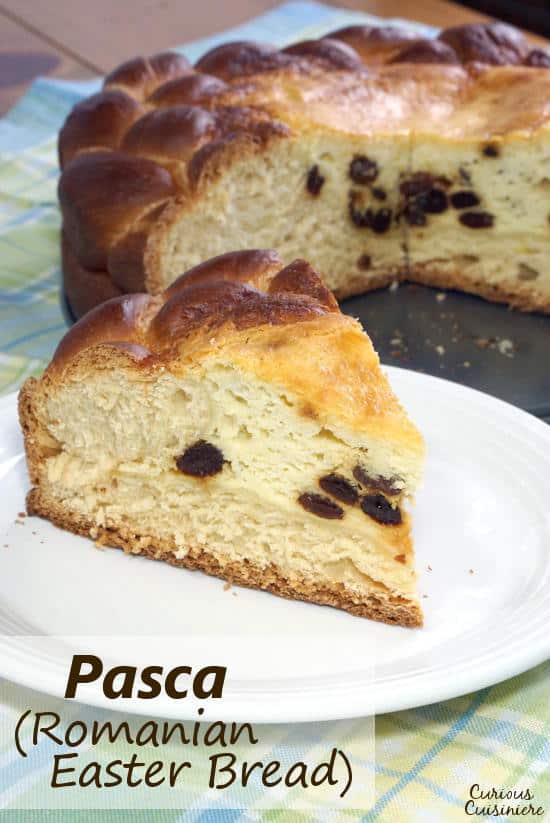 Romanian Easter bread: bread meets cheesecake
Many cultures have their own, traditional Easter breads, and Romania is no exception.
Theirs is called Pasca, after the term for Easter in the Eastern Orthodox faith.
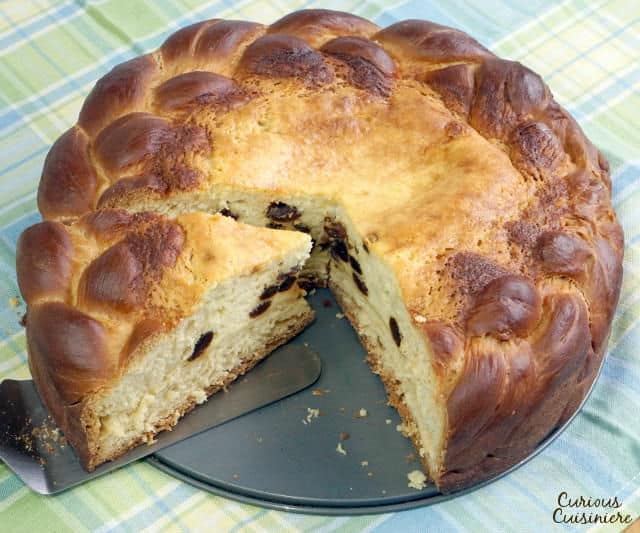
What makes Romanian Easter Bread unique from the Easter breads of other cultures is that it has a farmer's cheese, cheesecake-like filling that is studded with raisins. This filling blends in with the light and fluffy bread so that it is hard to tell where the cheese filing ends and the bread begins.
The base bread is another traditional Romanian celebration bread called cozonac. This bread has a flavor like a light Italian panettone, with the texture of Jewish challah.
It is traditional for Easter tables in Romania to have both loaves of the cheese-filled pasca and the fruit and nut studded cozonac.
What a celebration!
Easter cymbolism in Pasca
While cozonac is eaten during many Romanian celebrations, Easter calls for something special to be added to the bread.
As with most Easter breads, Romanian pasca carries religious symbolism. The white cheese filling that is added to the traditional cozonac dough symbolizes the risen Christ, as well as the Holy Spirit.
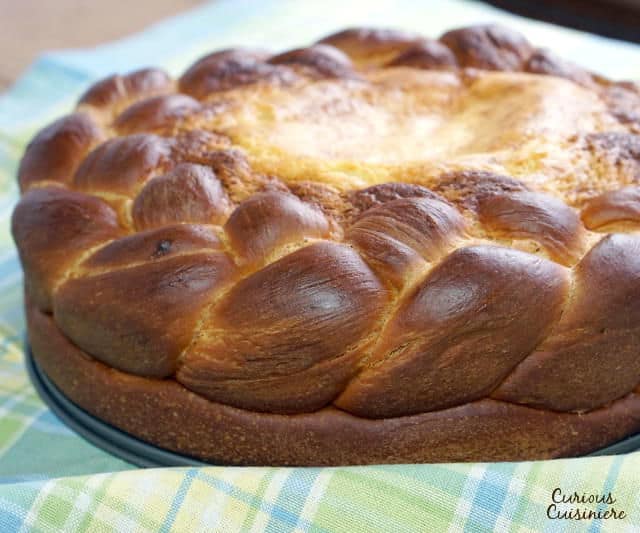
Making Romanian Easter bread
This bread does take a long time to make, but the good thing is, most of the time is waiting time.
So, pick a day when you have some things to do around the house to make the bread. (As a bonus, your house will smell amazing while the bread is baking.)
Starting with a "sponge"
This bread starts with a process called a sponge, where flour, sugar, liquid, and yeast are mixed together and then left for a while for the yeast to do its thing.
The sponge helps develop the flavor of the bread, so it is not a step that you want to skip.
Mixing the dough for Pasca
Once the sponge has set, you will see bubbles beginning to pop on the surface of the mixture. Now it is time to add the remaining ingredients to create the dough.
After mixing the ingredients together with most of the flour, the dough gets turned out onto the counter to be kneaded by hand. (You can also make this dough in the bowl of your stand mixer fitted with a dough hook, and it will take slightly less time.)
When finished kneading (by hand or with the mixer) the dough should be soft and smooth. It should be slightly tacky to the touch, but it shouldn't stick to your hands. (Although it might stick to the counter if you leave it in one place for too long.)
Now it's time to cover the dough and let it rise.
This bread gets quite a long rise time. Don't skimp on this, it's all a part of creating that authentic flavor and texture.
Shaping the bread
After rising, the dough is divided into two (roughly equal) portions.
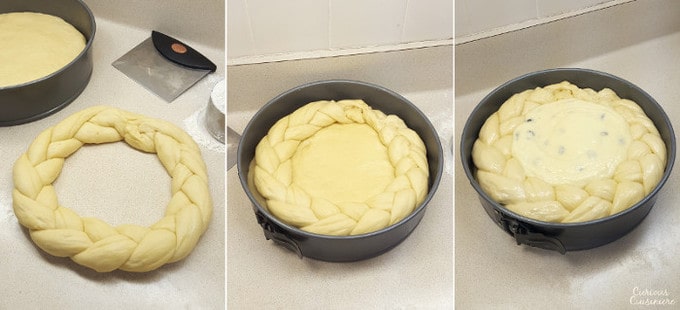
Half of the dough goes into the base of a buttered 9 ½ or 10 inch spring-form pan.
The remaining dough gets divided into three pieces which are rolled into ropes and braided.
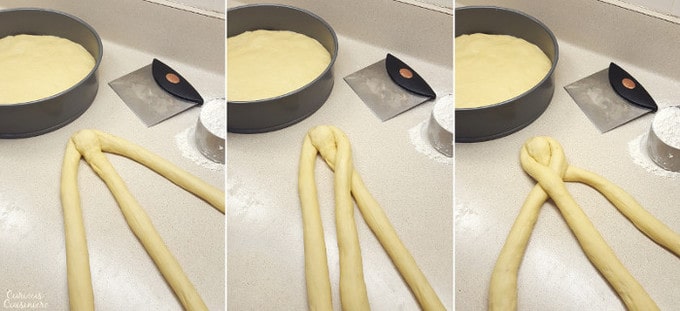
The braided dough is nestled around the outer edge of the spring-form pan, on top of the base layer of dough.
Then, the shaped dough is left to rise one final time, while we make the filling.
Filling and baking Pasca bread
After the bread has risen, is brushed with an egg wash and the sweetened ricotta cheese filling is poured into the center.
If you are used to baking cheesecake, you will be familiar with the way we bake this bread: hot at first, then low and steady through the end.
Finally, the bread is cooled in the oven (that has been turned off) to avoid drastic temperature changes that can affect the cheese center.
Our Pasca recipe
We love the fluffy bread and the sweet cheese filling of this pasca.
It's hard to tell where the soft bread starts and the cheese filling ends, until you take a bite and are greeted with the unmistakable sweet and smooth texture.
This is a stunning recipe that is definitely worthy of an Easter table!
More Easter bread recipes from around the world
Easter is a time for elegant and indulgent loaves of bread. It seems every culture has their own. Here are a few to try.
Pasca (Romanian Easter Bread)
Ingredients
For the Dough
- 4 -5 c unbleached all purpose flour
- ⅓ c sugar
- 1 c milk, warmed to 80F
- 2 teaspoon active dry yeast
- 3 eggs
- 2 TB butter, softened
- 1 teaspoon pure vanilla extract
- 1 teaspoon salt
For the Filling
- 6 oz ricotta cheese or farmer’s cheese
- ¼ cup sugar
- 2 eggs
- 1 tablespoon unbleached all purpose flour
- ¼ teaspoon pure vanilla extract
- Pinch salt
- ¼ c raisins
Instructions
For the Dough
- In a large bowl, mix together 1 ½ cup of flour, warm milk, sugar, and yeast. Cover the mixture and place it in a warm place for 25-30 minutes, until bubbly.
- Separate ONE of the eggs, placing the whites in a separate bowl and setting it aside. (We will use this later to brush the bread before it goes into the oven.)
- Once the flour and yeast mixture is nice and bubbly, mix in the 2 eggs and one egg yolk. Add 2 ½ c of flour, the soft butter, vanilla, and salt. Mix until the dough starts to come together. Then, turn the dough out onto a lightly floured surface and knead it until it is smooth and elastic, 8-10 minutes, adding only as much of the remaining 1 cup of flour as is necessary to keep it from sticking to your hands. (Alternately, you can mix the dough in the bowl of a stand mixer fitted with a dough hook for 2-3 minutes, until it is smooth and elastic, adding flour as necessary to keep it from sticking to the sides of the bowl.)
- Place the dough into a clean, well greased bowl and cover it with a damp tea towel. Let the dough rise in a warm, draft free place until it has roughly tripled in bulk, 2 hours.
- Once the dough has risen, turn it out onto a lightly floured surface and knead it a few times. Divide the dough in half.
- Press one half of the dough into the bottom of a well-buttered 9 ½ or 10 inch spring-form pan.
- Divide the other half of the dough into three even pieces and roll them into thin ropes, about 2 feet long. Press one end of each of the ropes together and braid the ropes gently. Arrange the braid into a ring, connecting the two ends. Stretch the braided ring gently and place it into the spring-form pan along the outside edge of the pan.
- Cover the spring-form pan with your damp tea towel and let the dough rise again in a warm, draft free place until doubled in bulk, roughly 30-40 minutes.
- Preheat the oven to 375F.
- While the dough is rising, make the cheese filling by beating all of the filling ingredients (except the raisins) together with an electric hand mixer, until smooth and pour-able. Gently stir in the raisins.
- In the small bowl with 1 reserved egg white, add 1 teaspoon water. Mix the egg whites and water together and brush the dough with the egg whites once it has risen.
- Then, pour the cheese filling into the middle of the braided circle. (Only pour enough in to fill the cavity, do not let it run over.)
- Bake the bread at 375F for 15 min. Reduce the heat to 325F and bake for an additional 40 minutes, until the bread is nice and golden and the center is set, but still jiggles slightly.
- Turn off the oven and let the bread cool in the oven for 1 hour with the door shut.
- After cooling 1 hour, remove the bread from the oven and serve or let cool completely on a wire rack before serving.

Sarah founded Curious in 2010 as a way to save her recipe creations and share culinary experiences. Her love for cultural cuisines was instilled early by her French Canadian Grandmother. Her experience in the kitchen and in recipe development comes from over 10 years working in professional kitchens. She has traveled extensively and enjoys bringing the flavors of her travels back to create easy-to-make recipes.

This sounds like a bread that my Busia used to make in a loaf without the cheese. It was so good she used to give it to us with sour cream slathered on top or with a thick topping if butter & white sugar.
Any idea to adjust cooking for that?
Hi Gail. You could definitely just bake this dough without the cheese. Braid it (or shape it however you will) and then bake at 375F. I would check it after 30 minutes. It may take longer, depending on the shape you have it in. To be sure it is cooked, you can use an insta-read thermometer and make sure it reaches 180F in the center. Enjoy!
I will certinally try this have made something similar, do you think you could use cottage cheese. Also made a recipe called hanklich, had a egg melted butter topping. when I mixed eggs and butter, both at equal temp. it curdled - do you know how I can repair before baking.
Hi Loretta. We have never tried to make this with cottage cheese, however it should work as long as you’re using very fine curd cottage cheese or blending it so it’s not chunky before using. If you give it a try, let us know how it turns out!
We are not familiar with hanklich. Not knowing the dish, and what the end goal is, I’m not sure that I can be of much help for how to repair it before baking.
Loretta, I’m not familiar with the butter & egg thing you spoke of but is it maybe made like blender hollandaise where egg yolks are whirled in the blender as melted butter is drizzled in thus cooking the egg yolks but remaining sauce like?
I want to convert the measurements to grams to use as I don't have cups, are the cups American measurements or English?
Hi Daniela. Thanks for your question. These are American cup measures. So, for liquid 1 cup is 263.5ml. 1 c of all purpose flour is 120g. 1 c of sugar is 200g. 1/4 c of raisins is 37.5g. Hope this helps. Enjoy!
The bread was SO dry. No one really liked it, and we do have yeast breads quite often in our family (dad was Romanian and mom is Yugoslavian). Not sure why it was so dry. Maybe shouldn't have left it in the oven for that last hour? I don't know, but I probably won't make it again.
Hi Loretta. We're sorry you had trouble with this bread. It is a tricky one because the bread likes high heat and the cheesecake likes low heat, so finding the perfect temperature combination is a bit tricky. If your oven was running a little hot, that could be why cooling it in the oven may have dried out the bread. If you do make it again, you could definitely try cooling it in the oven with the door cracked to reduce the temperature more quickly, or you could just remove it from the oven to cool on the counter. The cheesecake center may crack from the drastic change in temperature, but the bread would definitely not dry out. Thanks so much for trying the recipe and for letting us know how it turned out for you!
I plan to make the Easter Bread. Is this something I can made two days before Easter? Then do I place it in the refrigerator after is has cooled???
Hi Mary. I would personally suggest making it one day before, because it will be more fresh. Store it in the refrigerator, loosely covered, overnight. Then, let it come to room temperature on the counter before serving. Enjoy!
Thank you for a great recipe. I haven't tasted it yet but I'll be cutting into it tomorrow. 🙂
We're glad you enjoyed the bread!
Looking to make Paska (Easter Bread) for Easter tommrow.
We hope you enjoy it Sharon. Happy Easter!