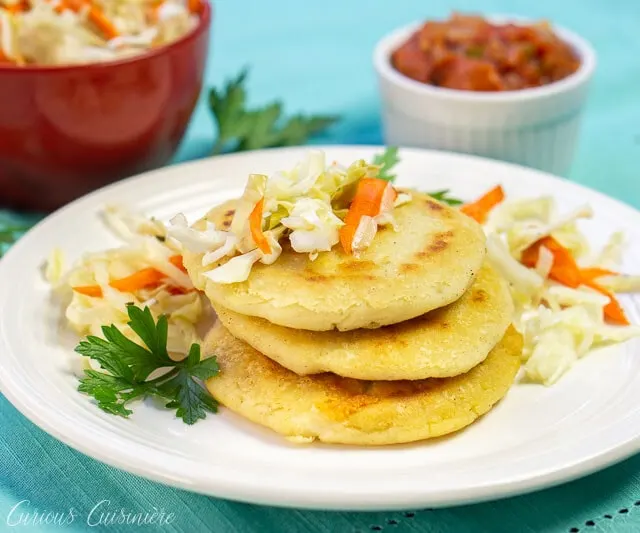
Crispy on the outside, soft and cheesy on the inside, homemade pupusas de queso are stuffed tortillas or filled corn cakes that are widely popular in El Salvador and Honduras.
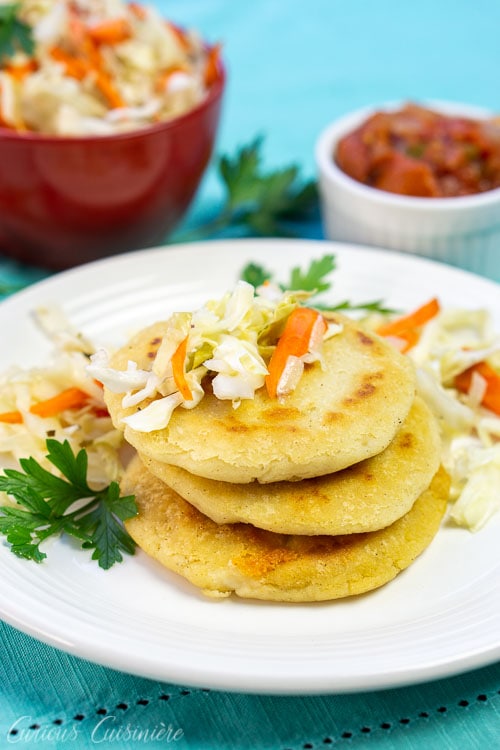
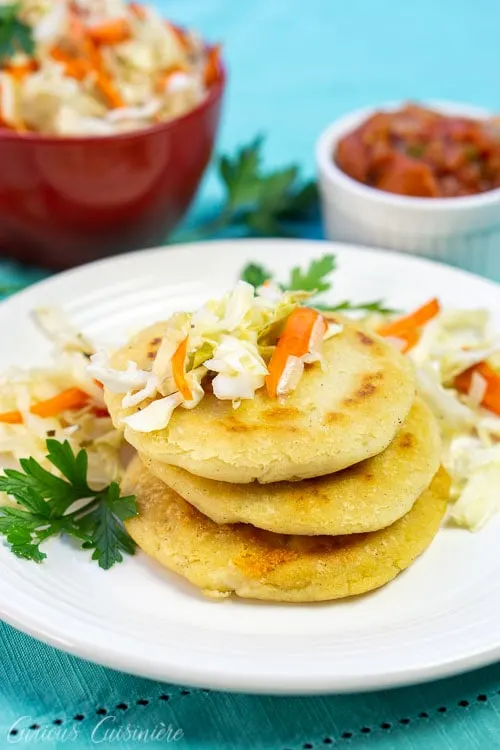
What Are Pupusas?
Pupusas are the National dish of El Salvador. These thick, corn tortillas are stuffed with various fillings, similar to Venezuelan arepas and Mexican gorditas.
Pupusas originated in El Salvador and the western part of Honduras, possibly as long as 2,000 years ago.
How Are Pupusas Different From Arepas?
While similar in general concept, pupusas are different from arepas in many ways.
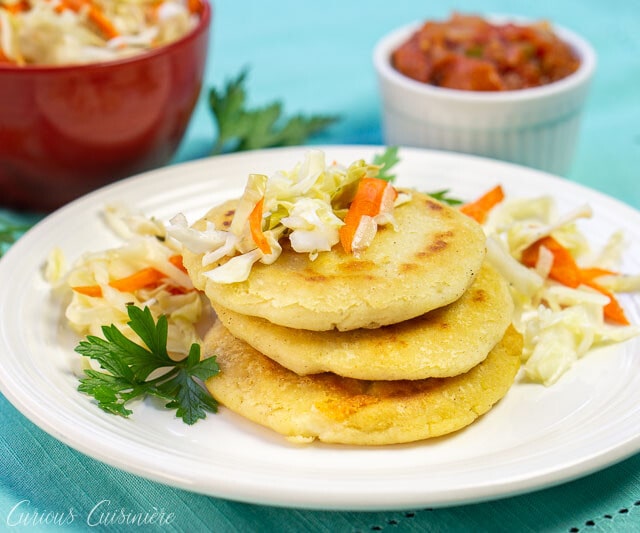
Pupusas tend to be larger and flatter than arepas. Typically pupusas are more like a very thick corn tortilla.
(Some of ours came out a bit thicker than we expected. So, don’t be disappointed if your first few tries aren’t quite as thin as you have found if you’ve eaten them before.)
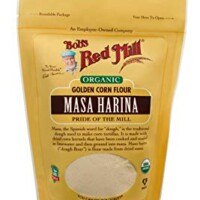
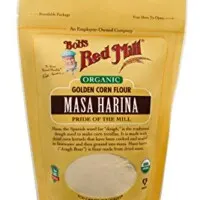
Pupusas are also different from arepas in that they use masa harina, while arepas most often use a slightly different corn flour called masarepa.
Masa harina is the more easily found of the two corn flours, and also the same flour you would use if making your own corn tortillas, tamales, or atole.
Arepas are also typically sliced through the side and stuffed with a filling after cooking. Pupusas, on the other hand, are stuffed before filling. Which is why pupuasa are most like a thick, stuffed corn tortilla.
What Are Some Fillings For Pupusas?
We were first introduced to pupusas by a reader from Honduras who was sharing some information about her country’s cuisine with us. She said that although pupusas are El Salvadorian in origin, they are widely loved in Honduras as well.
Most commonly, pupusas are filled with cheese (as in the pupusas de queso recipe we are sharing today) . But they can be also filled with meat or beans, or a combination of the three.
The cheese that is most commonly used is a soft, fresh cheese called quesillo. Our Honduran reader said that Jack cheese makes a good substitute for this traditional cheese.
(And if you love the idea of cheese-filled pockets, you have to check out these Brazilian cheese pastries.)
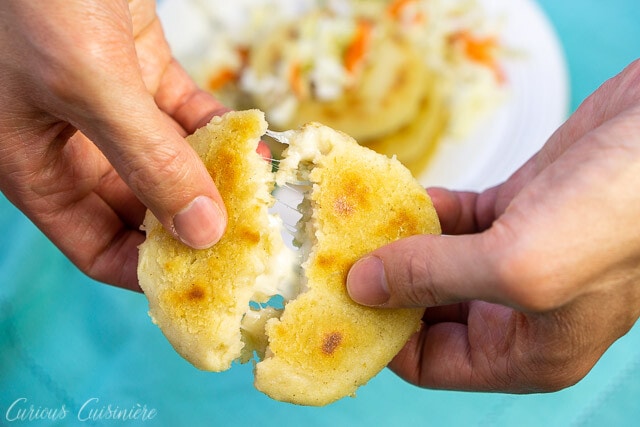
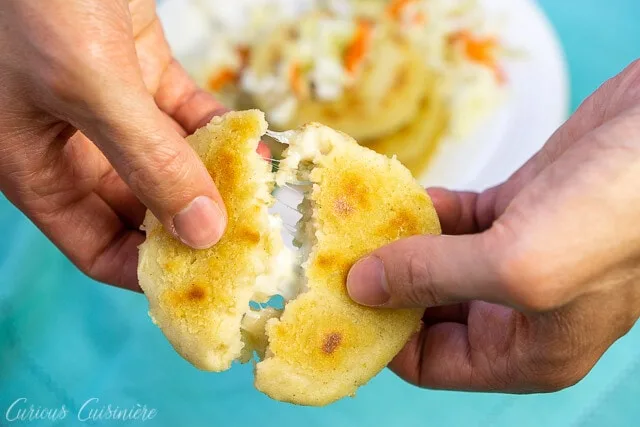
Chicharrones (ground pork rinds) or refried beans are also very common fillings. However, you can also find different regional fillings using local ingredients. (Like loroco flowers that are a common filling along the border of Honduras and El Salvador.)
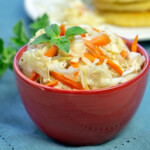
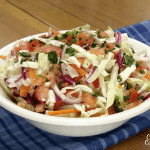
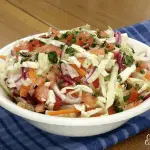
They are typically served with a pickled cabbage slaw called Curtido. (Think of it like a tangy, vinegar-based, oregano-infused coleslaw.)
How To Make Our Recipe for Pupusas De Queso
Making pupusas starts off very similar to making a classic corn tortilla. You are, after all, making a corn tortilla that is going to be wrapped around your filling.
First mix, masa harina, salt, and hot water together to form a fluffy dough.
Once you have your dough, however is when the process changes from making traditional tortillas.
Rather than rolling your dough into a ball and pressing it flat on a tortilla press, for pupusas, you roll your dough into a ball and make an indentation in the middle with your thumbs.
This is where the cheese (or other filling) goes.
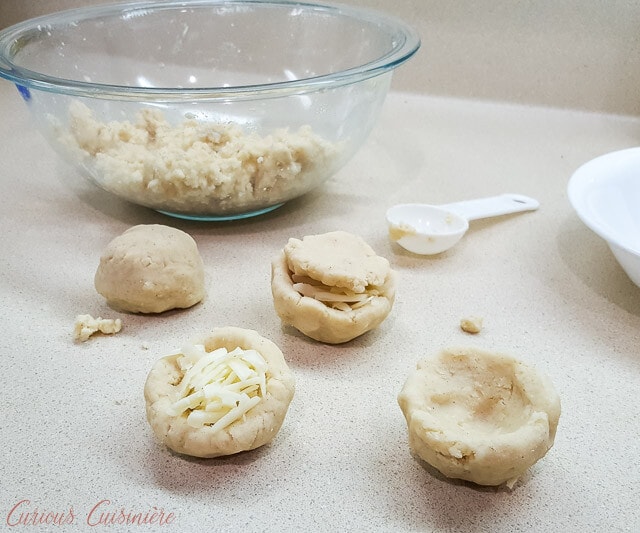
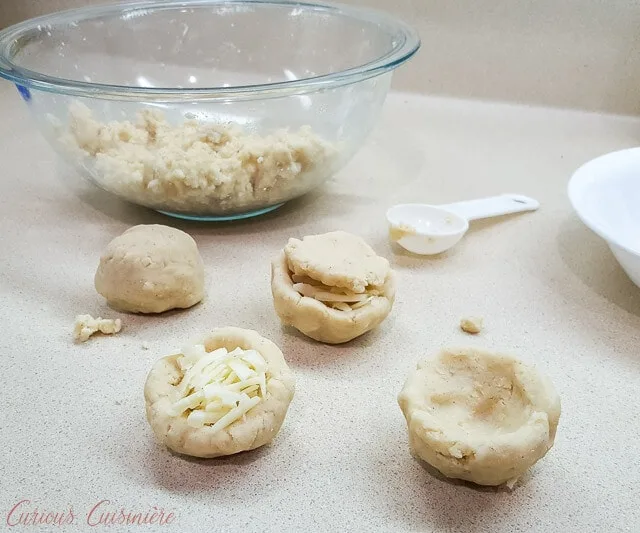
After filling, you pinch a little extra dough to cover your filling, pinching the dough together to make sure the filling is sealed in.
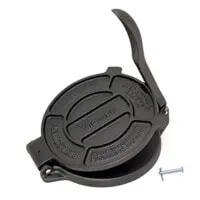
Then, you press the filled masa ball as flat as you can while still keeping the filling tightly sealed inside your masa dough. (Some people will even use a tortilla press at this point to get it quite flat.)
How To Cook Pupusas
Pupusas are often served as a street food, in which case they are fried on a griddle with oil. In homes or restaurants it is common to use less oil to fry the pupusas. Although, some is still needed, or else the masa will crack and the pupusas won’t have their characteristic crispy exterior.
How To Serve Pupusas
In El Salvador, pupusas are commonly served topped with a crunchy, pickled cabbage slaw called Curdito and sometimes a mild red salsa (salsa roja).
In Honduras, pupusas aren’t typically eaten with any toppings and they are often eaten as a mid-morning stack.
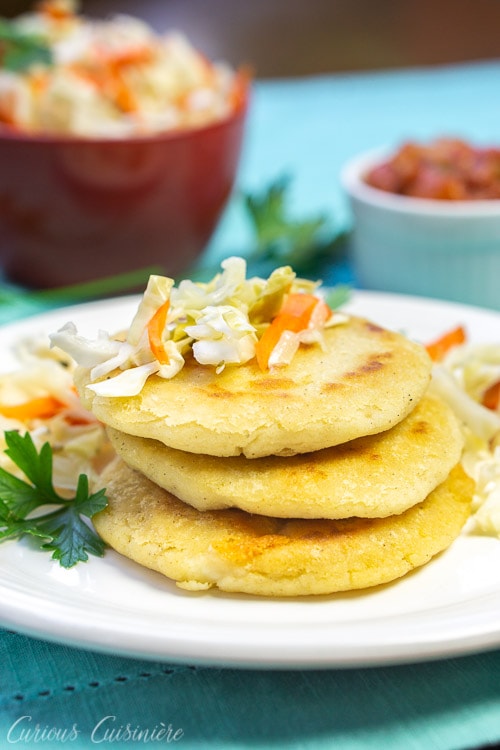
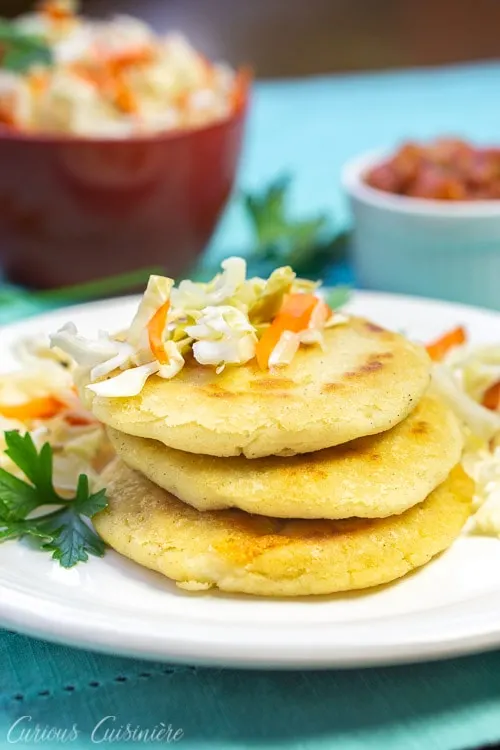
Pupusas de Queso (El Salvadoran Cheese Stuffed Tortillas)
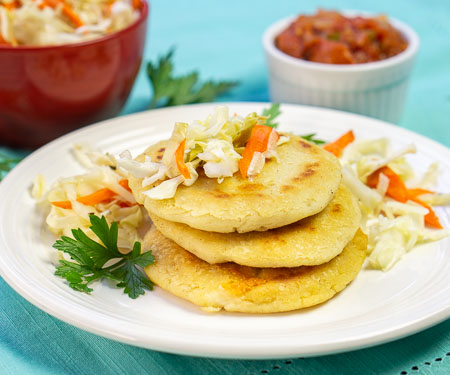
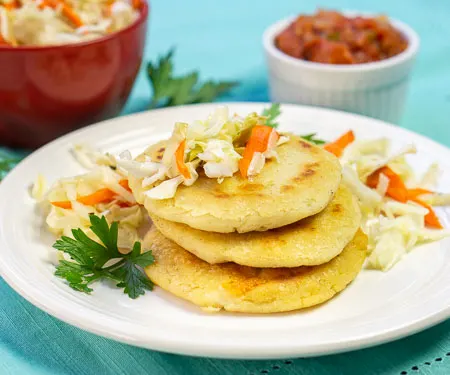
Crispy on the outside, soft and cheesy on the inside, homemade pupusas are stuffed tortillas or filled corn cakes that are widely popular in El Salvador and Honduras.
Ingredients
For The Dough
- 2 c masa harina
- 1 ½ tsp salt
- 1 ½ - 1 ¾ c hot water
For The Filling
- 1 c shredded jack cheese
- Oil for cooking
Instructions
- Mix masa harina and salt in a bowl. Add the hot water, starting with 1 1/2 cups and mix until all the masa is moistened and a fluffy dough forms. (Add more water if necessary.) Cover and let stand for 15 minutes.
- Dip your hands into some water to keep the dough from sticking to your hands (and to help hydrate the dough if it crumbles as you shape it, meaning it’s too dry). Pinch off about a golf ball size (roughly 2 Tbsp) of dough and shape into a ball. Form an indentation in the dough ball with your thumbs. Place about 2-3 tsp of cheese into the hole. Pinch a little more dough as needed to cover the hole and seal the filling in the dough ball.
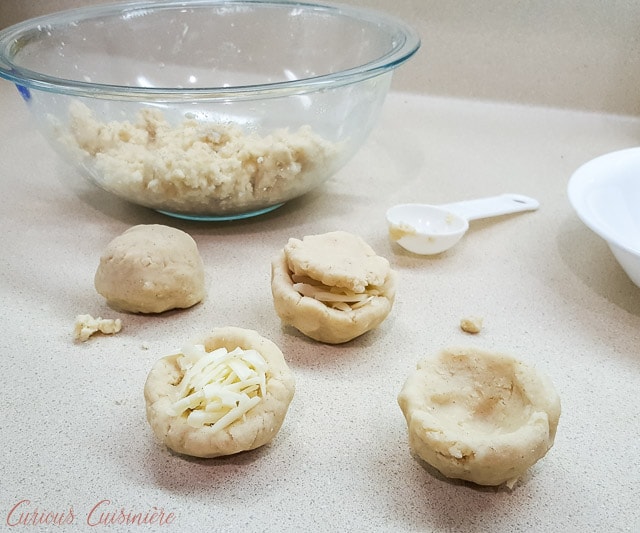
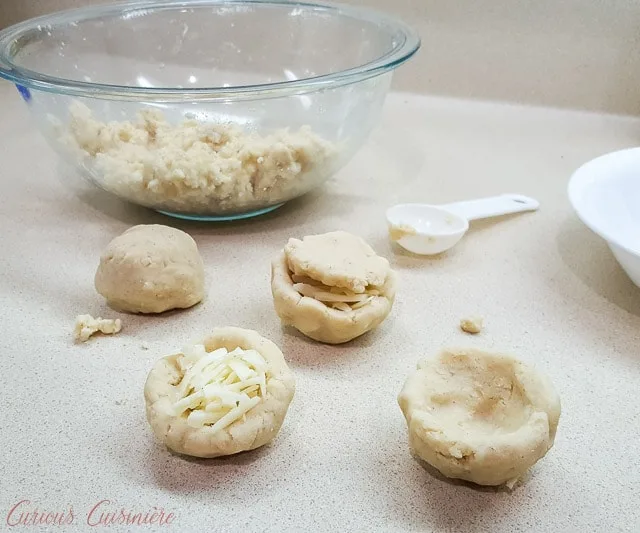
- Repeat with the remaining dough, keeping already filled masa balls under a damp tea towel while you work.
- Preheat a skillet or griddle to medium heat and add a little oil.
- Press a filled dough ball flat with your hands, so it looks like a thick tortilla (about ½ inch thick, 3 or so inches in diameter). (Alternately, you can use a tortilla press to flatten the tortillas.)
- Place your shaped pupusa on the hot griddle and cook until lightly golden, roughly 3 minutes per side.
- Repeat with the remaining pupusas, adding more oil to the skillet as needed to keep the crust nice and evenly golden.
- Serve hot by themselves or with curtido slaw and/or a red salsa.
Notes
Pupusas are best served immediately after making, while they are still hot and crispy. If you have leftovers, store them in a sealed container in the refrigerator and reheat in a toaster oven until crispy and heated through.
Recommended Products
As an Amazon Associate and member of other affiliate programs, We earn from qualifying purchases.

Nutrition Information:
Yield:
5Serving Size:
2 pupusasAmount Per Serving: Calories: 289
If you liked this recipe, here are some similar dishes you may enjoy!


Sarah founded Curious in 2010 as a way to save her recipe creations and share culinary experiences. Her love for cultural cuisines was instilled early by her French Canadian Grandmother. Her experience in the kitchen and in recipe development comes from over 10 years working in professional kitchens. She has traveled extensively and enjoys bringing the flavors of her travels back to create easy-to-make recipes.
Alicia Colindres
Wednesday 13th of July 2022
Salvadorean pupusas ARE NOT FRIED May be in Honduras they do fried them
Sarah Ozimek
Monday 18th of July 2022
Hi Alicia. If you read through our recipe you will see that neither are these deep-fried, we use a bit of oil to grease the pan and get better color on the pupusas. How do you make yours? Are they are baked or dry-pan fried with no oil at all? Thanks for clarifying.
Niña Meli
Monday 11th of July 2022
I've lived in El Salvador for a few years now. Pupusas are an art form. In your description you left out two pretty important details. First, rice flour is pretty popular to use instead of corn. Second, It's somewhat offensive to eat these with a fork and knife. FINGERS ONLY! Pupusarias always have a hand washing station for clients even if no bathroom exists bc eating with your fingers is essential. It's also amazing to pair this with instant coffee in the morning or a real hot chocolate drink that is made with water and not milk. There is also a special cheese and depending on your pocket book you use different grades of it. It's called quesillo. Although Salvadoran pupusas are the best, Nicaragua has one of the highest qualities of the quesillo. A few years back El Salvador was buying so much that a special report went out saying that they used formaldehyde in it trying to get the people to stop buying so much of it. Of course no one could prove this and we all Continued to use Nicaraguan quesillo!
Sarah Ozimek
Monday 18th of July 2022
Thanks for sharing Niña!
The Barber
Monday 11th of July 2022
Correction to your description of our Salvadorean pupusas. The pupusas became large when they crossed the US border. I am guessing mid 80's and through years got even larger for competition. Original street vendor pupusas all were the size of street Mexican tacos. That is a fact. I am 54yo I came to us at age 10.
Sarah Ozimek
Monday 18th of July 2022
Thanks for sharing. We are simply stating that they are often larger than arepas. Would you agree?
Marta lainez
Sunday 20th of December 2020
Hi I'm from El Salvador my beautiful country. We enjoyed pupusas for breakfast and dinner with famous Curtido making with cabbage an onion vinegar oregano and carrot as well. Delicious especial /spinach an carrot with cheese . Thanks for included my tipical food in your recipes. Marta.
Sarah Ozimek
Monday 21st of December 2020
Thanks for sharing Marta!
Teresa holland
Sunday 23rd of February 2020
I made these with my granddaughters six and three they are vegetarians from birth loved it easy to do and tasty to boot
Sarah Ozimek
Monday 24th of February 2020
So glad you all enjoyed the pupusas!