Traditional Italian Giardiniera for Canning
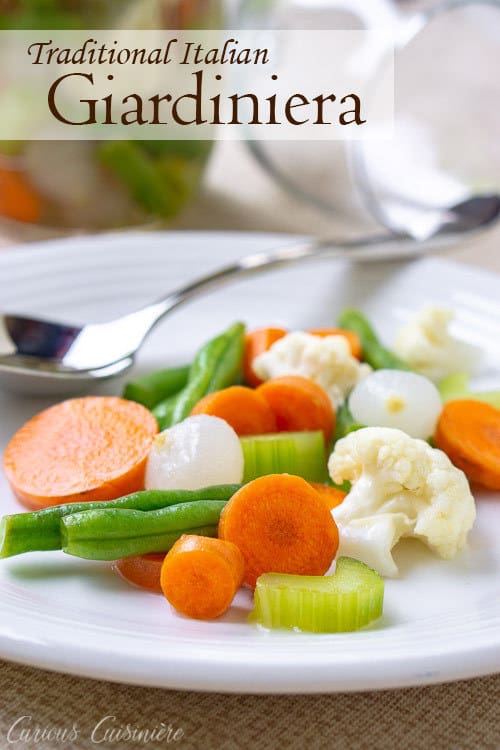
Traditional Italian Giardiniera is full of large chunks of pickled vegetables and is served as an antipasto or appetizer. This recipe for canning giardiniera uses no oil, so it is the perfect way to preserve your summer produce.
 What Is Giardiniera?
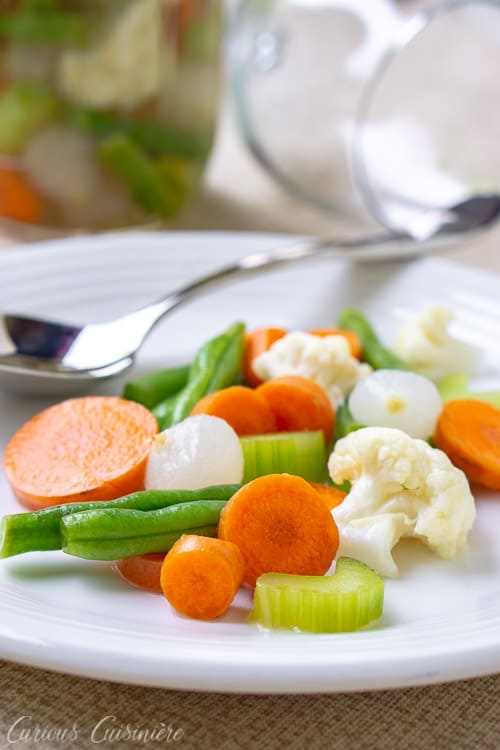
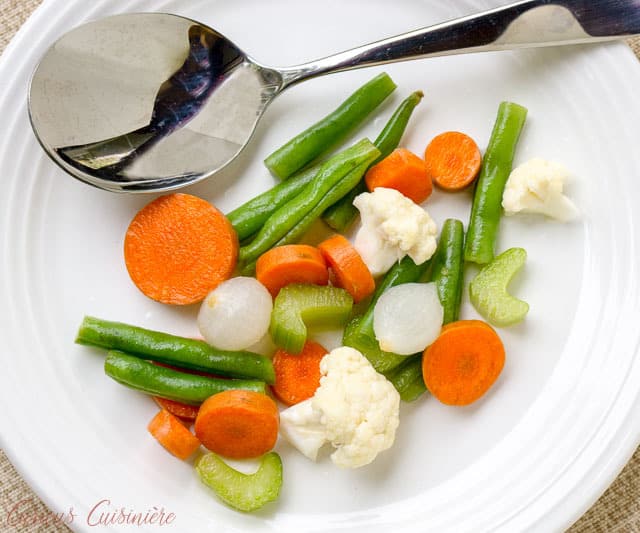
Giardiniera (pronounced JAR-di-NAIR-ah) is a traditional Italian antipasto dish made up of pickled vegetables.
It's also a traditional Italian way to preserve summer produce so that it can be enjoyed all winter long.
What Is In Giardiniera?
Since the main goal of giardiniera is to preserve the summer harvest, it is common to find quite an array of vegetables used.
It's quite simply whatever you happen to have an abundance of!
Often in giardiniera you will find vegetables like:
- green beans
- cauliflower
- carrots
- sweet peppers
- small onions
It's not uncommon to also find:
- zucchini
- eggplant
- summer squash
- celery
- other beans
- brussels sprouts
- artichokes
Many Variations Of Giardiniera
There is a wide range of ways to make giardiniera, depending on what region (or country) you're in.
Some regions in Italy will make a giardiniera with smaller vegetable pieces. And some regions will also add olive oil to the marinade for the vegetables.
In the States, Chicago, Illinois is the main hub for giardiniera. There, they use a finely diced giardiniera as a condiment.
How To Make Giardiniera For Canning
For our giardiniera recipe for canning, there is one important adjustment we have to make from other giardiniera recipes.
Oil.
When canning, you can't use oil.
So a giardiniera recipe for canning needs to be simply pickled vegetables in vinegar and seasonings, rather than a marinated vegetable in a mixture of oil and vinegar.
We're not straying far from the traditional version though, because that is how they make their giardiniera in Northern Italy. They just used vinegar, like this recipe below. (This is in contrast to Sicily, where it is more common to use some oil in the marinade.)
What Is Italian Antipasto?
Antipasto is Italian for "before food". So, it is the course that comes before the main meal is served.
You could also call them an appetizer or hors d'oeuvres.
Antipasto can be cooked or raw. It could be an arrangement of meats and cheeses, bruschetta, olives, giardiniera, or other dishes.
Often, multiple antipasto dishes are served together on the same large platter. (Then you have antipasti, the plural of antipasto.) Antipasti are put together to create a complementary arrangement of flavors and textures. And, they are also chosen to prepare your palate for the meal to come.
How to Serve Giardiniera
As an antipasto, it is common to serve giardiniera along side of a salumi platter, or with cheese, olives, and/or bread.
Before you start canning, be sure to check our Canning Basics article for a refresher on the process. For additional resources, here is the USDA safe canning guide from the National Center for Home Food Preservation.
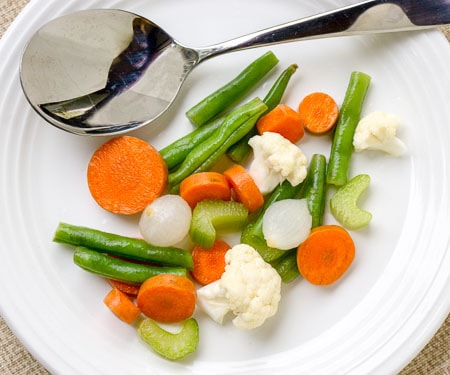
Traditional Italian Giardiniera for Canning
Yield 4 c (1 quart)*
Ingredients
Day 1
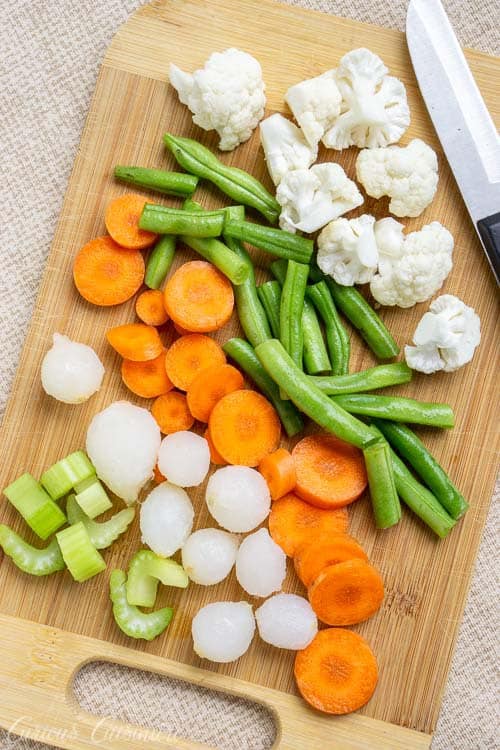
- 1 c pearl onions or small onions, quartered
- 1 c green beans, cut into 1 inch pieces
- 1 c cauliflower, cut into bite-sized pieces
- 1 c carrots, cut into rounds
- ½ c celery, sliced
- 2 ½ c water
- ¼ c salt
Day 2
- 4 c white vinegar
- 1 tablespoon sugar
- ¼ teaspoon whole peppercorn
- 2 bay leaves
- 2 whole cloves
Instructions
Day 1
- Chop all of your vegetables into bite-sized pieces and place them in a large bowl.
- In a liquid measuring cup, mix together 2 ½ c water with ¼ c salt, until the salt has dissolved.
- Pour the salt water over the vegetables, to cover. (If the water doesn’t completely cover the vegetables, make another batch of salt water, as needed.)
- Set the vegetables aside to rest in the salt water bath for 12 hours or overnight.
Day 2
- Drain and rinse the vegetables.
- In a large soup pot, mix the vinegar, sugar, peppercorn, bay leaves, and whole cloves. Bring the mixture to a boil.
- Add the drained and rinsed vegetables and bring everything to boil.
- After coming to a boil, scoop the vegetables into clean, warm canning jars.**
- Ladle the hot liquid over the vegetables in the jars, leaving ½ inch of head space.
- Cover the jars with clean lids, placing the seal around the lip of the jar. Tighten the bands over top of the lids.
- Process the jars in a boiling water bath for 10 min for pint jars or 15 minutes for quart jars.
- Remove the jars from the water canner and set on a cooling rack to cool completely.
- Once cool, remove the bands and test the seals on the lids of the jars. Any jars that did not seal should be refrigerated and used within 1-2 months.
- Wipe off the jars that have sealed properly and finger tighten the bands on them.
- Store in a cool, dry place for 1 year.
Notes

Sarah founded Curious in 2010 as a way to save her recipe creations and share culinary experiences. Her love for cultural cuisines was instilled early by her French Canadian Grandmother. Her experience in the kitchen and in recipe development comes from over 10 years working in professional kitchens. She has traveled extensively and enjoys bringing the flavors of her travels back to create easy-to-make recipes.

Hi Sorry and also should it be in the fridge for the 12 hours.?
If your kitchen in cool, you should be able to leave them out, covered. If it is warm, I would refrigerate them.
Do you pick out the bayleaves and cloves befor you put the veggies in the jars ?
Hi Mike. You don't have to. They will continue to add flavor as the jars set. It's really a matter of personal preference.
What about the pearl onions. Should I use raw, boiled, blanched, frozen or pickled onions? If I use raw onions, how do I prepare them for canning in this recipe?
Hi Richard. You can use raw or frozen (and thawed) pearl onions. If you want less onion flavor, you could go with boiled or blanched. You can use the raw onions as-is in this recipe, just make sure they are clean and free from any roots or papery layers.
So in the recipe when it calls for cloves that's not garlic cloves, its the spice clove correct?
That is correct.
Hi, I am in the process of making this, it is Day 1. My concern is for Day 2, that it is totally vinegar, no water? Just want to make sure before Day 2 comes.
Yes, you are using all vinegar for Day 2.
My mother used brown vinegar diluted I believe and I would like to replicate that any comments would be much appreciated
We haven't seen a recipe like that, but maybe one of our readers can comment!
Two things.
Can I throw a couple of chopped garlic cloves in there?
Any reason that I can't pressure can?
oh, three....
Giardiniera without peppers just seems .... unnatural. 🙂
Hi Paul. Yes, you could throw some garlic in there and there’s no reason you couldn’t pressure can it. (You could always swap a little of one of the vegetables for peppers, if you desire. 🙂 ) Enjoy!
Great flavor.
My veggies did not hold their crisp.
A bit soft. For my taste. It this correct or did I do something wrong. ?
Let me know what you think.
I respect your opinions.
Hi Rise. How long did you store your vegetables before eating? The storage time may effect their crispness.
@Sarah Ozimek, it was because this recipe calls for boiling the vegetables. I would pour the hot vinegar over the vegetables in the jar add 1/4 tsp of Mrs wages extra crisp. Then do your canning jar boil
Thank you for your suggestions Roger. We typically don't have any issue with the vegetables losing their crisp with just a quick blanch. But, possibly the other reader boiled them for too long.