Pizza Gain (Italian Easter Pizza)
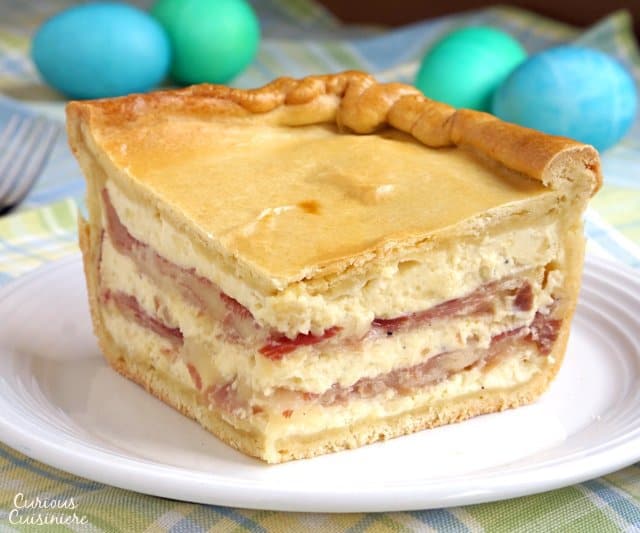
Pizza Gain (also known as Pizzagaina, Pizza Rustica, or Pizza Chiena) is an Italian Easter Pizza that is unlike any pizza you have ever tasted. Forget the tomato sauce, this filled pizza is more like a cheese and salami pie with a pizza crust. With beautiful layers, this impressive pie is the perfect dish for Easter brunch!
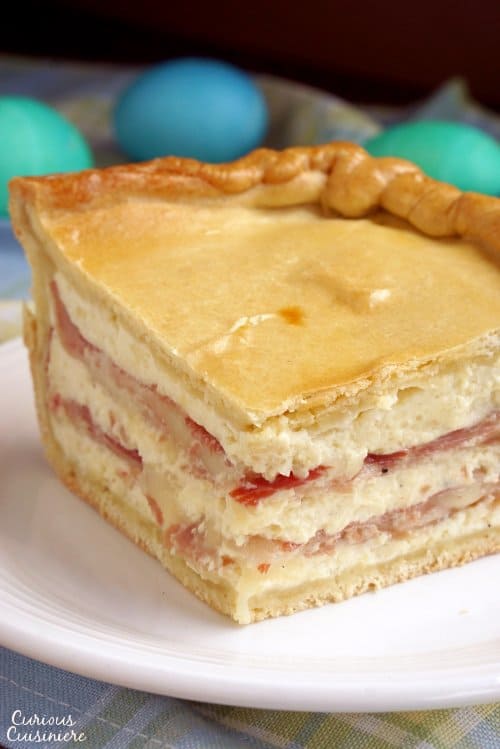 Italian Easter Pizza: A Pie With many Names
Pizza in Italian simply means pie.
We'll let that sink in a moment.
That's why this pizza probably looks so un-like any pizza you've come across.
While un-familiar to non-Italians, this Easter pizza is widely popular across Italy. It's so popular that this celebratory dish really doesn't have a name.
Rather, it has many names, all meaning the same thing.
The History Of Italian Easter Pie
This Italian Easter pizza comes from Naples and can trace its history back to the 17th century.
During this period, it was a staple Easter treat. After fasting for 40 days from dairy and eggs, this was the perfect, indulgent dish to break the Lenten fast.
In and around Naples, the dish is known as pizza rustica, pizza ripiena, or pizza chiena. The different spellings and names come from the different dialects in Italian but they all mean the same thing: "stuffed pizza".
And stuffed is what this pizza is.
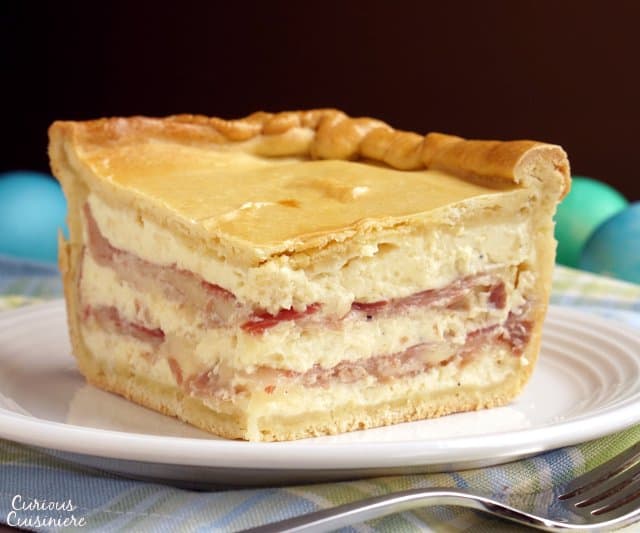
Since the begining, pizza rustica has been built out of layers of cured meats, fresh salami, and traditional Italian cheeses.
All "stuffed" into a sturdy pizza crust.
Pizza Rustica Comes To The States
When Neapolitans and other Southern Italians immigrated to America, they brought their recipes with them.
It was in America that pizza rustica took on a new name: pizza gain (or pizzagaina).
In America, it was difficult to get many of the specialty ingredients that the Italians were used to using to make their pizza rustica, so they improvised.
Traditional Italian salamis and cured meats were replaced with ham and pepperoni, and more easily accessible cheeses were used to get those nice, cheesy layers.
Pizza Gain Today
What this means for us is that pizza rustica (or pizza gain) is more of a concept than a set in stone recipe.
If you can't find a particular meat, substitute something you can find.
If you can't locate the cheese it calls for, use what you have on hand.
The idea is to create a beautiful creation of layers that fills the soul with rejoicing that the Lenten fast is over and Easter has come.
What Cheese Is Traditionally Used In Pizza Rustica?
One traditional ingredient you will find in every traditional recipe for pizza rustica is something called "basket cheese".
Basket cheese is a fresh cow's milk cheese that is pressed in baskets as it drains. After it is pressed, it keeps the basket's imprint, giving it its name.
Unless you live near a good Italian deli or grocer in the States you probably won't be able to find basket cheese. (And even if you do, it might only make an appearance for a few weeks before Easter.)
But, don't worry if you don't have the in on this special Italian cheese.
A good substitute for basket cheese is Greek feta or a ricotta salata (salted ricotta).
These cheeses add a nice softness and flavor to the pizza rustica.
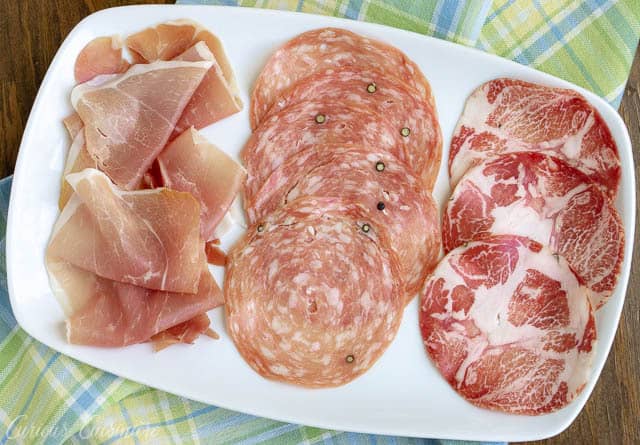
Cured Italian Meats In Pizzagaina
Layered with the cheese mixture are a collection of traditional Italian cured meats. Some of the traditional meats you've probably heard of before, like prosciutto. But many you may be unfamiliar with.
- Prosciutto - Dry cured ham that originates from Parma, Italy. Prosciutto is sliced thin and has a buttery texture, with a slightly salty flavor. Serrano ham is a good substitute, but any thinly-sliced, salty deli ham will do.
- Soppressata - An Italian dry, pork salami, soppressata is often peppered, although seasonings can vary. The texture and flavor is similar to deli hard salami (particularly a peppered hard salami), which works great as a substitute.
- Capicola - Dry cured, spiced and smoked pork neck that some consider a cross between prosciutto and sausage. Capicola has a flavor and texture similar to prosciutto, but it's meatier and less salty. Prosciutto or thinly-sliced, smoked deli ham would be a good substitute.
- Mortadella - While not a cured meat, some recipes for pizza rustica use mortadella. This is a large, unsmoked, Italian sausage or lunch meat, often referred to as "Italian bologna". With its pink hue and smooth texture, bologna or olive loaf would make a good substitute.
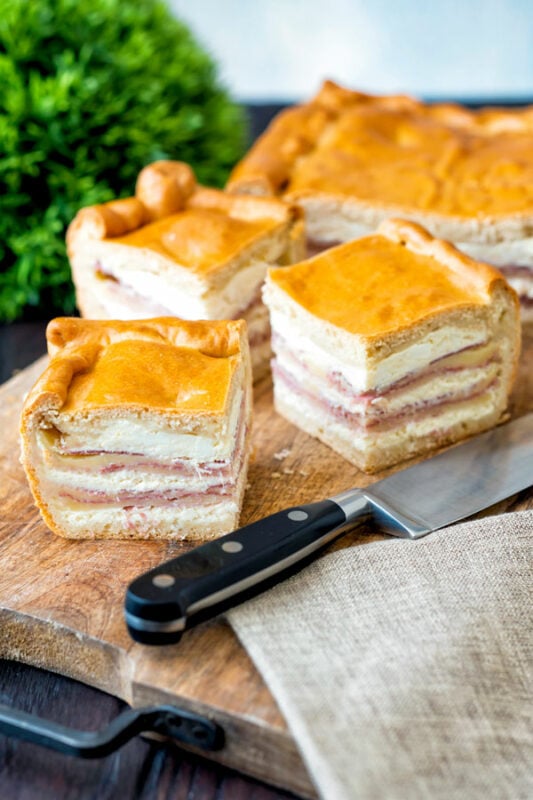
If you don't live near a good Italian deli, you might have difficulty finding some (or all) of these meats. We've listed some economical substitutes above, so don't be afraid to substitute for meats you can find easily.
As we touched on earlier, pizza gain is more of a concept than a set-in-stone recipe. Each region in Italy (and each family) makes their Easter pizza differently, according to what they have locally available to them.
So, have some fun experimenting with the combination of meats and cheeses that sounds good to you!
How To Make Pizza Rustica
The process to making this impressive pie is relatively simple.
The dough is slightly stiff, but it comes together fairly easily.
While the dough rests, the cheese mixture is easily mixed together.
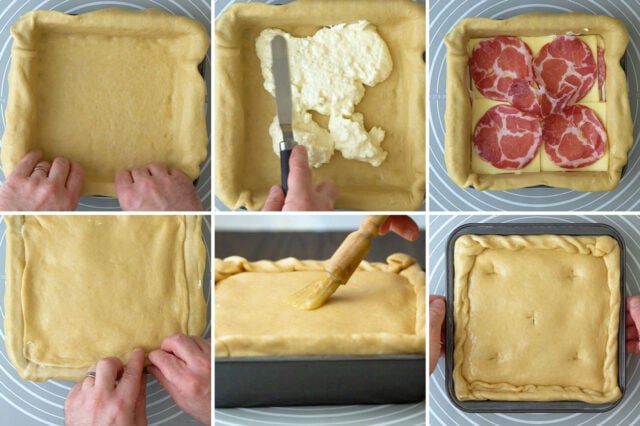
Once the dough has rested, it is divided into two pieces: roughly ⅔ and ⅓ of the total dough. Your larger section will become your bottom crust, and your smaller section will become your top crust. The dough takes a little patience to roll out, because it has a bit of a spring. If you have too much trouble, cover the dough with a damp tea towel and let it rest for 5 minutes before continuing rolling.
After rolling, when your bottom crust is in the baking dish, it's time to layer the cheese mixture, meat slices, and more cheese!
Really, the hardest part of making pizza rustica is trying not to sample all of the sausages and cheeses as they go into their respective layers.
"A little for the pie... A little for me..."
Here's a tip, you might want to buy more meat and cheese than you need, so you can have a snack while you're constructing your pie.
Just sayin'.
After layering, the whole pie is baked for one hour in order to get the crust nice and golden and the insides hot and bubbly.
Our Italian Easter Pizza Gain Recipe
For our pizza gain, we thought we were going to have to do some serious substitutions on the meats, but imagine our surprise when we found that our Aldi grocery store had prosciutto, capicola, and soppressata sitting right next to their sliced sandwich cheeses.
We were super excited!
Sadly, the basket cheese was another story.
So, instead of basket cheese we used feta. And, we can honestly say that the results were delicious!
We baked our pie in a standard 8x8 baking dish, and it was plenty to serve 8 people.
The crust is so sturdy that with a well-greased dish, the pie just popped out after cooling. So, if we had wanted to present it free-standing, we could have.
If you're feeding a crowd, the recipe below could easily be doubled to fill a 9x13 baking dish, or a 10 inch springform pan, if you want to get really fancy and deep-dish pizza-like.

How To Serve Pizza Gain
With all the cheese inside of a pizza gain, it is necessary to let the pie rest for 20-30 minutes before serving. This way, the cheese will set and the slices will hold together nicely as you distribute them.
Since this dish is typically eaten for Easter brunch or as an Easter appetizer, it is often made ahead, to ease the Easter-day oven load.
If making your pizza gain ahead of time, be sure it is completely cool before covering and refrigerating it.
To serve, it can be warmed in a low oven (300F) for 30 minutes, if you'd like to serve it warm. (Tent the pizza loosely with aluminum foil to keep the top crust from darkening too much.)
Pizza gain is delicious warm or cold, so don't be afraid to serve your made-ahead pizza gain chilled as an appetizer, an entree for Easter brunch, or even as a light lunch.
(And, if you're looking to complete your Italian Easter menu, check out more of our Italian recipes and specifically our collection of Italian Easter recipes.)
Pizza Gain AKA Pizza Rustica (Italian Easter Pizza)
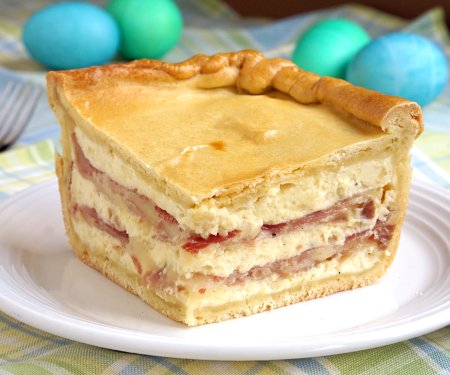
Pizza Gain (also known as Pizzagaina, Pizza Rustica, or Pizza Chiena) is an Italian Easter Pizza that is unlike any pizza you have ever tasted.
(Recipe is scaled for an 8x8 baking dish, but can be doubled to fill a 9x13 or 10“ springform with 2.5-3” sides)
Ingredients
For The Dough
- 3 c unbleached all-purpose flour
- ½ teaspoon salt
- 2 teaspoon baking powder
- 2 eggs, lightly beaten
- ¼ c olive oil
- ½ c water (plus more as needed)
For The Ricotta Filling
- 1 lb ricotta
- ½ lb feta cheese, (patted dry, if moist), crumbled
- ¼ c grated Pecorino Romano cheese
- 3 eggs
- ⅛ teaspoon ground black pepper
Putting It All Together
- 3 oz prosciutto, thinly sliced
- 3 oz soppressata, thinly sliced *
- 3 oz capicola, thinly sliced (or mortadella) *
- 6 oz mozzarella cheese, sliced
- 4 oz provolone cheese, sliced
- 1 egg beaten with 1 teaspoon water, (for the egg wash)
Instructions
For The Dough,
- In a medium bowl, combine the flour, salt, and baking powder.
- Add the eggs and oil. Mix by hand until evenly distributed.
- Add the water and mix with your hands (adding more water, 1 tablespoon at a time, as necessary) until the dough comes together.
- Cover the dough and let it rest while you prepare the filling.
For The Ricotta Filling
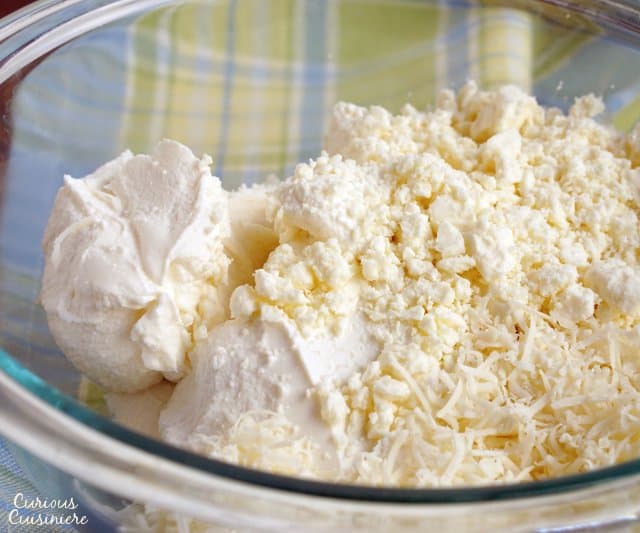
- In a medium bowl, add the ricotta, crumbled feta, grated Romano, eggs, and pepper. Mix until smooth and even.
Putting It All Together
- Preheat your oven to 350F.
- Divide the dough into two portions, roughly ⅓ and ⅔ of the bulk.
- Cover the smaller portion and roll the larger portion out to a 13x13 inch square. Press the rolled out dough into your greased 8x8 baking dish, leaving about ½ inch overhanging the sides.
- Spread ⅓ of the ricotta filling over the bottom crust.
- Top the ricotta layer with half of the prosciutto slices, followed by half of the mozzarella, half of the soppresata, half of the provolone, and half of the capicola.
- Spread another ⅓ of the ricotta filling over the meat and cheese layers.
- Layer the remaining meat and sliced cheeses, as done above.
- Finish it off with the remaining ricotta mixture.
- Roll your smaller portion of dough out into a, 8x8 inch square arrange it over top of the ricotta mixture.
- Lightly moisten the edges of the crust with a little water, and fold the overhanging bottom crust over the top crust, to create a nicely rolled edge.
- Brush the crust with egg wash.
- Using a sharp paring knife, carefully cut a few vent holes into the top crust.
- Bake the pizza for 1 hour, loosely tenting the pie with aluminum foil if the top crust begins to brown too much.
- Cool the pie on a wire rack for 20-30 minutes before serving. Or, cool completely (2-3 hours) before refrigerating (covered) until ready to serve.
Notes
*See the article above for substitution options, if needed.
Nutrition Information:
Yield:
8Serving Size:
1 gramsAmount Per Serving: Calories: 482

Sarah founded Curious in 2010 as a way to save her recipe creations and share culinary experiences. Her love for cultural cuisines was instilled early by her French Canadian Grandmother. Her experience in the kitchen and in recipe development comes from over 10 years working in professional kitchens. She has traveled extensively and enjoys bringing the flavors of her travels back to create easy-to-make recipes.
How long do you let the dough rest before preparation?
It doesn't need to rest for long, maybe 10 minutes, just enough to relax the gluten.
Why does the bottom of my Pizzagaina gets soggy should I put the crust in first for about ten minutes
Hi Barbara. My first question would be what meat are you using? If you are using something fresher, rather than the cured meats, it may be releasing juice. In that case, try to pat the meat dry with paper towels before adding it.
Hi Barbara. One of our readers has offered her family's tip of starting the filling with a layer of sandwich pepperoni or Genoa salami to help prevent a soggy bottom. This would definitely be worth a try!
Thanks for publishing this recipe. The formaggio fresco is difficult to find, for sure. Urban areas with Italian specialty shops just might carry it the week before Easter, but rarely seen the rest of the year. I've made it b/c my parents did (totally unavailable in the 'burbs of NYC). A gallon of milk will make 1 normal or 2 small baskets (I still have them) and it's really super easy to do once you get the rennet tablets (Amazon). There's nothing like it. Sadly, Chiena became "gaina" - who knows why. They all mean stuffed pie.
Thank you for sharing Darren. We will have to find a recipe and try our hand at making the formaggio fresco.
My family, which originated east of Salerno, made this for years. We called it pizza cane or cairn (or cairne, perhaps from the same root as the Spanish carne), and now I know why. Apparently the pronunciation of the Ch generiscised to the American C in our family. We didn't use a baking pan, though, but formed it like a calzone and cooked it on a cookie sheet or something like that.
The women who made it always cautioned about the problem with a soggy bottom crust. When I first tried it they were very skeptical (not being old and female!). Taking their concern into account I baked mine on a perforated pizza pan and the crust came out perfectly. It was declared a success by all and sundry. The other difference between your recipe and ours was that we didn't do layers. We diced the ham and mixed it all together, and added parsley. (Everything has to have parsley!)
It freezes well, is good cold out of the refrigerator, so it keeps for a long time. I hated it as a kid but loved it as an adult! (Especially when I made it.)
Buono appetito.
Thank you so much for sharing!
@Stevenz, My family is from Montefalcione.If you place a layer of thin sliced sandwich style pepperoni or Genoa salami on the bottom crust before layering the basket cheese or ricotta, it prevents a soggy bottom. I àlso do the same before putting on the top crust. This is something my Nonna taught me over 70 years ago.
Wonderful tip! Thank you so much for sharing Carolyn!
Mine turns out soggy even after cooling and refrigerating. How can I make it come out more sturdy?
Hi Dave. If it's coming out soggy, my first thought would be to look at your cheese mixture. If your ricotta is very moist or your feta is very moist, that would add too much moisture to your pie. I would make sure to pat your feta dry, and you could even strain your ricotta through cheesecloth, if you are finding that it is moist. Take a look at our images of the cheese mixture and the video to see how yours compares. Another thought could be that if you are using deli ham instead of the cured meats, the ham may be releasing extra moisture. (I recently had this issue using deli ham in a quiche.) Do let us know if either of these help!
@Dave, The Martignetti and Festa are my family from Montefalcione.You can prevent a soggy crust by doiñg what they have done. If you place a layer of thin sliced sandwich style pepperoni or Genoa salami on the bottom crust before layering the basket cheese or ricotta, it prevents a soggy bottom. I àlso do the same before putting on the top crust. This is something my Nonna taught me over 70 years ago.
Hi Sarah!
I've been making this since my grandmother died. Can you please suggest how to avoid having a gap between the egg mixture and the pizza dough after its cooked. I do cut slits, but maybe they are not large enough? Any suggestions would be most appreciated.
Thank you,
Hi Regina. Have you noticed if the slits are closed when it comes out of the oven? It is possible they close up as the crust bakes. I would try making the slits a bit bigger (or doing more of them), as the slits really should be letting that trapped air out.
Thank you for responding.....
So I made the crust thinner this year, so having larger and more slits worked this year, but the now crust cooked too much :-).....I'm thinking I should be covering it for the first half of cooking, or tent it like you suggest in your recipe.
Thank you again for responding! It is so appreciated!
~Regina
Glad to hear larger and more slits worked well!
I also dona low carb version... last year I did crustless... this year I am trying a dough made with almond flour. Wish me luck!!!!
Hope it turns out well for you!
This dish is actually from Naples and is known uniquely in this area of Italy (to be more precise, I recently discovered that it is from the region of Irpinia, which is located east of Naples). As an Italian born and raised in Florence, I discovered this dish when I first came to the United States, since the family that was hosting me was originally from the area of Naples.. On that occasion, I realised that Neapolitan cuisine had an enormous impact on what is nowadays Italian-American food, Remember that in Italy you can't find a national cuisine, rather there are many different traditions regarding food. Most of the dishes that Americans identify as Italian are from the South (for Instance from Naples or Sicily) because that's were most Italian immigrants came from.
Thanks for sharing Matteo. That is a really interesting point! We’ve never thought about it that way, but now that you say it, it really is quite true!
Can it be frozen ?
Hi Caroline, We've never tried to freeze the pizza gain, however I don't see why you couldn't. I would freeze it unbaked and then thaw to bake before serving.
We make pizza gain each year and we make a hugh pan of it but we do not use procutto but enough eggs to cover the meats that cut not layered so there is meat in every bite..you can use mozzarella cut into pieces..also pepperoni supprasade salami and basket cheese..don't need salt as the meats are salty..take a large bowl put in all meats and cut basket cheese and add all eggs to cover all the ingredents. Sprinkle some grating cheese once around the bowl and make sure all is incorporated. Bake at 350 until the knife is dry..3 to 4 hours..take out and let it rest then refridgerate.. and eat and Enjoy!!!!!!
Thanks for sharing Linda!
I make it according to my grandmother's recipe, and it can be frozen after baking. No problemo.
Thanks for sharing John!
Yes, it can be frozen after its baked.
I do it every year (40 years). Now I use the food saver I put them in a couple wedges . So when I’m in the mood for a slice take it out of the freezer the night before ,put it in the refrigerator. It’s better to slowly defrost the pie . Had a slice in July ! Enjoy
Sarah, Very nice article on pizza chiena. My family is Neapolitan, and I've written a book on the history of Italians and their foodways in the United States. The "chi" sound in chiena is pronounced as a hard "g" in Neapolitan dialect, and that is why it is pronounced like pizza gain. Neapolitans also leave off the last vowel sound in their dialect. So if you hear any other reason for this, it is incorrect.
Also, you should be able to find basket cheese at an Italian specialty store. What you can also do is drain some ricotta in cheesecloth to get out the excess moisture and use that instead of basket cheese. Most Italians would probably not use feta cheese, but I'm glad it turned out to be delicious!
Thanks for your tips and insight Dina! Good to know about strained ricotta!
I use ricotta, but I do not strain it. I just add some grated Parmesan, a raw egg, some black pepper, and a little fresh parsley. I've never heard of using Feta either, but it sounds like it might make a nice addition.
Finally! A Pizza gain recipe that doesn’t have you chopping up everything. My mother and her mother would be apalled at the way these recipes suggest that everything get chopped up in mixed together.
I’ve had this every year since I was born and I’ll probably make it every year until I die. I’m low-carb now, so I do it without the crust but I still love it. And we never never never eat it warm … Only cold.
We love how this way looks, with all the fun layers. What a fun tradition for your family to enjoy each year!
Yes eat it cold and there is nothing wrong with chopping .the meats .especially when you have a very large family.my gramma and aunts who taught us to make it knew what they were doing.right from Foggia and Naples. They knew what they were doing !!!!!
Linda my family came from Foggia and Basikicata (San Fele) which is next to Naples. We chop our meats also. Nice to meet you Paisan!
@Lucille Lo Sapio, I agree same I don’t get the chopping the meat thing I prefer layering like my grandmother’s recipe for both presentation and taste!! Also folks with the soggy situation my first layer is meat. That may help you!
@Theresa, Thank you....our family also uses meat as a first layer...usually,thin sliced salami or sandwich size thin sĺiçèd pepperoni.We also place it as the fiñàl layer before putting on the top crust.