
Homemade Clotted Cream
Clotted Cream is deliciously creamy and the essential companion to a batch of British scones. You don't have to go to England to enjoy your tea-time treats though, because it is so easy to make at home!
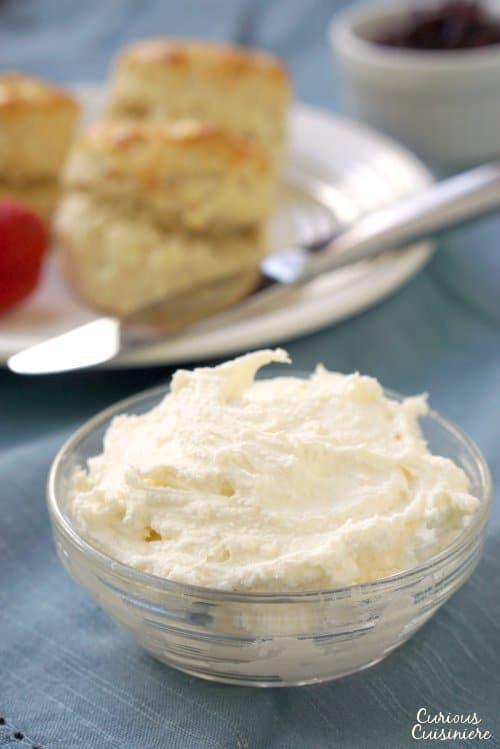
What is clotted cream?
Clotted cream is a staple on British tea-time tables. You'll find it served in a little dish right alongside your scones (or very traditionally, Cornish 'splits', a type of yeast bun).
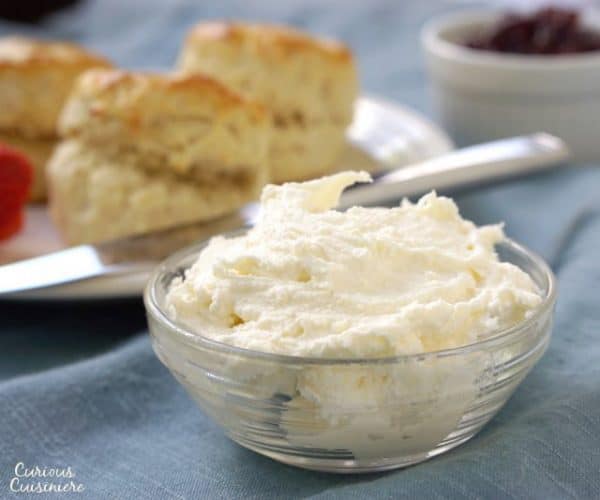
It is a thick, creamy, white spread, with the consistency of softened cream cheese. It is ever so slightly sweet, but mostly just incredibly creamy. Like a good, unsalted butter.
But so much more.
Devonshire cream vs clotted cream
Sometimes you may hear "clotted cream" called "Devonshire cream" or "Cornish cream". It really all depends on the region you are in.
The making of clotted cream started in Devon as a way to separate the fat from milk to make butter. Centuries later in Cornwall, it became popular to use the cream on its own. At that time, clotted cream and butter were the most popular ways to preserve milk.
One of our readers sent us a wonderful insight into clotted cream making, that is worth sharing. Angela spent her childhood during WWII at Callington with her grandparents who were retired farmers on the Devon/Cornwall border. She explained that the real difference between clotted cream in Devon and Cornwall came down to the process.
She stated,
"Devon cream was made by putting the full milk straight from the cow into a large enamel pan. It was then rested overnight to allow the fat to rise to the top. Then the pan was placed on the range over a pan of simmering water until the cream became a crust. (The milk must not boil!) It was then removed and allowed to become cold in the pantry - no fridges then.
When cold, the thick crust was carefully scooped off the top of the milk and put in a cream dish ready for use. The remaining fatless milk was used for cooking and on farms, surplus skim milk was used to feed pigs etc.
This was the method we used as we no longer had the farm. Just 2 bottles of unpasteurized full cream milk produced enough cream for splits, stewed fruit or junket.
Cornish clotted cream was made as follows - The full milk was poured through a separator. This was a rather complicated piece of mechanical equipment used on farms to separate the fat from the milk.
The full cream was then put into the enamel pan and very slowly heated on the stove until it thickened from top to bottom. No skimming needed. When cold, it could all be eaten!
This is what can be bought in supermarkets today."
Many thanks to Angela for sharing her knowledge and family heritage story with us!
Of course, those in Devon and Cornwall each claim that their cream is superior.
I guess we'll have to take a trip to decide for ourselves!
Ingredients
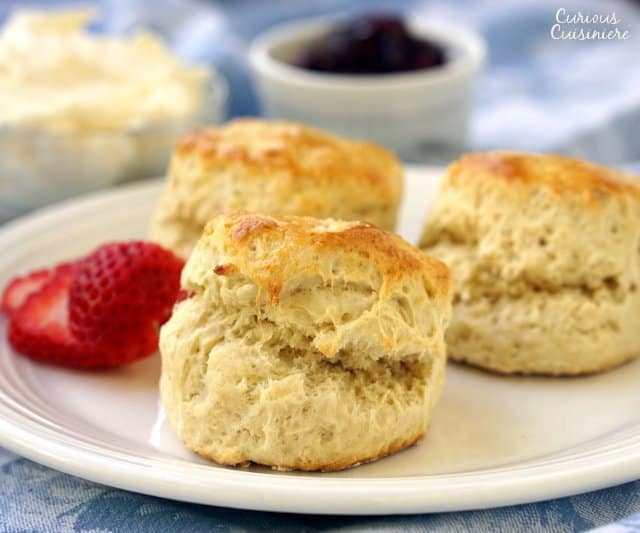
The ingredient list here couldn't be any shorter. You just need to get yourself some heavy cream.
However, the hardest part about making clotted cream might just be finding the cream.
You see, for best results, you need to start with heavy cream that has not been ultra-pasteurized for a longer shelf life.
Simply look for a carton of heavy cream that does not say "ultra-pasteurized", and you're good to go!
Can I use ultra pasteurized cream?
Finding non-ultra-pasteurized cream is becoming more and more difficult in the States, so many of our readers have asked if they can use ultra-pasteurized cream in this recipe.
Luckily, the answer is yes (most of the time). Some of our readers have had luck using ultra-pasteurized cream. However, because of what the ultra-pasteurization process does to the protein and fat molecules in the cream, you will get less clotted cream if you start with ultra-pasteurized cream than if you can find some that isn't.
How to make clotted cream
Clotted describes the look of the cream when it is heated ever-so-gently so that the fat separates to the top and clings together.
After you find your cream, the second hardest part of making clotted cream is the wait.
This is not a quick process.
The cream has to be heated slowly for 12 hours, which we find easiest to do overnight. Then it is cooled for another 8 hours (or over the next night).
Finally, you separate the cream from the liquid, and you have the spread that you have been waiting for.
It might take a long time, but it's mostly hands-off.
And it's SO worth the wait!
Can you make clotted cream in the slow cooker?
This is a question that we get often from our readers, so we did some testing to find out.
The answer is yes you can! Have a look at our recipe and process for making clotted cream in the slow cooker.
There are also some nice tips and tricks about making clotted cream in general over there, so even if you're thinking about making it using this oven method, take a look over there for the tips!
How to store the finished product
You will want to store your clotted cream in an airtight container in your refrigerator. For best storage, store it a place in your fridge that stays a consistent, cool temperature - so not in the door. Closer to the middle is where we like to keep it.
How long does homemade clotted cream last?
Your homemade clotted cream will stay fresh for about 3-4 days if properly stored in the refrigerator. After that, it may start to lose its consistency.
However, if you happen to let your clotted cream get just a bit past its prime and the texture just isn't quite right you can always use it to make fudge or ice cream.
How to use clotted cream
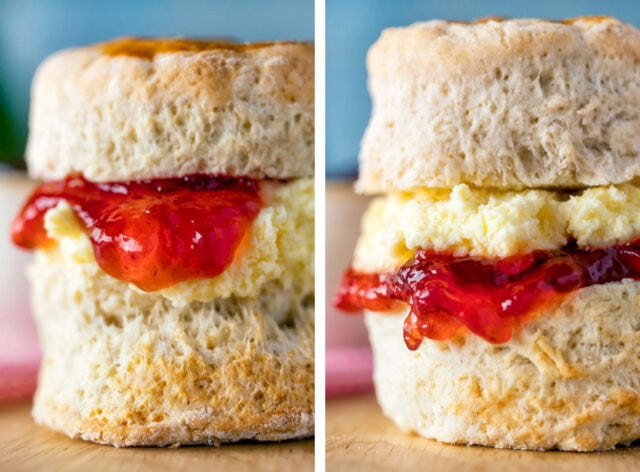
The traditional use for clotted cream is on scones, with jam, served with tea.
However, if you find yourself with an excess of clotted cream and no scones, you can always serve it with Irish soda bread, muffins, apple pie, a fruit tart, or any dessert or sweet bread of your choosing. It also makes a nice fruit topping.
Basically, you can use it any way you would typically use whipped cream or butter.
Savory uses for clotted cream
Clotted cream typically lends itself to sweeter uses: spread on scones (or "splits" as Angela pointed out to us were more common where she was growing up) with some jam.
However, it is rich and creamy and you can use it for savory applications as well.
We think it would be delicious as a veggie dip or spread on a cucumber slice as an appetizer.
You could also add it to mashed potatoes, risotto, or eggs to give them extra creaminess, much like you would butter. Or you could add it to soups or sauces to give them a creamy boost.
What's the difference between clotted cream and whipped cream?
While at first, a bowl of clotted cream might look similar to whipped cream. But once you take a taste, you'll know the difference.
Both start with the same basic ingredient: heavy cream. But, for whipped cream, you whip that cream into light and fluffy pillows. Often you'll add sweetener and possibly a flavoring, like vanilla, to whipped cream as well.
Clotted cream, on the other hand, is heated and separated, as we'll go into more detail below. This process produces a thicker, creamy substance.
Another difference is that clotted cream is typically not sweetened. People love it for the creamy texture it adds, similar to butter, rather than a particular sweetness or flavor.
What's the difference between clotted cream and butter?
So, if it has a thicker consistency and is more savory, how is clotted cream different from butter?
Again, it comes down to the process.
Butter is made by churning (or whipping) cream. So, if you over-whip your whipped cream, you'll end up with nice, whipped butter.
Clotted cream, again, has to do with the separation of the fat in your cream.
Our reader Angela pointed out to us that the making of butter in a churn took additional time and hard work. So making clotted cream was a much easier option.
What to do with the leftover whey from making clotted cream?
When you make clotted cream, you will be left with a thin, milky liquid below the clotted cream.
That liquid is basically skim milk, and while we don't think it has the best flavor for drinking, it is perfectly good for baking.
You can use it in any baking recipe that calls for milk. Our favorite way to use it is to make a batch of British scones.
However, it would also work well to make this Brazilian French toast or this Finnish braided bread.
Can you freeze clotted cream?
Frozen dairy tends to lose its thickness and creamy texture, so we wouldn't recommend freezing homemade clotted cream. (We'd use it in some of the ways suggested above first.)
That being said, we have heard of some people having luck freezing clotted cream in an airtight container, if it is thawed overnight in the refrigerator before you would like to use it.
If you'd like to try this, we'd suggest starting with a small test batch to see how you like the results.
Buying jars of imported clotted cream can get quite pricey. But you don't have to worry about that anymore!
Homemade Clotted Cream
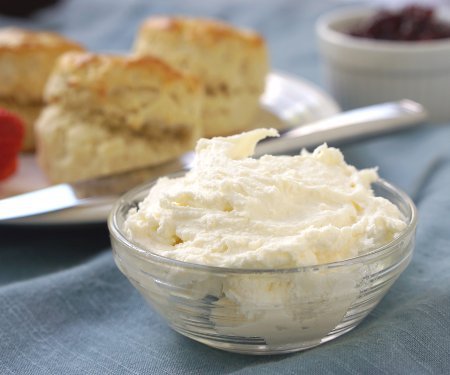
To make clotted cream, you will want to start the process 3 days before you plan to serve your cream. It sounds like a lot of time, but most of the process is done while you sleep!
Ingredients
- 2 c (237 ml) heavy cream, (not ultra-pasteurized)
Instructions
Day 1
- Preheat your oven to 170-180F.
- Pour the cream into a shallow casserole dish or glass baking dish. (The cream should only come up the sides about 1-2 inches. The key here is to have a lot of surface area.)
- Place the cream in the oven for 12 hours, uncovered. (This works great overnight.**)
Day 2
- After heating for 12 hours, the cream will develop a skin. Carefully remove the dish from the oven and let it cool to room temperature. Once cool, cover the dish and refrigerate it for 8 hours (or overnight again).
Day 3
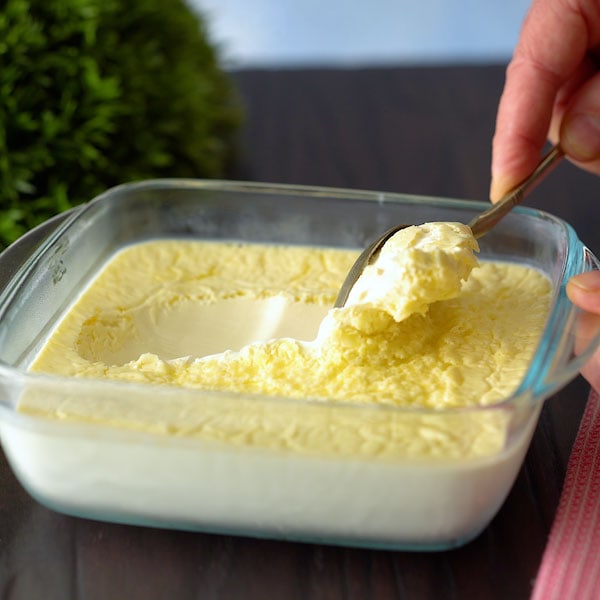
- After chilled, gently skim the thick layer of clotted cream from the surface, leaving the thinner liquid behind. (It will feel like you’re pulling a layer of slightly softened ice cream from the top of a layer of milk*. The skin in fine, it will soften as it is mixed into the cream.)
- Gently stir the skimmed clotted cream to create a smooth texture. (If your cream is too thick for your liking, you can always stir a little bit of the thin liquid back into your cream, until it reaches your desired consistency.)
- Store the clotted cream in a sealed container in the refrigerator for up to two weeks. (Clotted cream can also be frozen and thawed in the refrigerator, if desired.)
Notes
*The leftover liquid can be used like milk. It’s great for baking!
** Oven note #1: Some ovens have a safety feature that shuts them off after extended periods of time. If this is your oven, you may want to do the clotting step during the day, when you can make sure your oven stays on and at a low temperature.
Oven note #2: We have a lot of readers who are discovering as they try this recipe that their oven runs hot. After 12 hours in the oven, their cream has developed a dark brown skin. The skin on your cream should only be a pale tan if it starts to darken. If you think your oven may run hot, check your cream after 8 hours and again after 10 hours to see if the top is darkening. If it is, you may need to cycle your oven between off and on to keep a temperature that is not too hot for the cream. (As a side note, the darkened top on the cream does not mean it is ruined. It simply means your finished cream will have a bit of a deeper flavor, and it will most likely have some flecks of brown and not be a pure creamy white.)
Nutrition Information:
Yield:
16Serving Size:
1 gAmount Per Serving: Calories: 101

Sarah founded Curious in 2010 as a way to save her recipe creations and share culinary experiences. Her love for cultural cuisines was instilled early by her French Canadian Grandmother. Her experience in the kitchen and in recipe development comes from over 10 years working in professional kitchens. She has traveled extensively and enjoys bringing the flavors of her travels back to create easy-to-make recipes.


Why did u bake it in a pan?
We use a baking dish with at least 3 inch sides.
Clotted cream isn't all that easy to come by here in Switzerland, where I live. I'm sooooo happy I found your recipe. 🙂 I tried making it for the first time last week and loved it. Now I'm in the process of making some to surprise my husband for his birthday on Sunday.
So glad you enjoyed it! What a fun birthday surprise!
@Tirza Baumberger, if you are in Switzerland - you can use unpasteurised milk to make it for a more authentic experience.
No, you must not stir the finished cream. Clotted cream has a yellowish layer of butter-like fat on the surface. Part of the exquisite pleasure is to break through this layer to reach the smooth cream below. It has a distinctive taste and texture, and should be enjoyed for it's own sake.
Thank you for sharing!
Excellent! I baked about 3/4 of a quart of cream in a pan where the depth of the liquid was about an inch. Put on the oven at 7pm and it went off at 3am..about 8 hours. It was room temp at 7am when I checked. Put it in the fridge for about 10 hours and it was perfect! Used the liquid milk to make pancakes the next morning. 🙂
So glad you enjoyed it!
Oh my goodness! This is brilliant. I just skimmed off the cream a few minutes ago after baking yesterday and putting in fridge overnight. This is fabulous😁. Had I bought the amount that I made it would have cost over $50!!! The heavy cream cost me $5.79 at my local supermarket and I did use the whole carton, but what a lovely treat it will be and what a great gift for my friends too😁
So glad you're enjoying it Victoria!
I tried this recipe (first attempt at clotted cream) and whilst it was delicious, and easy, I found the skin didn't totally incorporate fully into the cream, i still had little bits of flecks of the skin throughout. I didn't serve it for a few days, (made ahead so i could still do an emergency whipped cream if it didn't work out!) so when i served it, it was quite soft and delicious, but not perfectly smooth.
i used organic whipping cream, it was the only cream i could get without other ingredients in it.
I will definitely be doing it again though!
Hi Andrea. It sounds like yours turned out perfectly! Only store bought clotted cream will be perfectly smooth. Homemade and really any authentic clotted cream will have a bit of a crust and isn't 100% smooth. Making it ahead of time, like you did, is the best way to get those crust pieces to soften up before serving. Also, serving it at room temperature helps too. Glad you enjoyed it!
How about using a sous vide bath instead of the oven?
Hi Sullin. We haven't seen sous vide working well, mostly because there needs to be some type of enclosure for the cream, which doesn't allow for evaporation. If you give it a go and it works for you, let us know!
I've just tried making this cream. I used a litre of 35 percent cream in 9"x9" glass dish and the cream came up to about 1". I covered it and left it in the oven at 180 degrees (the lowest setting on my oven) for 12 hours. Then I cooled it for 2 hours, then chilled it in the fridge for 12 hours.
I ended up with 3 distinct layers-the top clotted layer, middle layer was milk and the bottom later was gelatinous. I skimmed off the top layer, which was a nice creamy consistency when stirred and spooned off the middle milk layer, and was left with quite a lot of gelatin-like whey. What went wrong-why 3 layers? Some recipes suggest covering and some say uncovered. Which is preferred and why?
Hi Yvonne. Can I ask where you are located? After doing some looking into this issue (you are the second person who recently came to us with this), I discovered that in some parts of the world (Australia, for example) often contain a thickener like gelatin. So, my best guess is that what you are seeing is the thickener settling out of your cream. Try making sure that your cream doesn't have any additives and see if that solves your issue. As for covering, if you are covering it while cooling, that may keep the top layer a bit softer.
Thank you so much for this easy to follow guide! I've been dying for some good heavy cream for scones and since the start of the pandemic it's been impossible to get where I live in Canada, or outrageously expensive (50$ for a tiny jar on Amazon)
Someone else here already pointed out that real clotted cream is banned here so there is that as well.... I've been making due with Creme Fraiche which, is fine but.... Not the same.
I just made sure to follow the directions to the letter,and bought a half litre of good quality, organic,non UHT 35% whipping cream from a grocery store (about 7.50$) and poured it into a medium sized ceramic casserole dish to give me roughly 2" deep liquid and ... Holy moly. It's pure heaven. 😍
The clotted layer ended up with just a slightly yellow "crust" in a few patches. And was so thick and chunky I did have to add a few spoonfuls of the liquid to soften it up and stir it into a wonderful thick cream. Just like in the photos.
6 stars out of 5 from me!
So glad you found us Jason and so glad you're finally getting to enjoy clotted cream again!
I've made this recipe a number of times, always to good results. Out of necessity I've even tried it with ultra pasteurized to decent if not great results. However, recently I've noticed something different with my clotted cream. I use 40% fat, organic heavy whipping cream from Trader Joe's. I put it in the oven at 180 degrees Fahrenheit for 11-13 hours depending on my schedule and the visible separation of the clotted cream. I then chill it for 8-10 hours also based on schedule and observation. The last few times I've made the clotted cream I've noticed that it's splitting into four distinct layers, rather than three. The top buttery tan crust, and the middle pure white, creamy, sweeter cream clinging to the skin. But instead of the thin almost whey like liquid at the bottom I'm getting two other layers. A layer of white cream that tastes the same as the second layer but is a little thinner. It's thicker than the original cream but still very much a liquid. Underneath that is an almost gelatinous, transparent layer at the very bottom. I don't know what this means or if this is normal. I can't find anyone who has had a similar experience. The clotted cream that comes from the four layered batches is the tastiest I've made, but it's also incredibly thick. Even brought to room temperature it's only just spreadable and spreading it cold is a non starter. I'm hesitant to put the weird leftover gel back into the clotted cream since I can't find any information on what it might be. The third layer of thinner cream only yields a few table spoons. Do you have any idea what might be going on? Am I doing something wrong or is this a normal thing to happen?
Hi Janene. This is interesting and I haven't seen or heard of this before. It seems that you have made this recipe quite a lot and this is only a recent happening, while using the same method. So my first thought would be to wonder if you are using a different brand of cream. If you have used the same brand with the same process and gotten good results in the past, then maybe it has something to do with how old the cream is. I will do some research to see if I can figure out what might be up. And I will be interested to see if other readers have experienced the same thing you are with the gelatinous layer.
Hi Janene. I wonder if the cream you are using has any additives, like thickeners, that might be settling out in the clotting process and causing your gel layer? See my response to Yvonne's comment above.
Hello. I have made this clotted cream before and it turned out amazing! This time I forgot that I needed to made it in advance to when I need it. I have it in the oven now but I need it for lunch tomorrow. Which means it will only have about 6 hours to cool. Do you think this will be enough time for it to set up?
Hi Karen. Likely you will be fine with 6 hours to cool. If you are using a clear glass container, you should be able to see the separation happening while in the oven, and if after 10 or 11 hours you see a distinct separation, then you could remove it from the oven a bit early too. (It will all depend on the cream you are using, and worst case, shorter time in the oven will just result in slightly less yield.) Let us know how it works for you!
Good morning,
I’ve made this cream a few times. It turned out a bit dark the first couple of times but nonetheless, my hubby and I enjoyed it. I am making it again this morning and I noticed the cream is nowhere near 1-2” deep in my container—I am using a round, 9” glass baking dish. Do you think this is why the last time it came out a bit burned?
The last few times I made it, I used an oval Corningware dish. It also did not get filled 1-2” deep.
FYI: we live in Canada and we can no longer purchase clotted cream. The Canadian government has banned it for health reasons as the real deal uses unpasteurized milk/cream.
Thanks for any insights you can offer.
Hi Lore. It is possible that being more shallow in the container would cause it to heat a bit more quickly. However, the dark color is more likely from the oven temperature being a bit too hot or the dish of cream being a bit too close to the heating element. I would try reducing the oven temperature by a couple degrees. Or, you can try using a smaller container and see how the results differ when the cream is thicker. Let us know what you discover!
@Lore, I too live in Canada and the reason clotted cream is not sold here right now is because of the pandemic, they aren’t importing it right now, not because of it being unpasteurized. So not to fear, it will be back soon! Also, I found this recipe to be better than anything you can buy in the store.
Thank you Karen!
@Sarah Ozimek, I have used ultra pasteurized cream and it came out fine. You just can't use ultra-ultra pasteurized cream.
Thanks Leah. Glad you have had good luck with the ultra!
@Lore, It is next to impossible to find heavy cream in the US that isn’t ultra-pasteurized. I use it just the same. It has come out great every time. Occasionally it makes less solids than usual, but still tastes great.
My daughter lived in Scotland for a few years and fell in love with scones and clotted cream & jam. We have not found any scones or clotted cream as good UNTIL I tried YOUR recipe! The clotted cream was easy once I found some proper heavy cream. And the scones turned out just right too. We had a perfect British tea party this afternoon. Thank you🇬🇧
Wonderful! So glad you found us!
Why can't you use ultra-pasteurized heavy cream? Can't find any around here that isn't.
The ultra-pasteurizing process breaks down the proteins which are needed to help the cream clot. Some readers have had ok luck using UHT cream, but we don't recommend it because the results vary so much. You could always try it and see how it does for you.
@Sarah Ozimek, I haven’t found any heavy cream in the US that isn’t ultra-pasteurized. I’ve used it many times following this recipe and it comes out great.
So glad it has for you. We've had varying results with ultra-pasteurized. There are a few brands, such as Organic Valley whose cream is just pasteurized, not ultra-. But they can be hard to find depending on your location.
@Sarah Ozimek,
I just looked online to see my local options and Organic Valley contains Carrageenan, a thickener.
Oh, that is interesting. Where are you located? Ours, in the States does contain a bit of thickener "Gellan Gum", but not carrageenan. Even with the gum, it does work well. Strauss brand, which you can get at Whole Foods and from instacart (in the States), doesn't have any additives. That might be one of the best brands I have come across, outside of heading to your local dairy to see if you can buy it straight from them.
@t--, in the UK and the EU it has protected status just like Champaign does. While you can follow a recipe to make Champaign with grapes grown elsewhere (which the USA has done and called Champaign) it’s not the same thing. There is a reason Cava, Prosecco and Champaign while all similar are not called the same. It’s the same with clotted cream. The authentic stuff uses unpasteurised and unhomogenized milk as it’s base. Pasteurising it changes the fat textures. While using pasteurised milk/cream as a base you can make something similar (which is what this recipe does) you cannot create actual clotted cream.
Ultra pasteurised creams destroys the fatty globules you need to create the right texture as they are converted in the process.
I made this and it turned out wonderful!!! So easy! Just takes time 🙂
My oven worked well at 170F and since I live up in the mountains at 10,000 feet I only cooked it for 10 hours, then cooled, then refrigerated it overnight. In the morning it was finished and ready! Thank you so much! I have always complained about the fact that American‘s don‘t know how to make cream (single, double, triple, clotted). This is one way I can have some clotted! My British husband is so pleased with it! His Mum is from Cornwall and they know their clotted cream!
So glad you enjoyed this Kat! Thanks for sharing what you did!