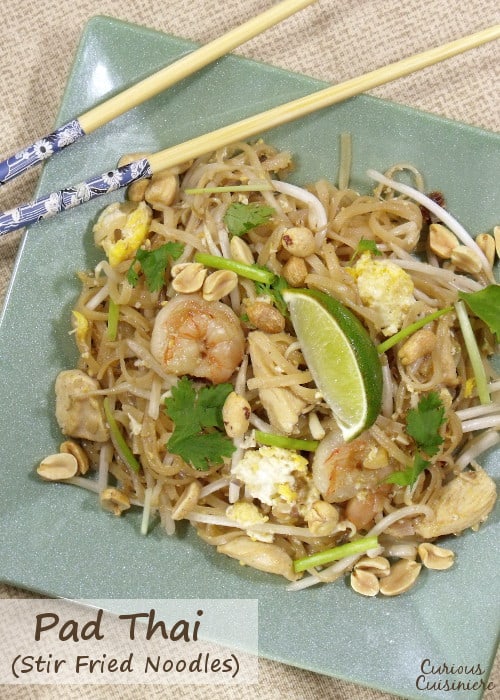
Pad Thai
A perfect balance of sweet, salty, and sour, this recipe for flavorful stir fried Pad Thai noodles makes for a quick and unique meal.
 (DISCLOSURE: This post contains Amazon affiliate links. These links are provided to help you find some of the more specialty products we mention in the recipe. If you make any purchase after clicking through one of our links, we receive a small commission from Amazon, at no extra cost to you. Thank you for supporting Curious Cuisiniere!)
Pad Thai: Classic Thai Cuisine, or Not?
The interesting thing about Pad Thai is that, for as often as we see it in Thai restaurants and think of it as the essential Thai food, it really isn't a typical Thai dish.
It is thought that the dish originated from Chinese settlers, since noodles and stir fries play a large role in Chinese cuisine.
Even the traditional name of the dish, kway teow pad Thai, speaks to the dish's Chinese origins.
- Kway teow is Chinese for 'rice noodles'.
- Kway teow pad Thai literally means 'Thai-style stir-fried rice noodles'.
Why would you classify a dish as Thai-style in its own country of origin?
The History of Pad Thai
Pad Thai is a fairly new dish, which exploded in popularity in the 1930's and 40's due to the Thai government's push to improve the national diet and westernize the nation by instilling a national image.
Apparently, a noodle dish was just the thing to do both.
Rice noodles were inexpensive and filling, and by adding vegetables, bean sprouts and a protein, Pad Thai became a cheap and nutritious meal.
As far as creating a westernized image, the success of that goal can be seen by the number of Pad Thai restaurants you will find all over the globe. In fact, many believe that a Thai restaurant's Pad Thai is the ultimate test of their quality.
Making Our Pad Thai Recipe At Home
With its complex flavors and perfect mix of textures, a bowl of pad Thai might seem like an intimidating dish to recreate at home. But, it is really quite a quick and easy dish to make.
If you've ever made Fried Rice, then you will have no problem throwing together a fantastic Pad Thai.
In fact, it could be said that the technique for making pad Thai is like a cross between making chow mein and fried rice.
While similar in technique, the flavors of Pad Thai are very different from Chinese noodle dishes, since Thai cuisine leans more to the sweet and spicy flavors of fish sauce and red chilies, often in combination with peanuts.
What really makes Pad Thai unique is the way it brings together some ingredients that are unfamiliar in many western kitchens:
- rice noodles
- bean sprouts
- tamarind paste
- fish sauce
Lets break these ingredients down a bit.
What Are Rice Noodles?
Rice noodles (banh pho) are simply noodles made of rice flour rather than wheat flour. They are translucent and have a tender, chewy texture.
Unlike traditional pasta, they only need to be soaked in warm water to re-hydrate.
What Is Fish Sauce?
Fish sauce (nam pla) has a saltiness that is similar to soy sauce, with an added depth of flavor that is uniquely its own.
It is made from fermented fish (typically anchovies) and salt. (Now, before you go running at the mention of anchovies, let me remind you that the Worcestershire sauce that you probably have taking up a corner of your pantry also includes anchovy on the list of ingredients. Just sayin'.)
Due to the fish, the sauce does have a slightly off-putting smell. But, once added to a dish or dipping sauce, it brings an incredible punch of flavor.
We have been able to find fish sauce fairly easily in the Asian section of our local grocery stores, right next to the rice noodles.
What Is Tamarind Paste?
Tamarind paste is a paste made from the fruit of the Tamarind tree.
This paste has a fruity-sour flavor with a hint of sweetness. There really is nothing like it.
Unfortunately, tamarind paste can be a bit tricky to find in some areas.
If you just so happen to live in one of those tamarind-void places. Don't fret!
We have found that you can create a similar flavor by using a ratio of 1 part fresh lime juice, 1 part water, and roughly ¼ part brown sugar. (So for ¼ c of tamarind paste you would use 2 tablespoon fresh lime juice, 2 tablespoon water, and 1 teaspoon brown sugar, mixed well.)
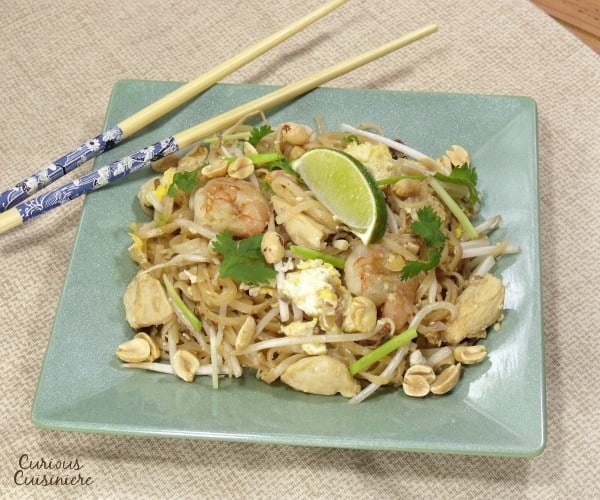
Even though you will find some unique ingredients in this dish, there is no reason to be scared.
In fact, the delicious balance of flavors and textures in a good Pad Thai should have you running to the kitchen to create your own!
Pad Thai
Ingredients
- ¼ lb thick rice noodles (banh pho)
For the Sauce
- 3 tablespoon tamarind paste*
- 1 ½ tablespoon fish sauce (can substitute soy sauce in a pinch)
- 1 tablespoon sugar
- 1 teaspoon crushed red chili peppers
Putting It Together
- 2 tablespoon peanut oil
- 2 shallots, chopped
- 3 garlic cloves, minced
- ¼ lb pork, chicken or tofu, uncooked, cut into bite sized pieces
- ¼ lb shrimp, whole, shelled and veined
- 2 eggs, beaten lightly
- 2 c bean sprouts
To Garnish
- ¼ c peanuts, roasted, unsalted
- 1 lime, cut into wedges
- Cilantro or green onions, chopped
Instructions
Preparing the Ingredients
- Place the dry noodles in a large bowl filled with warm water. Let the noodles soak for 30-40 minutes, until they are flexible, but still quite solid. (It is better to under soak them at this point rather than over soak them.) Once the noodles have soaked, drain and set them aside.
- While your noodles are soaking prepare the rest of your ingredients. Cooking Pad Thai goes very quickly, and it is helpful to have all of your ingredients prepped and ready to be thrown into the wok.
- Create your sauce by mixing together the tamarind paste, fish sauce, white sugar, and chili peppers. (See note below if you can’t find tamarind paste.) Every version of tamarind paste and fish sauce will taste slightly different, so taste your sauce and adjust it to your liking. The sauce should be a nice balance of sweet, salty, tangy, and spicy.
Making Pad Thai
- Heat your oil in a large wok over high heat. Add the shallots and garlic and sauté for 1-2 minutes, until lightly golden. Add the pork and shrimp and sauté until both are cooked through, 2-3 minutes.
- Next, add the drained noodles and your prepared sauce. Toss the noodles with the sauce and sauté for 1-2 minutes. Taste the noodles for texture and add a tablespoon of water to your wok if they are still too firm and tough. (The noodles should be soft, chewy, and dry.)
- Push everything in your wok to one side and pour in your beaten eggs. Let them cook on the bottom of the wok until nearly cooked through. Then, fold them in with the noodles.
- Add the bean sprouts and toss them with the noodles. Remove the pan from the heat.
- Serve the Pad Thai with roasted peanuts, lime wedges, and chopped cilantro or green onions as desired.
Notes
More Asian recipes from from some of our favorite bloggers:
Small Bites
- Baked Turkey Lumpia - Filipino Eggroll by Food Done Light
Soupy Goodness
- Asam Laksa by Caroline's Cooking
- Bok Choy Gai See Tong (Bok Choy and Shredded Chicken Soup) by A Day in the Life on the Farm
- Pork Prawn Wonton Soup by Food Lust People Love
Big Plates
- Cheese Korokke by Manu's Menu
- Grilled Pork Báhn Mì by That Skinny Chick Can Bake
- Sri Lankan Vegetable Curry by Panning The Globe
- Vietnamese Flank Steak by Bobbi's Kozy Kitchen
On the Lighter Side
- Nam Sod (Thai Pork Salad) by Magnolia Days
- Soba Noodle Salad by Jane's Adventures in Dinner
Cheers!
- Best Wines To Pair with Asian Cuisine by ENOFYLZ Wine Blog

Sarah founded Curious in 2010 as a way to save her recipe creations and share culinary experiences. Her love for cultural cuisines was instilled early by her French Canadian Grandmother. Her experience in the kitchen and in recipe development comes from over 10 years working in professional kitchens. She has traveled extensively and enjoys bringing the flavors of her travels back to create easy-to-make recipes.

Thanks so much for this recipe!! For almost a year now, I've been trying a few recipes in an attempt to learn how to make Pad Thai for my family. The first time I made it, I got CHOPPED (my nine year old is brutal). I must tell you that it hurts to get chopped in your own kitchen!! The past few attempts have been just decent, but getting better. I have a good feeling about this recipe, though. If you guys get me there, I'll be back with copious amounts of gratitude.
I'd like to ask a question though, I thought that Thai peppers were an essential ingredient. Is this not the case? Please advise.
Hi Jim. We hope this recipe is a hit! We substitute crushed red pepper flakes to make this dish more easily accessible for people who don't have access to a store with Thai chilies. If you have some Thai chilies, go ahead a substitute them for the crushed red pepper, according to your family's heat preferences! Let us know how it turns out for you!
I remember getting a great pad Thai at a street market near where I used to work in London now and then - so delicious. Keep meaning to make it myself more, and your recipe looks tasty!
If you give it a try, be sure to let us know what you think!
Looks so good! I like mine with those little sliced hot red peppers though. I love spicy!
I'm with you there! Bring on the red peppers!
This sounds like the perfect Pad Thai
Thanks Wendy! It is delicious 🙂
I totally enjoy a good Pad Thai. Interesting on the history of it though. I really did think it was an old Thai dish.
We did too Renee! The history is so interesting!
My husband love pad thai. He used to get it a lot when we lived in FL, I should make it to surprise him.
P.S. - pretty chopsticks.
Tim's brother brought us back the chopsticks when he visited China. We love them!
I love Pad Thai! So happy to have this recipe. Thanks for this recipe Sarah. Cant wait to make it!
We hope you enjoy it Lisa!
Lovely explanation of the ingredients, Sarah, and a delicious dish! One of my favorites!
Thanks Stacy!
I love pad Thai and yours looks outstanding, Sarah!
Thanks Liz!
What a great recipe!
Thanks Connie! It was fun to make!
I never knew that about Pad Thai, I truly thought it was just a normal staple in Thai cuisine - whoops. Regardless, I love Pad Thai!
We love it too! It's funny how a dish's history can be so complex!