Polish White Borscht (Bialy Barszcz)
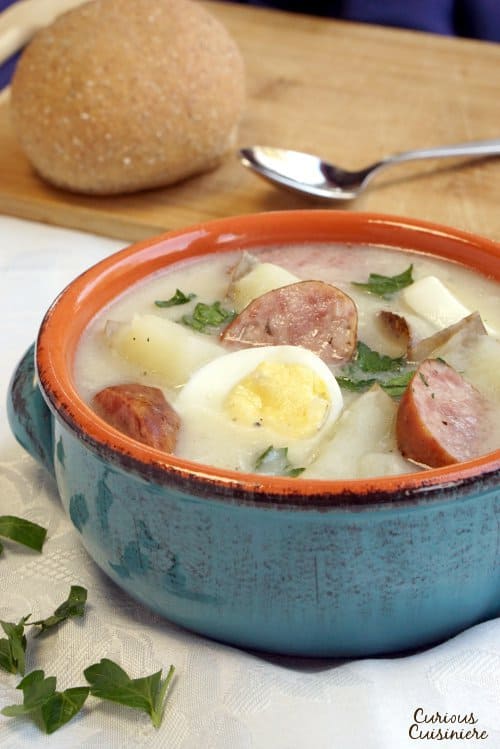
White Borscht is a tasty Polish Easter soup that is full of sausage, eggs, potatoes, and other ingredients that bring a lot of religious symbolism to each bite of this delicious soup.
 White Borscht: A Polish Easter Soup
White borscht (or Bialy Barszcz in Polish) is a classic Polish dish eaten on Easter Sunday morning.
Traditionally, this soup is made with items in the basket of food that Polish families take to Church to have blessed on Holy Saturday.
The History Of Easter Baskets
We never realized that blessing baskets of food on Holy Saturday is a tradition in many cultures.
In the States, we're used to Easter baskets for the kids on Easter morning, but this tradition has long standing roots in the baskets that families would bring to Church to have blessed on Holy Saturday.
These Easter baskets were filled with things that symbolized every part of life, and their blessing was considered a sign of blessing for a bountiful year ahead.
Polish Easter Baskets
In Poland, the practice of blessing Easter baskets dates back to the early 15th century.
Each family brings a large basket to church on Holy Saturday. These baskets (called Święconka) are lined and covered with a white linen cloth, representing the shroud of Christ. And, each of the foods in the Easter basket has a special significance.
- Bacon is a symbol of the abundance of God's mercy.
- Easter bread symbolizes Christ, the Bread of Life.
- Butter or other dairy products celebrate the end of Lent and the richness of salvation.
- A candle, while not edible, symbolizes Jesus, the light of the World.
- Cheese reminds Christians of moderation.
- Hard cooked eggs are signs of hope in new life.
- Ham or other meats symbolize the abundance of the celebration of the Resurrection.
- Sausage links represent the chains of death that were broken by Christ's resurrection.
- Horseradish is a reminder of the bitterness of the Passion and the sour wine given to Christ at the Crucifixion.
- Salt preserves us from corruption and speaks to the Bible passage "You are the salt of the earth."
Now, that's a lot of food!
Ingredients for the Family Meal
Not every basket has to contain all of these items, but the important things is that every family member has a bite of blessed food from the basket.
So, Polish mothers typically include foods that they will be using at Easter breakfast or dinner, and a few daily staples.
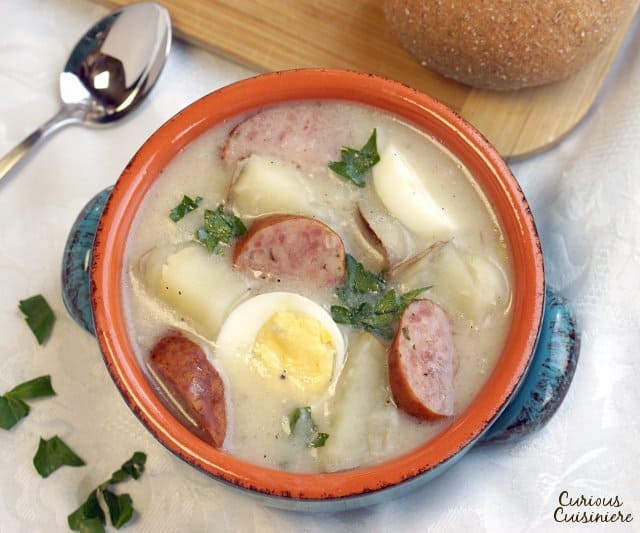
You will notice that a few of the basket items appear in this soup:
- sausage
- butter
- hard cooked eggs
- salt
It's almost as if this soup was designed to be a soup made from the blessed ingredients!
Ingredients in white borscht do vary greatly by region and family.
With meats ranging from Polish sausage, to ham and bacon; and add ins including sour cream, buttermilk, vinegar and sugar.
The two elements that do not change are the sausage-water base and some type of sour (kwas) used to flavor the soup.
What's The Difference Between Red Borscht And White Borscht?
In a word: EVERYTHING.
Well, maybe not everything.
But it would be easier to talk about what characteristic these two, seemingly VERY different, soups share.
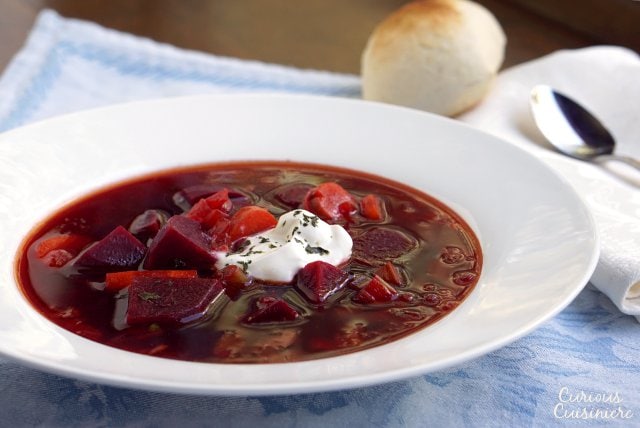
The one thing that these two soups have in common is that they are both considered sour soups.
Red borscht uses a splash of apple cider vinegar near the end of cooking time to give a slight sour brightness.
White borscht uses a sour starter (kwas) as a base, which gives the soup an underlying taste that is similar to sour cream.
What Is Polish Sour Starter?
Kwas (pronounced kvas) is a sour starter (similar to a sourdough starter) that is traditionally made by fermenting bread. This fermentation technique is actually quite popular in many Slavic countries.
In Poland, you will find another soup, very similar to bialy barszcz, called zur or zurek. The only difference is that zurek uses the kwas rye sour starter, while the bialy barszcz uses a wheat starter.
Our White Borscht Recipe
Tim was a bit skeptical about using fermented bread as a base for the soup, so we went a more non-traditional route and used a mixture of sour cream and flour to give a sour taste and thickness to our soup.
The resulting soup is creamy with a mildly sour flavor.
While flavor of this soup is slightly different than if you would use the traditional sour bread starter, we found the flavors to be incredibly similar to the bialy barszcz that we tasted during our trip to Poland. It made us happy to discover that sour cream does work quite well as an easy adaptation to stand in for the more traditional ingredients!
We've made it numerous times since our trip, and love the way the flavors of this soup transport us right back to Krakow.
Polish White Borscht (Bialy Barszcz)
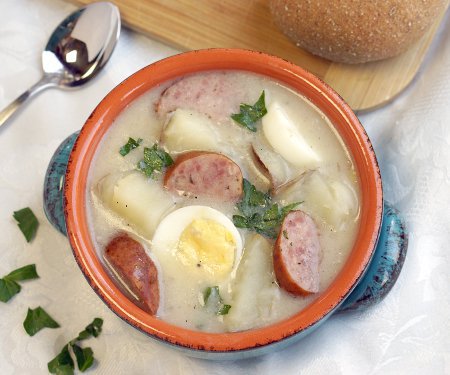
White Borscht is a tasty Polish Easter soup that is full of ingredients carrying religious symbolism.
Ingredients
- 4 hard boiled eggs*
- 1 lb Polish kielbasa, (smoked)
- 6 c water
- 1 teaspoon salted butter
- 4 garlic cloves, diced
- 1 onion, diced
- 2 lbs potatoes, diced
- 1 bay leaf
- ¾ teaspoon salt
- ¼ teaspoon pepper
- 1 c sour cream
- ¼ c unbleached all-purpose flour
Instructions
- Bring keilbassa and water to a boil in a large dutch oven or heavy bottomed soup pot. Reduce heat slightly and boil for 25 minutes. Remove keilbassa to a plate and set aside. Leave the broth in the dutch oven.
- In a medium, non-stick skillet, saute garlic and onion with a teaspoon of butter until soft, 5 min.
- Add onion mixture to kielbassa broth. Add diced potatoes, bay, salt, and pepper. Cook until potatoes are tender, 15-20 min.
- In a small bowl, whisk flour and sour cream together until smooth. Add ½ c of the soup broth to the sour cream mixture and whisk until smooth and thin. Pour mixture into the soup, stirring constantly. Simmer, stirring often, until thickened, 10 min.
- Cut the kielbasas into ½ inch slices, chop the hard boiled eggs. Add both to the soup. Taste the soup and adjust the salt an pepper as desired. Cook 1-2 minutes to heat through.
Notes
*To hard boil eggs: Place eggs in a medium pot. Cover with water and add 1 tablespoon salt (to make peeling the eggs easier). Bring the pot to a boil over medium heat (20 mintues). Turn off the heat and let the eggs stand in the hot water for 3-5 minutes, depending on how firm you like your eggs. Remove the eggs and place them in a bowl of ice water to cool.
Nutrition Information:
Yield:
5Serving Size:
2 cupsAmount Per Serving: Calories: 460
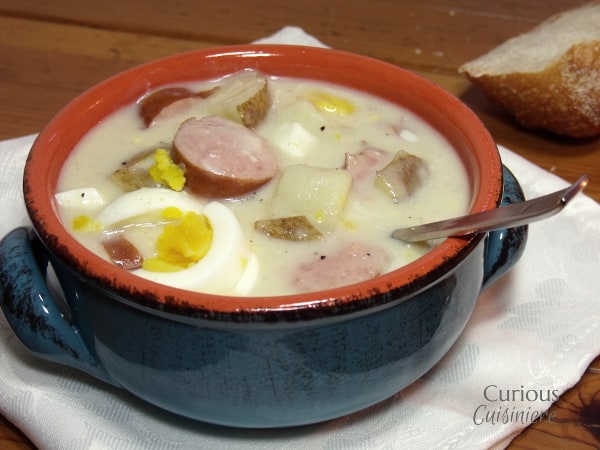
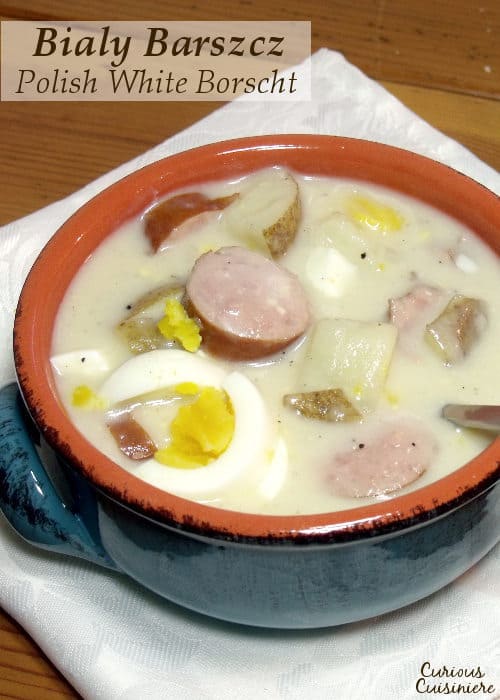
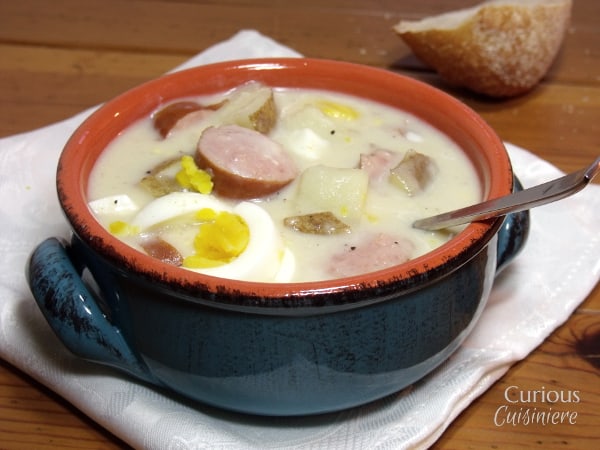
This is one of the recipes from the early days of Curious Cuisiniere. We've updated our pictures since we first shared it, but we've left some originals here, in case you've found us in the past and are looking for that old, familiar image.

Sarah founded Curious in 2010 as a way to save her recipe creations and share culinary experiences. Her love for cultural cuisines was instilled early by her French Canadian Grandmother. Her experience in the kitchen and in recipe development comes from over 10 years working in professional kitchens. She has traveled extensively and enjoys bringing the flavors of her travels back to create easy-to-make recipes.

Happy Easter
4/16/17
This is a Polish tradition in my family for as long as I can remember
My great grandmothers recipe - my mom makes it every Easter and we love it
Boil kielbasa's when they are done remove from pot, the kielbasa water is your broth then you add Sour Salt to broth - you need to keep tasting it to get it perfect
The ham, hard boiled eggs, farmers cheese, kielbasa, horseradish, each of us cut our ingredients in our "big bowls" and then the broth it has to be hot is added
Rye Bread on the side - the fun is also making your own bowl ! (How much of what ingredient and how big of a bowl)
This is our Polish Easter traditional lunch
My mother is Polish - My Father was Italian he loved his Easter Borscht
I will always carry this tradition forever
It's a big part of my Polish Heritage
That is looked forward to and enjoyed.
Happy Easter Carol! What a fun tradition and such a great way to keep the family heritage alive! Thanks for sharing!
What is sour salt? How do you make it?
Hi Cheryl...
Merry Christmas !
In answer to your question about "sour salt"
Sour Salt is actually Citric Acid , extracted from citrus and acidic fruits-lemons, oranges, pineapples it could also be called Citric Salt.
Used mostly in Borscht, I find it in Kosher section of Store. Or a smaller Polish Market.
I hope this explains and helps
I really enjoy learning about the history and culture behind the dish and a big fan of your site. How you made this without even using zakwas makes me question the authenticity of any other recipe on here.. Anyone who has made this soup the right way will tell you the flavor is completely different than sour cream, it's more similar to soups that call for sauerkraut but completely unique.
You can even find zurek concentrates in polish stores or off amazon, it's not that hard and completes the soup.
Hi Agnieszka, Thank you for your comment! As we mention in the post, the soup is traditionally made with a sour starter. But, our version is an adaptation to give a similar flavor for those who don't have access to that ingredient or for those for whom the sour starter might seem a bit strange. Our whole goal here at Curious Cuisiniere is to make traditional global flavors accessible to everyone, and sometimes that does mean making adaptations from traditional ingredients or cooking methods to make the dishes more easily relatable, while still bringing in traditional flavors and history. With regards to this soup, we have actually had Bialy Barszcz in Poland, and found it to taste very similar to our adapted version here. While, yes, using the sour starter is more authentic, many people have found this version to be a great alternative. Thanks again for stopping by and for your comment!
I usually use a soup starter but this year have not been able to vet to the polish store in time due to work schedule (and the store is 30 min away). So this will be an acceptable option for me. I'm sure my kids will love it. Can't wait to try it. Next year will be ordering soup starter via mail well in advance!!!
We hope you enjoy the soup Violet!
I cant wait to make it all my polish family died and my dad is the only one left . I hoping it comes out like he remembers.
Enjoy Casey!
Use fresh polish sausage if you must use the sausage. and Day old rye Bread. or as a real treat use spare ribs and sauer kraut in all of the above. In our hometown we had a lot of Polish Butchers and they always had fresh polish sausage available with the natural casings and the best ribs. For Easter they'd make and sell Butter Lambs, But this goes back 40 years ago and most of them are out of business, Ethnic foods especially from Europe are now very rare.
That is very true Mark. If you live in a place that still has a Polish Butcher, you are VERY lucky! Thanks for sharing your thoughts!
I still make the soup for Easter and then the mushroom soup for Xmas Eve.
How wonderful! Both are such great soups!
This recipe sounds very similar to one my family adopted from a newspaper back in the 40s. That one had green peas and green beans also as well as a spice basket containing whole black peppercorns cloves allspice and bay leaves. We used apple cider vinegar at the table as my irish father was not a fan of the sour aspect.
Your version sounds quite tasty E! I like the idea of adding cider vinegar at the table for people who might not be a fan of the sour aspect of the soup.
Ohhhh my we have been making the white borscht from my grandmother nobody ever heard of it we have it every Easter morning for our breakfast would not be Easter without it so so glad u shared this my mom now has passed so I try and keep it going my brother and nephew and niece love it keep the tradition going on I'm just amazed I found this and how other people make there's ??
Thanks so much for sharing Christina. What a wonderful way to keep your mother's memory and heritage alive in your family!
My mother used the kielbasa water, and then tempered a scrambled egg, cider vinegar witht eh sausage water to make the soup base. Hard boiled eggs, sour rye with caraway seeds, and kielbasa were cut up and added to the soup bowl. The soup base was poured over the meat, eggs, and bread and salt and pepper to taste. I still make it this way. The lielbasa was marianka (with marjoram) nice peppery taste.
The tempered egg mixture also had flour. forgot. sorry.
Thank you so much for sharing your family recipe Judy! It sounds delicious!
Thank You so much for sharing this. As the youngest of the family I did not involve myself with cooking and have wanted this recipe for many years since all have passed, I can now share with the nephews and greats on Easter Sunday. My brother who is 86 will really be surprised. He misses some of those meals. Again I thank you and have a Blessed Easter. Anna Matvchuk
Thank you for your note Anna. We're so glad that you can bring this tradition back into your family and pass it on. Have a Blessed Easter!
We make the barszcz with kielbasa, and hard . boiled eggs and vinegar to our taste. My Italian husband's favorite!
Sounds delicious Karen! Thanks for sharing!
we use bosphina zupa : beet leaves, as recipe above. to bring in more flavor. hard boiled eggs, bay leaves, garlic and dill.
Thanks for sharing your version Mary-Ann! That sounds like a wonderful soup! We'll have to give beet leaves a try in ours!
Thank you for your wonderful sharing of the Polish Easter traditions! My friends don't understand because many have never heard of the WHITE borscht. We use vinegar and horseradish in our broth. -Mrs. Barlik
Thank you for comment Mrs. Barlik! The tang of vinegar and horseradish sound like a wonderful addition to the white borscht. It is sad that more people don't know about white borscht, because it is such a tasty (and traditional) soup! We hope you had a wonderful Easter!
My mother and grandmother used to make the white bordcht only we had it for christmas eve dinner. They are both gone now. I lost my mother 2 yrs ago so i have been trying my best to make it the same and my kids think I've done preyty good but nothing can compare with babchis
Thanks for sharing your memory Linda! It's so true that nothing ever compares to the flavors we remember. But it is so great for your kids that they can share in the traditions and memories, while making their own with you!
How much vinegar and horseradish do you use? Do you mean the horseradish from the store shelf, or some form of horseradish sauce, like Hellman's or so?
Thank you for your input.
This has always been our tradional Easter meal, on my mother's side. Our dish has smoked ham, kielbasa and boiled egg. We add horseradish sauce to each individual taste. Entire family eagerly awaits this once a year treat! In fact, we're enjoying it now, as I post this. Happy Easter!
Happy Easter Carolyn! What a great idea to serve the soup with a horseradish sauce so that everyone can add it to their own taste!
our EASTER borsch was made from the water after boiling a kielbasa , vinegar and flour added , my wife's family was almost the same except they added sour cream , all as a base broth .
That sounds very similar to ours! Using the kielbasa boiling water gives such great flavor to the soup!
Hiya, I'm going to make this for my Polish friends for Easter. How many does this serve? There will be 8 of us and we all have a healthy appetite. Thank you. Will give feedback afterwards. =)
Hi Timea, The recipe does make a big batch, around 10 cups of soup. We typically serve 1 - 1 1/2 cup servings, which means this would serve 6-10. If you are serving it as a main dish, you may want larger servings (closer to 2 cups per person), so you might want to make a double batch just to be safe. We hope you enjoy the soup! A blessed Easter to you and your friends!
I love that you included the history and meaning of the ingredients. Happy Easter and thank you for a delicious new recipe.
Thanks Betsy! Happy Easter to you too!
has anyone ever heard of Pitu soup
Hi Judy. We have not. But maybe another one of our reader has!