
Homemade Clotted Cream
Clotted Cream is deliciously creamy and the essential companion to a batch of British scones. You don't have to go to England to enjoy your tea-time treats though, because it is so easy to make at home!
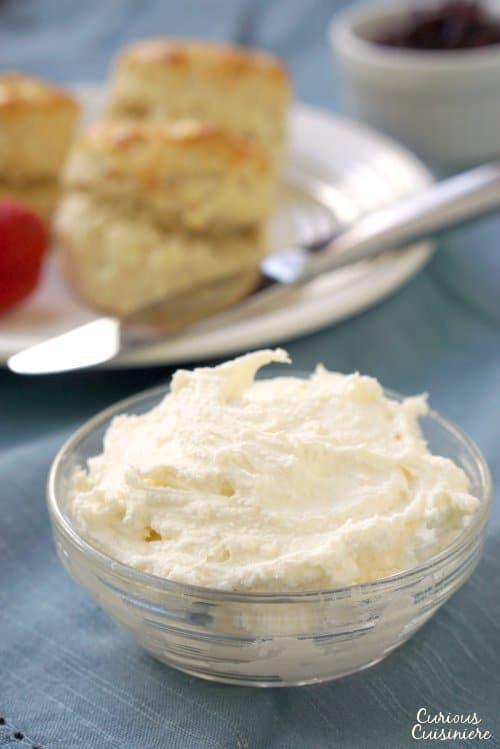
What is clotted cream?
Clotted cream is a staple on British tea-time tables. You'll find it served in a little dish right alongside your scones (or very traditionally, Cornish 'splits', a type of yeast bun).
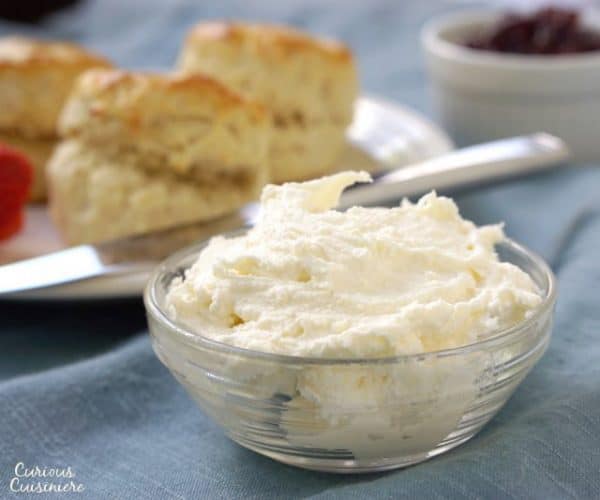
It is a thick, creamy, white spread, with the consistency of softened cream cheese. It is ever so slightly sweet, but mostly just incredibly creamy. Like a good, unsalted butter.
But so much more.
Devonshire cream vs clotted cream
Sometimes you may hear "clotted cream" called "Devonshire cream" or "Cornish cream". It really all depends on the region you are in.
The making of clotted cream started in Devon as a way to separate the fat from milk to make butter. Centuries later in Cornwall, it became popular to use the cream on its own. At that time, clotted cream and butter were the most popular ways to preserve milk.
One of our readers sent us a wonderful insight into clotted cream making, that is worth sharing. Angela spent her childhood during WWII at Callington with her grandparents who were retired farmers on the Devon/Cornwall border. She explained that the real difference between clotted cream in Devon and Cornwall came down to the process.
She stated,
"Devon cream was made by putting the full milk straight from the cow into a large enamel pan. It was then rested overnight to allow the fat to rise to the top. Then the pan was placed on the range over a pan of simmering water until the cream became a crust. (The milk must not boil!) It was then removed and allowed to become cold in the pantry - no fridges then.
When cold, the thick crust was carefully scooped off the top of the milk and put in a cream dish ready for use. The remaining fatless milk was used for cooking and on farms, surplus skim milk was used to feed pigs etc.
This was the method we used as we no longer had the farm. Just 2 bottles of unpasteurized full cream milk produced enough cream for splits, stewed fruit or junket.
Cornish clotted cream was made as follows - The full milk was poured through a separator. This was a rather complicated piece of mechanical equipment used on farms to separate the fat from the milk.
The full cream was then put into the enamel pan and very slowly heated on the stove until it thickened from top to bottom. No skimming needed. When cold, it could all be eaten!
This is what can be bought in supermarkets today."
Many thanks to Angela for sharing her knowledge and family heritage story with us!
Of course, those in Devon and Cornwall each claim that their cream is superior.
I guess we'll have to take a trip to decide for ourselves!
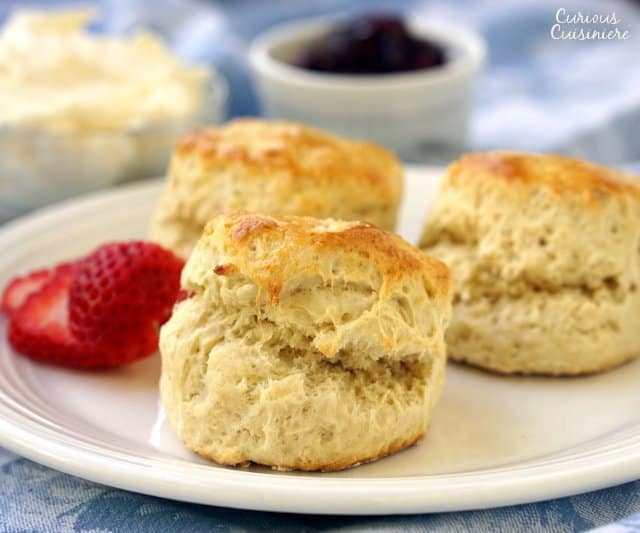
Ingredients
The ingredient list here couldn't be any shorter. You just need to get yourself some heavy cream.
However, the hardest part about making clotted cream might just be finding the cream.
You see, for best results, you need to start with heavy cream that has not been ultra-pasteurized for a longer shelf life.
Simply look for a carton of heavy cream that does not say "ultra-pasteurized", and you're good to go!
Can I use ultra pasteurized cream?
Finding non-ultra-pasteurized cream is becoming more and more difficult in the States, so many of our readers have asked if they can use ultra-pasteurized cream in this recipe.
Luckily, the answer is yes (most of the time). Some of our readers have had luck using ultra-pasteurized cream. However, because of what the ultra-pasteurization process does to the protein and fat molecules in the cream, you will get less clotted cream if you start with ultra-pasteurized cream than if you can find some that isn't.
How to make clotted cream
Clotted describes the look of the cream when it is heated ever-so-gently so that the fat separates to the top and clings together.
After you find your cream, the second hardest part of making clotted cream is the wait.
This is not a quick process.
The cream has to be heated slowly for 12 hours, which we find easiest to do overnight. Then it is cooled for another 8 hours (or over the next night).
Finally, you separate the cream from the liquid, and you have the spread that you have been waiting for.
It might take a long time, but it's mostly hands-off.
And it's SO worth the wait!
Can you make clotted cream in the slow cooker?
This is a question that we get often from our readers, so we did some testing to find out.
The answer is yes you can! Have a look at our recipe and process for making clotted cream in the slow cooker.
There are also some nice tips and tricks about making clotted cream in general over there, so even if you're thinking about making it using this oven method, take a look over there for the tips!
How to store the finished product
You will want to store your clotted cream in an airtight container in your refrigerator. For best storage, store it a place in your fridge that stays a consistent, cool temperature - so not in the door. Closer to the middle is where we like to keep it.
How long does homemade clotted cream last?
Your homemade clotted cream will stay fresh for about 3-4 days if properly stored in the refrigerator. After that, it may start to lose its consistency.
However, if you happen to let your clotted cream get just a bit past its prime and the texture just isn't quite right you can always use it to make fudge or ice cream.
How to use clotted cream
The traditional use for clotted cream is on scones, with jam, served with tea.
However, if you find yourself with an excess of clotted cream and no scones, you can always serve it with Irish soda bread, muffins, apple pie, a fruit tart, or any dessert or sweet bread of your choosing. It also makes a nice fruit topping.
Basically, you can use it any way you would typically use whipped cream or butter.
Savory uses for clotted cream
Clotted cream typically lends itself to sweeter uses: spread on scones (or "splits" as Angela pointed out to us were more common where she was growing up) with some jam.
However, it is rich and creamy and you can use it for savory applications as well.
We think it would be delicious as a veggie dip or spread on a cucumber slice as an appetizer.
You could also add it to mashed potatoes, risotto, or eggs to give them extra creaminess, much like you would butter. Or you could add it to soups or sauces to give them a creamy boost.
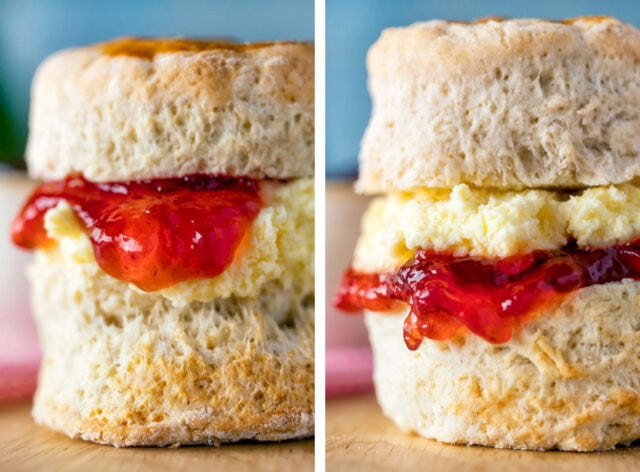
What's the difference between clotted cream and whipped cream?
While at first, a bowl of clotted cream might look similar to whipped cream. But once you take a taste, you'll know the difference.
Both start with the same basic ingredient: heavy cream. But, for whipped cream, you whip that cream into light and fluffy pillows. Often you'll add sweetener and possibly a flavoring, like vanilla, to whipped cream as well.
Clotted cream, on the other hand, is heated and separated, as we'll go into more detail below. This process produces a thicker, creamy substance.
Another difference is that clotted cream is typically not sweetened. People love it for the creamy texture it adds, similar to butter, rather than a particular sweetness or flavor.
What's the difference between clotted cream and butter?
So, if it has a thicker consistency and is more savory, how is clotted cream different from butter?
Again, it comes down to the process.
Butter is made by churning (or whipping) cream. So, if you over-whip your whipped cream, you'll end up with nice, whipped butter.
Clotted cream, again, has to do with the separation of the fat in your cream.
Our reader Angela pointed out to us that the making of butter in a churn took additional time and hard work. So making clotted cream was a much easier option.
What to do with the leftover whey from making clotted cream?
When you make clotted cream, you will be left with a thin, milky liquid below the clotted cream.
That liquid is basically skim milk, and while we don't think it has the best flavor for drinking, it is perfectly good for baking.
You can use it in any baking recipe that calls for milk. Our favorite way to use it is to make a batch of British scones.
However, it would also work well to make this Brazilian French toast or this Finnish braided bread.
Can you freeze clotted cream?
Frozen dairy tends to lose its thickness and creamy texture, so we wouldn't recommend freezing homemade clotted cream. (We'd use it in some of the ways suggested above first.)
That being said, we have heard of some people having luck freezing clotted cream in an airtight container, if it is thawed overnight in the refrigerator before you would like to use it.
If you'd like to try this, we'd suggest starting with a small test batch to see how you like the results.
Buying jars of imported clotted cream can get quite pricey. But you don't have to worry about that anymore!
Homemade Clotted Cream
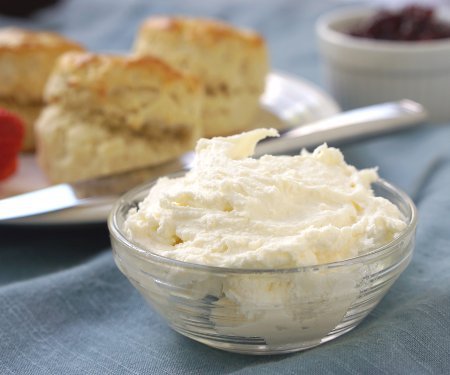
To make clotted cream, you will want to start the process 3 days before you plan to serve your cream. It sounds like a lot of time, but most of the process is done while you sleep!
Ingredients
- 2 c (237 ml) heavy cream, (not ultra-pasteurized)
Instructions
Day 1
- Preheat your oven to 170-180F.
- Pour the cream into a shallow casserole dish or glass baking dish. (The cream should only come up the sides about 1-2 inches. The key here is to have a lot of surface area.)
- Place the cream in the oven for 12 hours, uncovered. (This works great overnight.**)
Day 2
- After heating for 12 hours, the cream will develop a skin. Carefully remove the dish from the oven and let it cool to room temperature. Once cool, cover the dish and refrigerate it for 8 hours (or overnight again).
Day 3
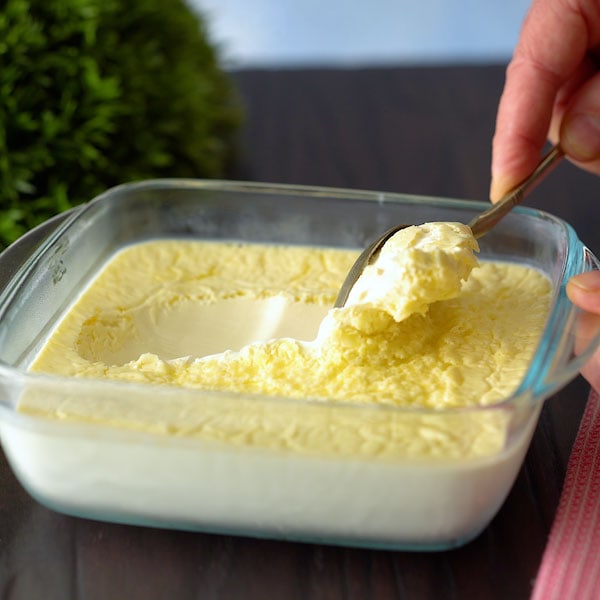
- After chilled, gently skim the thick layer of clotted cream from the surface, leaving the thinner liquid behind. (It will feel like you’re pulling a layer of slightly softened ice cream from the top of a layer of milk*. The skin in fine, it will soften as it is mixed into the cream.)
- Gently stir the skimmed clotted cream to create a smooth texture. (If your cream is too thick for your liking, you can always stir a little bit of the thin liquid back into your cream, until it reaches your desired consistency.)
- Store the clotted cream in a sealed container in the refrigerator for up to two weeks. (Clotted cream can also be frozen and thawed in the refrigerator, if desired.)
Notes
*The leftover liquid can be used like milk. It’s great for baking!
** Oven note #1: Some ovens have a safety feature that shuts them off after extended periods of time. If this is your oven, you may want to do the clotting step during the day, when you can make sure your oven stays on and at a low temperature.
Oven note #2: We have a lot of readers who are discovering as they try this recipe that their oven runs hot. After 12 hours in the oven, their cream has developed a dark brown skin. The skin on your cream should only be a pale tan if it starts to darken. If you think your oven may run hot, check your cream after 8 hours and again after 10 hours to see if the top is darkening. If it is, you may need to cycle your oven between off and on to keep a temperature that is not too hot for the cream. (As a side note, the darkened top on the cream does not mean it is ruined. It simply means your finished cream will have a bit of a deeper flavor, and it will most likely have some flecks of brown and not be a pure creamy white.)
Nutrition Information:
Yield:
16Serving Size:
1 gAmount Per Serving: Calories: 101

Sarah founded Curious in 2010 as a way to save her recipe creations and share culinary experiences. Her love for cultural cuisines was instilled early by her French Canadian Grandmother. Her experience in the kitchen and in recipe development comes from over 10 years working in professional kitchens. She has traveled extensively and enjoys bringing the flavors of her travels back to create easy-to-make recipes.


HI - I was wondering if anyone has tried this in a convection oven. If so, how did it turn out and were there any adjustments you had to make (or will make next time)?
Hi Julie. We haven't tried it in a convection oven, but the general rule of thumb for convection is to decrease the temperature by 25 degrees. So, that is where we would start. Also, I would recommend checking on your cream often after a few hours to make sure it's not browning too much (which would be an indication that the temperature is too high). If you give it a try, let us know what you do and how it turns out for you!
After 12 hours in the oven, mine had not browned at all. My oven is very old. To correct for it, I increased the temperature a little bit and left it in for 4 more hours. Turned out perfect! The second time I made it, I followed the same process and it came out like a granular paste. Would you recommend to taking it out after 12 hours or keep trying to get it to brown?
Hi Gaylen. The browning is not necessary, it tends to happen depending on the oven - if it's too hot or the cream is too close to the heating element. As long as your cream has developed a skin after 12 hours, and you are confident that the temperature was around 170-180F, your cream should have clotted properly.
Only about half my cream clots. Is this typical?
Hi Martha. The amount of clotting will depend on your cream, but this does sound fairly average.
Thank you. It tastes wonderful . Thx for all the nitty gritty details
Glad you enjoyed it!
I am just completing the oven bake using the CostCo Dairy Pure Heavy Whipping Creme Grade A Pasteurized, which contains carrageenan. I took it out after 11 1/2 hours as the crust was slightly more brown than light tan. Is this OK? I used two oven thermometers, which indicated I had kept the oven temperature between 160-175F; however, when I inserted an accurate meat thermometer (Lavatools Javelin Pro) in the liquid it measured 185F. Is the goal to ideally maintain 170F for 12 hours in the liquid?
Hi Christopher. The goal is to ideally maintain 170F, however yours should be fine. You finished cream might just be a little less smooth due to some chunks from the top crust, if it is difficult to incorporate.
Thank you for your reply, Sarah. My first batch did indeed turn out well, and was very well received in two get-togethers when I served it with your recipe for the British Scones, which I adjusted for Mile High baking (5280 feet). I am now making my second batch of clotted cream and watching the oven temperature more carefully.
So glad it turned out well for you!
Just made this recipe! It worked perfectly, overnight in my oven at 170 deg. I actually used nonhomogenized cream we are lucky enough to have at one of our grocery stores. Thanks for the recipe! Really looking forward to using the resultant clotted cream! Just a heads up for some, Trader Joe’s heavy whipping cream is NOT ultra pasteurized, just pasteurized, if you’re looking for a source.
Glad you enjoyed the recipe! Thanks for your tips on finding the cream!
Great recipe. I used a recipe almost like yours from another site, but it uses a lower temperature. The recipe I found does not have as many helpful tips, thanks for those. The tips were very helpful in confirming what I thought was the case. The first batch did come out with dark skin on top, but I mixed it in and had no problem with the taste or texture.
Fortunately, my toaster oven will run at a minimum of about 130-140 F, which is the temp I use. I get some browning, but not as much as I did the first batch.
I also found out I can freeze cream and use the thawed cream in the recipe - it's in the toaster oven now. That's good because I there is no point in my producing 16 oz of clotted cream at at time - 2/3 would go to waste before tow of us could use it. We'll see how freeze-thaw works.
PS Kroger in my area of WV gets the right kind of cream from Homestead Creamery, a dairy located in VA
Thanks so much for sharing your tips Bob. We're so glad you found our article helpful. Enjoy!
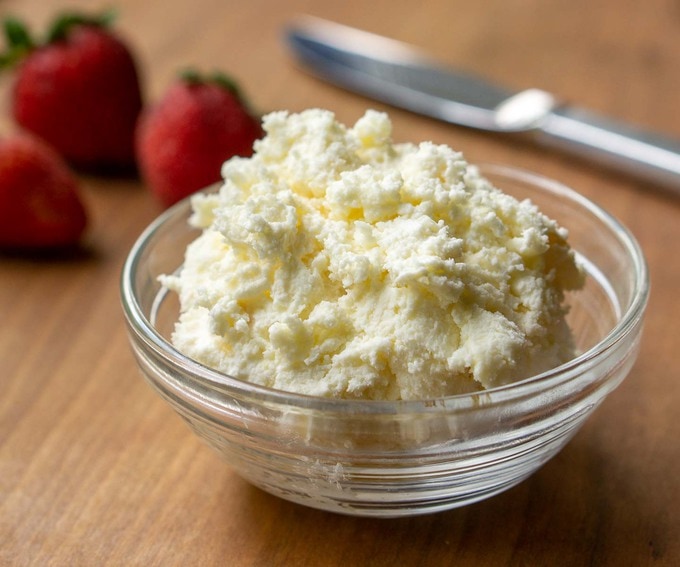
Mine tastes absolutely delicious but the texture is off. It is like a whipped butter texture instead of the smooth creamy stuff I remember. I added some liquid back in but didn’t really help much. And ideas of what has happened here? Also I did mix the top crust part in.
Hi Alicia. We're glad you like the flavor. However, I'm not quite sure what you're describing with the texture. Typically whipped butter is pretty smooth and creamy. Is your texture lumpy? If so, possibly you didn't mix in the top crust enough.
Hi! May I join in with a question? I’ve got a gas oven, and it seems to have the minimal temperature at around 120 Celsius (it’s just called „minimal”). I can dial the gas further down, but there’s a point it’ll just die. And sorry, no thermometer here. Can you give me any tips?
Is this method: https://youtu.be/62f9xo9eLUQ valid? To preheat the oven much higher and then leave it turned off for 12 hours? Thanks in advance
Hi Baskak. We've never tried the method mentioned in the video, so I can't comment on if it would work or not. It is a high temperature for clotting cream, but since you're turning your oven off, it may work, since the oven will cool as the cream heats up. A lot of that will depend on how well-insulated your oven is, and how it will hold temperature for 12 hours. But, you can definitely give it a try and see how it works for you.
Personally, in your case, I would make the cream during the day when you can manually cycle your oven on and off. I would pre-heat the oven to 120C, put in your cream, and then turn the oven off. After an hour or so, check the oven to see if it feels lightly warm, and if not, turn the oven on again, just until you feel it starting to warm inside, then turn it off again. I would continue to do this for the 12 hours. An oven thermometer would help a lot in this case, if you can get your hands on one. Hope this helps!
Thanks for a very kind answer! Will check and let know.
Just made my first batch of Clotted Cream using this recipe! It came out perfectly. I used Wegmans Grade A Pasteurized cream. It's a little on the "tacky" side but I'm sure that's fairly normal, I mean, I didn't really touch for consistency the clotted cream while over seas 🙂 . I am starting some scones now and look forward to surprising my daughter when she gets home tomorrow.
Wonderful Sandi! What a fun treat for your daughter!
I was despairing over the fact i had bought Ultra pasteurized cream and didn’t have time to get the correct cream. I went ahead and followed your directions for the 12 hr bake. When I took it out of the oven I was sure I had wasted so much cream. 4 hours later I scooped out perfect clotted cream. You might want to change the recipe as its hard to find the other cream, at least in the USA.
Hi Melissa. Glad the UHT cream worked for you! That may not always be the case, so we do stand by our recommendation, but it is good to know that some UHT creams can work.
I found it in my area in US....it is a dairy that still delivers..... Just keep hunting for one. Ultra pasteurized adds sugar and i don't want that. Her recipe is fine and tastes like the one in England I just had.
Just saying?
I am on my third/fourth batch of clotted cream (oven method). The first one turned out well using Trader Joe's heavy cream. For batches 2 and 3 (Costco heavy cream) I attempted to use an Instant Pot....#2 set at "keep warm" after heating it up. (2019 8 quart). No luck...I think too low temp. So, next I tried it at slow cooker (less) setting...better, but still very little clotting. Now, I am doing that #3 batch OVER, in the oven overnight tonight. We'll see what comes of this. After I put it in the oven, I read the ingredients list on the half gallon container the heavy cream from Costco came in and saw that it contained carrageenan. Could this be a problem? I saw that one of the success stories had used Costco cream, but wonder of Costco heavy cream here in northern California is different from other places...so the beat goes on and on. I'll report back when I get another success
Thanks so much for sharing the details on your trials Kathy! Carrageenan is a stabilizer (used to keep the cream from separating), so it could very possibly prevent the cream from clotting properly.
I’ve made yogurt in my instant pot, and I think that may be the way to go. Yogurt needs to set at around 180 F, so I’m assuming it should be okay. I’m going to try it, after getting some fresh cream from my brother who runs a raw dairy.
That sounds like a great method to try Sue. Do let us know how it turns out for you!
The yogurt setting is too low, only about 110 F. I took out my NuWave electric plate. I set the temp for 180, partially covered it, and kept a candy thermometer in it and set the timer. It stayed at 170 F the whole time. It had a very thick, very golden skin on it. Next time I’m going to try a shorter time. I couldn’t stir the skin in enough and I don’t like the mouth-feel of so many chunks. But, it was delicious on the stewed apples
Thanks for the update Sue!
If the cream doesn't clot in 12 hours, can I turn up the heat by 5 degs. and keep in the over longer than 12 hours?
Hi Genie. Unfortunately, if the cream didn't clot in 12 hours, your cream probably isn't going to clot. Is it possible that you purchased UHT (ultra high temperature) pasteurized cream?
Sarah, I make clotted cream all the time by this same method. Love it. I've made it with all sorts of heavy cream, and it always works. It's a common misconception that it cannot be made with ultra-pasteurized cream. I think one person put that idea out there at one time and others keep passing it along without testing it, but I've tested it! I've used organic and conventional, lightly pasteurized and ultra-pasteurized--it all works. Your gorgeous photos are making me hungry! Must get one of my last two little pots of clotted cream out of the freezer now for tomorrow. Then it will be time to make another batch.
Thanks for your note Jean. And that is great to hear. We have had better luck with some creams than others, as have some of our readers, so there's definitely something in that makes some clot better than others. Maybe it's the milk fat content or maybe it's a particular brand's process. It's so hard to know! Thanks for sharing your experience!
My boyfriend became lactose intolerant several years ago and really misses clotted cream. Vegan stuff just isn’t the same, so I wanted to make him some using lactose free cream. Unfortunately I can only find single cream, not heave. Would this work?
Thanks x
Hi Melody. I don't have experience making this recipe with lactose free cream, so I can't make any promises about the results. However single cream is typically around 18% milk fat, while heavy cream is typically 36-38% milk fat (whipping cream is 30-35% and double cream is 48%). So, I'm not so sure that single cream has enough fat to make the clotting work. If you could find a lactose free whipping cream or double cream, I would be more confident that those may work for you. If you do decide to give it a try with the lactose free single cream (or another version), definitely stop back by and let us know how it works for you, because I'm sure other readers would be interested!
Hi you can buy some lactase capsules open them up and add them to the heavy cream
Leave over night and you have lactose free cream. Also best to get Guernsey or Jersey cream if possible as it is A2 cream/ milk and often people are allergic to A1 milk which is the majority.
Just returned from Victoria BC where I enjoyed tea at The Empress Hotel.... I am in love with their scones and clotted cream..... I did much hunting around and found raw heavy cream locally..... So I'm going to try your recipe tomorrow during the day so I can watch it.....I hope raw is safe and the ideal choice..
Hi Jeanenne. What a wonderful trip! Yes, raw heavy cream should work nicely! Do let us know how it turns out for you!
I followed the directions.... the top was a light golden color.... I tried to skim it off, but it was pretty solid.... I should have poured the liquid off the bottom but didn't think of it... I pulled the top off and put in a bowl but some of the milk came with it....so it is not as thick....It is about half the clotted cream and half the top harder layer... It tastes great but it is chunky.... I'm making scones tomorrow.... I went to my local boutique market today and low and behold they had clotted cream in their dairy section so I can try them together and see which s best...
Thanks for the follow up Jeanenne. You can add some of the liquid back in as you stir and it will soften the chunks as it rests. Hope you enjoy the taste!