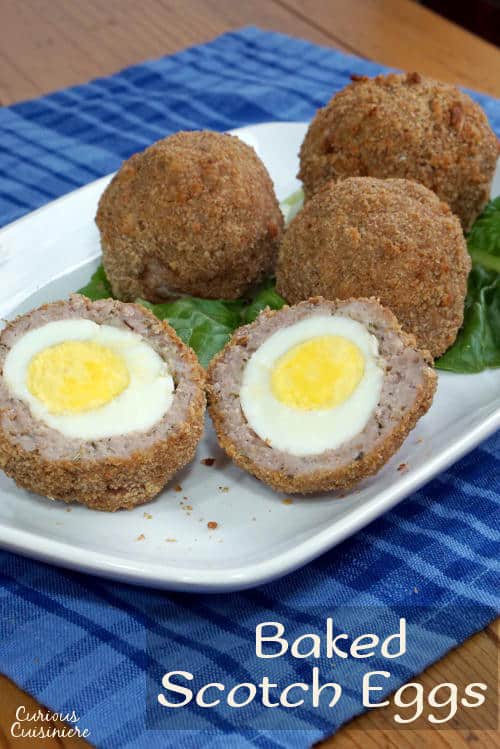
Baked Scotch Eggs
Avoid the deep fryer with these Baked Scotch Eggs, this easy recipe is perfect for a fun lunch or picnic.
Not Scottish?
Contrary to popular belief, Scotch Eggs have nothing to do with Scotland. Actually, these little, hand-sized snacks originated as a British picnic staple. It is only recently that they have begun to make their way into pubs and restaurants worldwide. (As one of our readers mentioned, Scotland is a part of Britain, but the origin of the dish is tied more closely to England, in the southern region of Great Britain.)
The original Scotch Egg is said to have been invented by the British department store Fortnum & Mason in 1738. The name "Scotch" didn't come as a reference to Scotland at all, rather, it came from the term "scotched" which refers to the preparation method of coating something with breadcrumbs and frying it.
Layers of Flavor
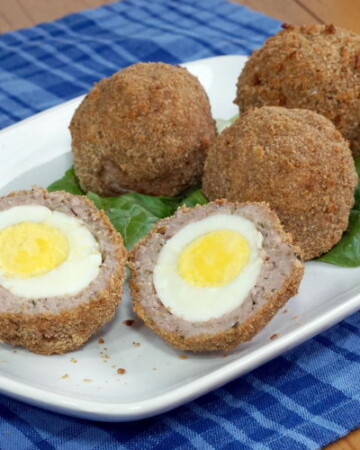
The perfect Scotch Egg is all about layers. A crispy exterior, flavorful sausage, and a slightly soft-yolked hard-boiled egg. The result is a combo that is strangely addicting.
What's not so addicting is the belly-bomb that the deep-fried version can be. Yes, traditionally all Scotch Eggs are deep-fried, but since Tim and I have an aversion to deep-frying at home (Don't get us started on that that oil smell that lingers for days...), we wanted to find a way to make these treats while avoiding the excessive use of hot oil.
Making the Eggs
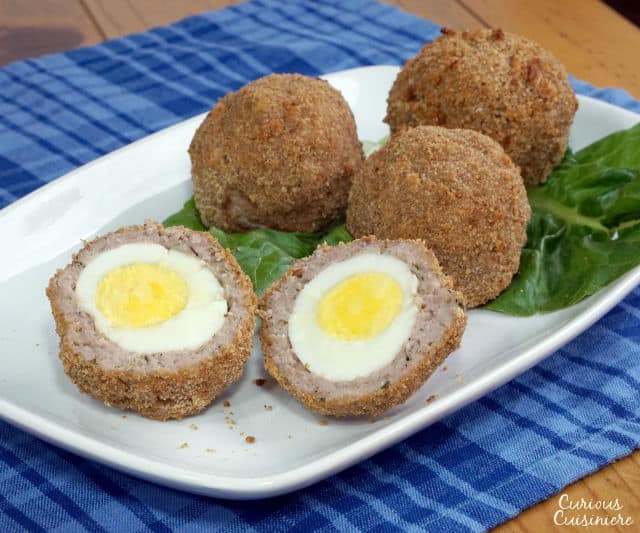
The Eggs: There is quite a bit of debate about what type of hard-boiled egg should be used for Scotch Eggs. Some like their eggs runny, other like them barely soft, others prefer them to be hard-cooked. Whatever your preference, keep in mind that the eggs will continue to cook in the oven. So, boil them for a smidge less than you typically would. (For example, our go-to hard-boiled eggs get 5 minutes of simmering after coming to a boil from cold water. So we cooked them for around 4, and you can see that the yolks still ended up quite well done.)
The Sausage: As for the sausage, we like to season ground pork roast and make our own sausage. But, to make the Scotch Eggs even simpler, just use a roll of your favorite breakfast sausage. We won't tell. In fact, our recipe below includes both methods, so pick your favorite.
The Breading: Don't skip the three-step breading process. Rolling the sausage in flour helps the breading to adhere better. Feel free to use your favorite bread crumbs, seasoned or unseasoned. Panko crumbs would also work very well.
 Have A Picnic
These really are great to take along on the go. It might seem strange, but they are just as tasty at room temperature or cold as they are fresh from the oven. Serve them with a nice salad for a perfectly complementary lunch or dinner.
Baked Scotch Eggs
Yield: 6 Scotch Eggs
Ingredients
- 6 hard boiled eggs,* large
For the Meat
- 1 lb ground pork or a pre-seasoned breakfast sausage roll
- 4 teaspoon bread crumbs
- 1 teaspoon thyme
- 1 teaspoon parsley
- 1 teaspoon fennel
- ½ teaspoon garlic powder
- ½ teaspoon salt
- ¼ teaspoon nutmeg
- ¼ teaspoon ground black pepper
For the Breading
- ¼ c unbleached all purpose flour
- 1 egg
- ½ c breadcrumbs
Instructions
- Preheat your oven to 400F.
- Peel the hard-boiled eggs and set them aside.
- Place the ground pork into a large bowl. Add the breadcrumbs and seasonings and mix well with your hands until combined. (If you are using pre-seasoned sausage, then just add the bread crumbs.)
- Place the flour in a shallow bowl. Set aside.
- Crack the raw egg into a second shallow bowl. Beat it slightly and set aside.
- Place the breadcrumbs into a third bowl. Set aside.
To Assemble the Eggs
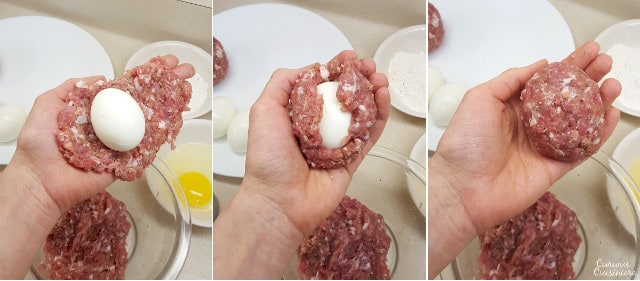
- Flour your hands and scoop a scant ? cup of the pork mixture into your hands. Flatten it into a patty. Wrap the pork around one egg, pinching it together to seal any seams.
- Roll the pork covered egg first in flour. Then, dip it in the beaten egg. Finally, coat it in bread crumbs.
- Set the coated eggs on a well-greased parchment or silpat lined baking sheet.
- Once all the eggs have been coated, spray them generously with cooking spray and place them into the preheated oven.
- Bake the eggs for 20 minutes, until they are golden and the pork is cooked.
- Serve the Scotch eggs warm, cold, or room temperature.
Notes

Sarah founded Curious in 2010 as a way to save her recipe creations and share culinary experiences. Her love for cultural cuisines was instilled early by her French Canadian Grandmother. Her experience in the kitchen and in recipe development comes from over 10 years working in professional kitchens. She has traveled extensively and enjoys bringing the flavors of her travels back to create easy-to-make recipes.
Thank you, these are excellent! Definitely a keeper! I was having cravings for Scotch Eggs from a favorite restaurant (currently closed) and these absolutely hit the spot. I always thought they would be harder to make. Your breading process made everything stick together perfectly.
Glad you enjoyed them Jessica!
I’ve always fried my scotch eggs but baking is easier and less messy. I also used a baking rack on a sheet pan in a convection oven. No problems with burning. Your history of scotch eggs was very interesting!
Glad you enjoyed the recipe! Convection ovens do work nice for these.
I love scotch eggs and am very pleased to have come across this recipe for baking them. However, due to health reasons I am not allowed to eat pork (?) so I was wondering if I could use chicken mince instead... Would love to know your thoughts...
Hi Anamit. I would think chicken would work for these. If you can, I would grind your own chicken and use mostly thighs, that way you get a higher fat content, similar to pork. If not, you might need to add an egg to your meat mixture to help the ground chicken to hold together. If you give it a try, definitely stop back by and let us know what you did and how it turns out!
Hi, how would you adapt this using quail eggs please ?
Hi Delorca. I'm not too familiar with working with quail eggs, however if they can be hard boiled, then the concept should be the same as written here, just smaller, so it will make more. That would be a fun way to make these small, appetizer sized! You'll probably want to reduce the baking time, since you will be using less meat. I'd check them after 10 minutes to see if the pork is cooked and they're golden, but you may need to go a bit longer than that. If you give it a try, definitely stop back by and let us know what you did and how they turn out for you!
Very happy with the result. One thing I did was to lay the fully prepared eggs (after spraying with oil/baking spray) on a baking rack over sheet pan and baked them as per the recipe. This method seemed to reduced risk of burning and gave a better overall baked exterior. Also prepped the eggs (before coating with meat mixture) just to the soft boil stage - they were perfect texture after baking.
Thanks for sharing Nan! Glad you enjoyed the Scotch Eggs!
I tried baking and the bottoms burned, I forgot to spray with cooking spray Ill have to try again. Do you rotate as they are baking. I traditionally do a dozen plus for X-mas by frying to I am experimenting with the baking to do all at once
Hi Lynn,
I'm sorry to hear the bottoms burned. We typically don't rotate them as we are baking them, but we also use a silpat mat, which may create a bit of a temperature buffer. I would try rotating them halfway through baking to see if that helps.
It is also possible that your oven is a bit too hot. So, you could try lowering the temperature 5 degrees or so. And, I would also make sure that the scotch eggs are being baked in the middle of your oven. If they're too close to the bottom heating element, that could have caused the bottoms to burn as well.
Merry Christmas!
I love these for breakfast when we are camping! One of my favorites!! And I totally agree with you about the smell of oil that lingers for days when you fry at home. Bleh!!
These would be perfect for camping. Great idea!
Glad you baked these. Scots fry everything, even when they shouldn't!
In our opinion, they're even better baked!
I made these with different meat sausages but pork does work the best. Your Scotch Eggs look great!
Thanks Cindy! We're excited to try the concept with different ground meats now. The possibilities are endless!
Mmmnn, that sounds delicious!
Thanks Michelle!
Yum! These have been on my list for a while. I will definitely have to try yours!
Thanks Tara! You guys will love these!
I like the idea of baking instead of frying. Not to be picky but Scotland is still part of Britain 🙂 But I think Scotch eggs are possibly more form the English part than further North.
Good point Caroline! Thanks! 🙂
No Scotch eggs started in Scotland, I'm 73 years old and my Mum taught us how to make them when we were little Btw they are also good made with lean ground beef for a change, just make sure you spice them up,
Thanks for your comment Sheena! It's quite possible that Scotch eggs spread in popularity very quickly! What a great idea to make them with lean ground beef! We'll have to give that a try!
Sara, I am so glad you baked these! I have wanted to try Scotch Eggs, but can't have deep fried foods. This looks great!
Thanks Kristen! So glad you can try these now!
I've only had a mini version made with quail eggs and they were delish! So nice to have a recipe now 🙂
A mini version would make such a great appetizer!
Scottish or not I want to try these. I like how they would be great to make for a party too.....
They would be such a fun party dish! Thanks Tammi!