No Pectin Apricot Jam (And All About Pectin)
If you've ever wondered how to make apricot jam without pectin, look no further! With just three ingredients, this jam brings all the classic flavor!
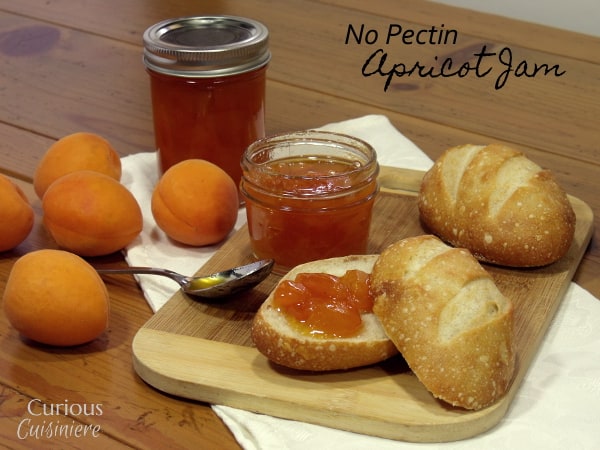
Maybe it is because we have spent this past year eating mostly mulberry jam that was the result of last year's bumper crop. Or, maybe it is a childhood craving coming back to haunt us.
Either way, Tim and I have both been dealing with some crazy hankerings for apricot jam.
A few days after realizing that something needed to be done to remedy the situation, I took a trip to the grocery store. There, right in the middle of the produce section, was a huge basin of apricots.
ON SALE!
It was fate.
Sweet, sweet fate.
No Pectin! What to do?
As I started making the jam, I realized I was almost out of pectin.
Not a big deal really, since I've been making jams with and without pectin for the past few years. Last year, my jams were turning out well with pectin, so I stuck with it.
This year, however, jams have been a bit of a struggle, even with the pectin, so I decided to do some research and try my hand at jamming the way grandmas have jammed for ages (any time prior to the 1900s in fact): without commercial pectin.
What is Pectin?
Pectin is a naturally occurring carbohydrate that is concentrated in the fruit's skin and the core.
In the fruit, pectin actually helps to build and form the cell walls.
When cooked, acid draws the pectin out of the fruit. The released pectin then binds with itself, causing jams and jellies to gel.
Apples, crab apples, raspberries, blackberries, currants, cranberries, concord grapes, plums, and the skin of any citrus fruit have more than enough natural pectin and acid to gel with only added sugar.
Apricots, blueberries, cherries, peaches, and strawberries typically need some sort of added pectin or acid.
Do you see a problem?
Apricots fall in the "need more pectin" group.
This was quite curious, since many of the recipes I found for apricot jam did not add pectin or high pectin fruits.
The only way to tell was to plunge forward.
No Pectin Apricot Jam
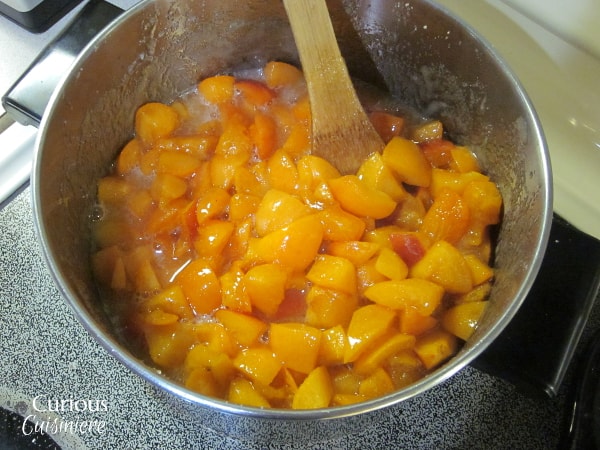
We chopped the fruit, mixed it with sugar and lemon juice, and started to cook.
Cooking a jam without pectin does require a longer cooking time. For us, it took about a half hour to reach 220F, the jellying point.
While the longer cooking time does result in less jam (more time for the liquid to evaporate), it also starts to caramelize the sugars, giving the jam a nice, deep flavor.
So, what was the jelling verdict?
This definitely isn't a hold-its-shape kind of jam.
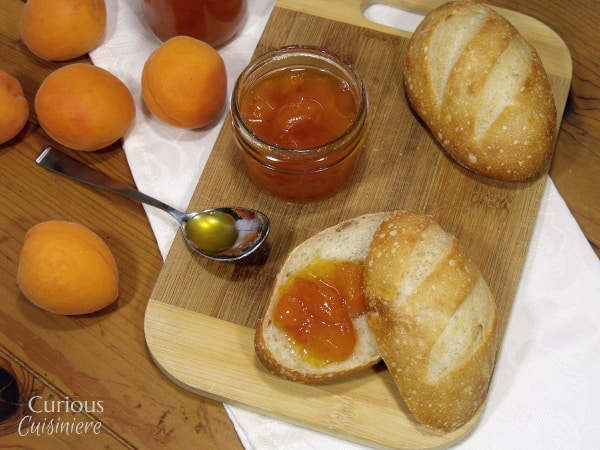
It is incredibly spreadable and fruity, a natural feeling jam, with an overwhelming amount of that classic apricot jam flavor.
For us, it was a winner!
Canning apricot jam
Our recipe for apricot jam below fills 6 (8 oz) ½ pint jars (and one 4 oz jar), so it's the perfect recipe to do some canning and save a few jars for later. (Or to make and give as gifts!)
If you are new to canning, you might want to check out our guide to water bath canning. (For additional references, here is the official USDA safe canning guide from the National Center for Home Food Preservation.)
However, when making jam there is often enough heat, sugar content, and acid that we have had luck doing a simplified canning version that is often called the French Canning Method.
It simply involves turning the (tightly sealed) jars upside down on a cooling rack and using the heat of the jam to activate the seal. We leave the jars upside down for 20-30 minutes, or until we hear the seal pop. Then we turn them back right side up to finish cooling.
It is important to note that (while used for ages by grandmothers) this method is not recognized by the USDA. So, use it at your own risk. If you are concerned at all, definitely follow our instructions for water bath canning linked above.
Are apricot kernels safe?
At one point we offered the option that you could take a hammer to the apricot pits to remove the outer husk and reveal the inner noyaux or kernel. One of these kernels can be placed in each jar with the jam to add a slight almond flavor. (This kernel should be for flavoring only, and we do not recommend that you consume it.)
We have received many comments about the safety of apricot kernels, so we wanted to take a moment here to address the issue.
Sweet apricot kernels are often used in European baking and sweets-making. For example, crushed kernels are a key component in Italian Amaretti cookies.
There is some concern about the safety of consuming apricot kernels because they contain high levels of amygdalin, which contains cyanide. But, before you get scared away from Amaretti cookies and using apricot kernels for flavoring, you should know that there are two different types of apricot kernels: sweet and bitter.
Sweet apricot kernels are sweeter in flavor and are significantly lower in amygdalin. These are the ones used in baked goods that would be consumed.
Bitter apricot kernels do contain enough amygdalin to be considered potentially toxic. Studies have shown that eating 30 bitter apricot kernels could cause cyanide poisoning.
As always, please use your best judgment. We feel that apricot kernels are safe if used only to add flavoring and are not intended for casual consumption. You definitely won't find us munching down handfuls of kernels, sweet or bitter, for an afternoon snack.
More jam recipes
Toast, biscuits, and scones call for jams, jellies, and curds. Here are some recipes to get you started!
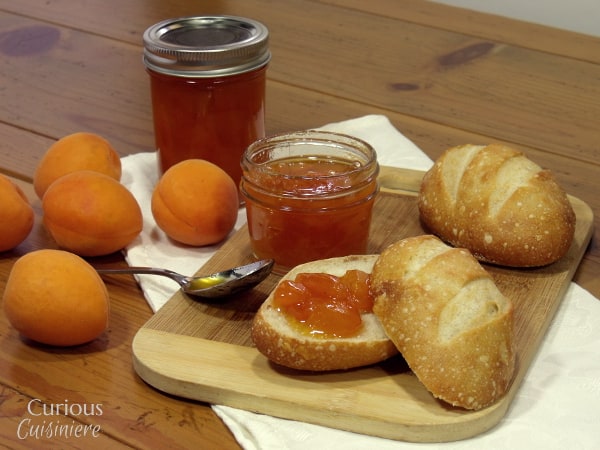
No Pectin Apricot Jam
Ingredients
- 3 lbs whole apricots (roughly 8 c chopped, pitted and diced)
- 4 c sugar
- 1 very large lemon, juiced (¼ c of juice)
Instructions
Preparing the Jars
- Clean your lids and jars, and place lids and jars, upside down, in a 200F oven.
Making the Apricot Jam
- In a 3-4 qt soup pot, mix all of the ingredients. Heat over medium, stirring often, until the mixture begins to bubble and foam. (For us, this was about 20 minutes.)
- Place the candy thermometer in the mixture and turn the heat to high. Continue to heat the mixture, stirring constantly. (At this point, you may want to put on an oven mitt. As the jam thickens it will begin to foam, sputter and spit. This is good; it means things are getting jammy. But, it's not too good if you get hit.)
- Once the mixture reaches 220-222F, remove the jam from the heat. (For us, it took 8-10 minutes to reach the jamming temperature.)
Canning the Jam
- Using oven mitts, remove the hot jars from the oven. Ladle the hot jam into the hot jars, filling to ¼" of the top. ( ¼" is roughly the width of then nail on your little finger.) Wipe the rim of the jar with a damp towel to remove any sticky spillage. Top the jar with a hot lid and band. Tighten the band as tight as you can. Repeat until all the jam has been jarred.
- If canning, process your jars in a water bath canner, using a water bath canning guide for jam.*
- After canning, remove the bands after the jam has cooled. Check the seal on your lids and refrigerate any jars that have not sealed. Wipe the jars down one last time to remove any sticky bits before placing the bands back on the jars loosely and storing the jam.
Notes
Nutrition
If you're looking for preserving recipes - look no further!
Learn how to …
- Dry Fruit - No-Dehydrator-Needed from Take A Bite Out of Boca
- Freeze Herbs from Rhubarb and Honey
- Make Freezer Harvest Soup Kits from Cindy's Recipes and Writings
- Make and Freeze Rosemary Butter from Momma's Meals
Salsas and sauces
- Classic Freezer Tomato Sauce from Noshing With The Nolands
- Peach Salsa from The Texan New Yorker
- Pico de Gallo from Bobbi's Kozy Kitchen
Jellies, jams and preserves
- Apricot Habanero Jam from Food Lust People Love
- Corn Cob Jelly from Daily Dish Recipes
- Hot Pepper Jelly from A Kitchen Hoor's Adventures
- Peach Preserves from Delaware Girl Eats
- Savory Fig and Sweet Onion Freezer Jam from Peaceful Cooking
- Spicy Ginger Tomato Jam with Coconut Sugar from Sue's Nutrition Buzz
Pickles
- Bread and Butter Pickles from That Skinny Chick Can Bake
- Pickled Beets and Onions from Kudos Kitchen by Renée
- Pickled Green Tomatoes from Culinary Adventures with Camilla
- Refrigerator Pickles from Webicurean

Sarah founded Curious in 2010 as a way to save her recipe creations and share culinary experiences. Her love for cultural cuisines was instilled early by her French Canadian Grandmother. Her experience in the kitchen and in recipe development comes from over 10 years working in professional kitchens. She has traveled extensively and enjoys bringing the flavors of her travels back to create easy-to-make recipes.
I've been using your website a lot for quarantine cooking, and our apricot tree is coming to the end of its yield and I figured I would try my hand at jamming a bunch of our apricots to make them last longer. On another recipe it said I needed to peel the apricots so do I need to do that for this recipe too, or can I just chop up the apricots skin-on? (I really don't want to peel 8 cups worth of apricots if I'm completely level with you)
Hi Zee. Glad you found us! I'm with you on not wanting to peel apricots, so I don't. I just make sure to chop them fairly small (skin on). I also don't mind skin bits in my jam. So, if you don't mind the texture of the skins, you're find to leave them on. Happy jamming!
Hello,
My name is Carola Croucher. My daughter, Victoria found your Apricot Jam recipe and she is interested in making it and submitting it to the National Junior Horticulture Competition. She will be attending this year's convention in Lincoln, Nebraska. http://njha.org
Your name and website link will be given credit on her submission. We would appreciate if you could grant as permission to do so.
Thank you!
Sincerely,
Carola
Thank you for checking with us on this Carols. We would be happy if your daughter uses our recipe with credit. Do let us know how it turns out for her and how she does!
I decided to make jam when I found two cheap bags of over-ripe organic apricots at my local farmers' market this morning. This was my first-ever batch and it turned out fabulous! Thank you for demystifying the jar prep process, which is what had kept me away from making jam all these years. I can't wait to make more as seasonal fruit comes in to the market! Merci!
So glad you enjoyed this recipe and your first jam experience!
h . ave you ever used crushed pineapple with your apricots and if you have what what recipe would you use. I never use pectin. Your jam is great
Hi Linda. We haven't tried pineapple with the apricots, but it sounds like something we are going to have to try soon!
First time I've made jam, and it turned out great. My candy thermometer wasn't working, so I just cooked until carmelized.
I'd add to your suggestions to have a splatter screen on hand!
Glad you enjoyed the jam! A splatter screen is definitely helpful. Great suggestion!
Apparently, five apricot kernels a day help combat the possible onset of cancer
That is really fascinating. I'd make sure they are sweet apricot kernels, just to be safe.
Hi,
My name is Nan. I followed your recipe for apricot jam, with out the pectin. I am having problems with it
thickning. Did I do something wrong?
Hi Nan. Thanks for your comment. Like we mention in the article, this is not a super-thick jam, so it is very possible that you didn't do anything wrong at all. As long as your jam reaches the jellying point of 220F, it is ready. (You can always go a little further if you like, but it's not necessary.) For us, it took about a half an hour, but if you doubled the recipe it will take longer. Apricots are one of those fruits that don't have much natural pectin, so making an apricot jam without adding pectin means that your jam will not set up like a jam that has lots of pectin (natural or otherwise). But, it is still a tasty jam! Enjoy!
So am I understanding this correctly, I KEEP the skins on?
Hi Jean, We kept the skins on, because peeling the apricots would have been a bit of a pain. The skins cooked down nicely for us, and honestly, we don't notice them in the finished jam. But, our jam is chunky anyway. That's just the way we like it. If you're looking for a smoother jam, you may want to try peeling your apricots.
Great recipe! Converts pretty well to freezer jam, too...
You might want to consider a little disclaimer about using apricot kernels, as they do contain amygdalin, which converts to cyanide in the stomach.
Sweet apricot kernels have significantly less of this than the bitter variety from the mediterranean, and the LD50 for a human is something like 1.5 mg/kg (where a sweet kernel only contains about 0.3 mg according to wikipedia) so the risk from a single kernel per jar is probably negligible. Still, as I found (before looking it up) that the sweet kernels are quite tasty, it might be worth warning people not to start eating them wholesale, e.g., in place of almonds.
https://en.wikipedia.org/wiki/Apricot_kernel
http://www.webmd.com/vitamins-supplements/ingredientmono-1190-apricot%20kernel.aspx?activeingredientid=1190&activeingredientname=apricot%20kernel
I have had some very tasty successes with apricot wines and was considering throwing some cracked kernels into this latest batch... now, not so much.
Hi Philip. Thank you for your comments and your concern. We have decided to remove our note about the kernels from the recipe and add a section addressing the concerns surrounding the kernels, to make people more aware.
Apricot wine sounds lovely! We might have to make that one of our next wine batches!
If pectin is naturally occurring in the skin of the fruit, why is having more sugar in the recipe preferable to adding certo.? Especially when we aim to reduce sugar in our diets? We've retired and have the first big crop from our 4 year old tree here in the desert of British Columbia and I'm ecstatic as this seems like the tropics after an Ontario upbringing with lots of fruits but no peaches, apricots.
Hi Rosemary. Thanks for your comment. There are a number of reasons some people prefer not to use commercial pectin. One of the major concerns to some people is that many commercial pectin products are derived from GMO corn or non-organic citrus.
For us, making jam without pectin is just a fun experiment in making jam the way people did for ages before commercial pectin was available. And, it is good to know that you can make jam without pectin in case you run out of pectin and really want to make a batch of jam!
Enjoy your fruit tree! Nothing beats fresh-grown fruit!
just made this recipe! Not sure if my thermometer may be broken? but after 20-25 minutes of hard boiling, the temp never went about 208. I finally decided that texture and color were right, so removed from heat and jarred. I'm hoping for the best! Looks and smells wonderful!
Hi Susan, Thanks for your comment. The last temperature hump does take the longest to get over, but it should have hit after that length of time. We would recommend testing your thermometer just to be sure it is working properly at those high temperatures. If the texture and color of the jam looked right, that's a good indication that you were right on track. Hopefully it turns out for you!
Thank you for this!! I'm going to try a little bit of both one batch with pectin and another batch without, since I have a whole apricot tree that is loaded with fruit.
How fun! We love doing comparisons like that. It's the best way to learn! We're super jealous of your apricot tree!
Sarah, thank you! I followed your instructions to the letter and my apricot jam is perfect. Is it possible to make plum jam using this same method? Mine are the Santa Rosa variety.
Wonderful Amber! Thanks for stopping by to let us know how your jam turned out! We haven't tried a plum jam, but the same method should work. Let us know how it turns out!
This jam looks really good! I don't use pectin in any of my recipes...I just stand there, stir and cook...then can! This year I made a peach apricot jalapeño jam that's to die for! It's fantastic with pork and chicken.
Thanks Susan. Your Peach Apricot Jalapeno sounds fantastic!
Wow! I would really like to get that peach apricot jalepeno jam recipe!!!
OK... I'm fascinated to hear about making almond extract with the pits!! I made apricot jam this year and last and its one we enjoy making each year! please send me the link when its up (acookingmizer@yahoo.com) - I love this recipe too! : ) I hope this satisfies your cravings!
Will do Alice! It is infusing as I type. Hopefully we will have good news to share!
I love this recipe, but please don't tell people to eat the pits!!! It contains a naturally occurring cyanide.
It is known for containing amygdalin, a poisonous compound that, together with the related synthetic compound laetrile, has been marketed as an alternative cancer treatment. However, studies have found the compounds to be ineffective in the treatment of cancer, as well as potentially toxic or lethal when taken by mouth, due to cyanide poisoning.
Please don't kill your guests
Hi Michele. We were definitely not meaning for people to eat the pits! But, simply placing a kernel in the jar will give the jam a nice flavor. We can understand how our note on the recipe may have been confusing, so we have gone ahead and removed that note. In place of it, we have added a section about apricot kernels and the concerns surrounding them. Thank you for your concern and your comments.