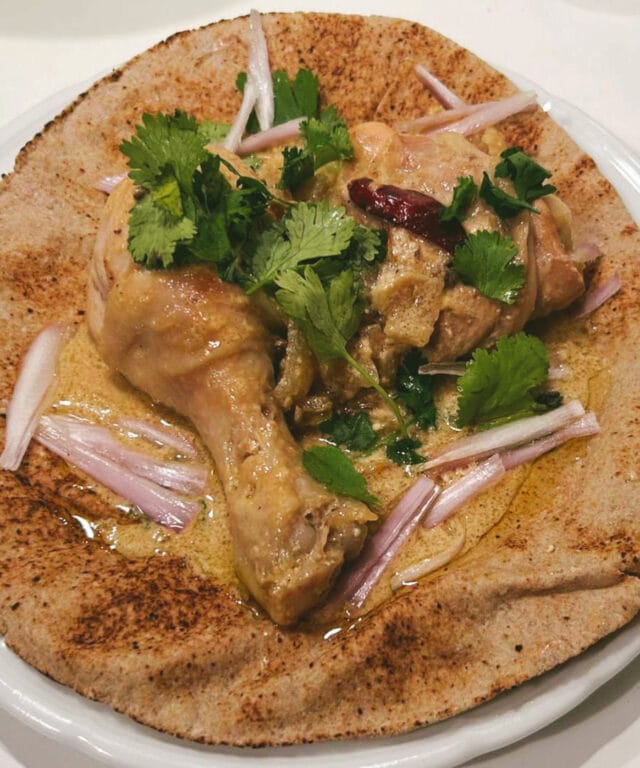
Padampuri Chicken Curry
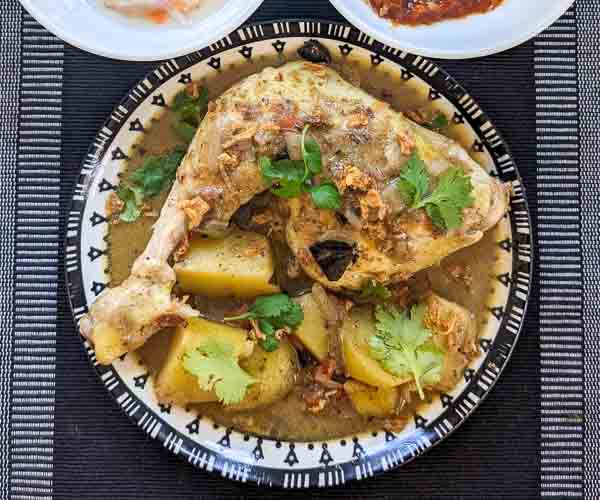
Padampuri Murgh (Padampuri chicken curry) is a rich and creamy milk-based Indian curry from the country's northwestern deserts.
Rajasthani Desert Feast - No Water Allowed
It is already past dawn in Rajasthan, the Land of Kings, in northwestern India. It is a very special day for the people of Padampur city, as it is the first wedding of this year, and everyone is excited.
After the rituals in the Hindu temple of Ganesh come to an end, the people of Padampur gather in the main square, eager to eat, drink and dance together under the moonlight.
Served alongside many small chutneys on a colorful rug, huge plates of Padampuri Chicken Curry are being brought to the center of the rug. Its creamy, milky sauce is as white as the full moon that governs the night. Its gentle aroma spreads into the air which has a holy presence to it, as the incense of the Hindu temple is still around.
And thus, the Rajasthani feast has begun.
What is Padampuri Murgh (Padampuri chicken)?
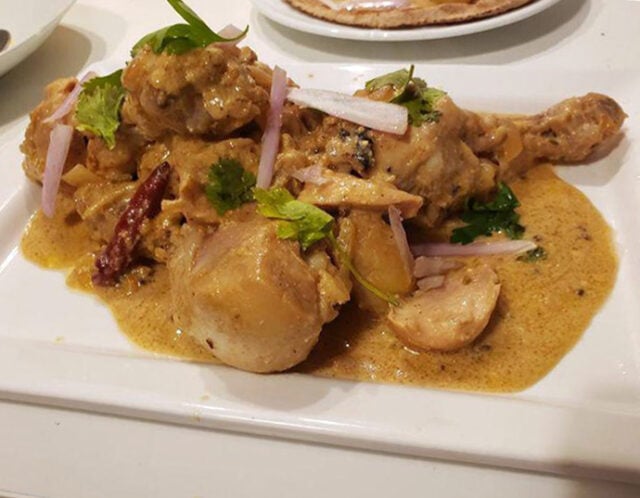
Padampuri Murgh is an Indian chicken curry that originated in Padampur, a city in the north of Rajasthan. The dish is very unique to the region. The people do not eat it daily, but only on festive and special occasions.
Rajasthan, which literally means "The Land of Kings", is a state in the northwest of India. It is the largest Indian state by land size, and it is home to the wide and inhospitable Thar desert.
Rajasthan's cuisine mainly comprises of spicy vegetarian dishes. However, back in the day, the Rajputs ruled the Kingdom. They were a warrior sect who glorified the meat that they hunted down by preparing luscious meat and chicken curries.
Padampuri Murgh is unique for two reasons. Firstly, the gravy that you cook the chicken in is based on khoya, a by-product of milk, which has a deep dairy flavor to it.
Secondly, in the spirit of the Thar desert, this curry is slow-cooked for a long time without any water. This also contributes to the dish's deep flavor and concentrated aroma.
What is khoya?
Khoya (or khoa) is widely used in India, Nepal, Bangladesh, and Pakistan. It is a concentrated milk product that you can make at home by reducing milk to about ⅕ of its original volume. To speed up the process, I use a combination of simmered milk and milk powder in the recipe below.
Its color is white or pale yellow. And it is widely used in making Indian sweets.
Is Padampuri chicken curry spicy?
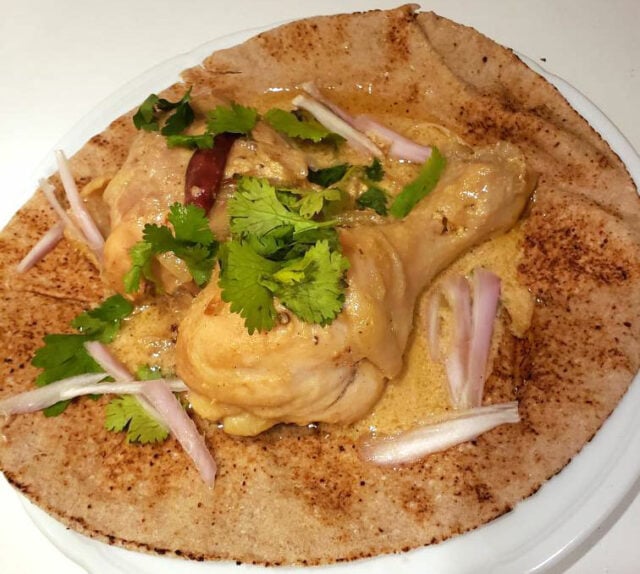
In Rajasthan, they commonly use the mathania red chili in this curry.
As a substitute, you can use Kashmiri dried chili, Sichuan dried chili, or guajillo dried chili.
Whichever chili you choose, this curry is not about the hotness of the chilies. Its flavor comes from the dairy and the other spices used in the recipe.
If you're not a fan of spicy curries, you can reduce the number of chilis or even omit them from this recipe. You will still be experiencing the full flavor of this Rajasthan feast dish.
How to serve this Indian chicken curry?
You can serve Padampuri chicken curry with flatbread or Basmati rice. Garnish with cilantro and shallots, if you like for added color and crunch!
Are you ready to feast in the Land of Kings? Give this Indian chicken curry a try. Rajasthan is calling you!
Padampuri Chicken Curry

Padampuri Murgh (Padampuri chicken curry) is a rich and creamy milk-based Indian curry from the country's northwestern deserts.
Ingredients
For homemade khoya
- 2 teaspoon ghee or butter
- ½ cup milk
- ½ cup milk powder
For curry
- 2 cups yogurt
- 1 ½ teaspoon salt
- 1 teaspoon white pepper (can be substituted with ½ teaspoon of black pepper)
- 2 cloves garlic, finely chopped
- 1 thumb-sized piece of fresh ginger, finely chopped
- 2 teaspoon ghee or butter
- 3 whole cloves
- 1 cinnamon stick
- 1 teaspoon coriander seeds
- ½ teaspoon fennel seeds
- 4-5 dry chilles (Kashmiri dried chili, Sichuan dried chili or guajillo dried chili) (optional)
- 2 white onions, finely chopped
- 2 ¼ lbs (1kg) chicken, bone in
- Homade khoya (or, alternatively, ½ cup of store-bought khoya)
- More salt to taste
- 4-5 tablespoon cream
- Chopped cilantro, for garnish
- Shallots, cut into thin strips, for garnish
Instructions
For homemade khoya
- Using a frying pan (preferably non-stick), heat the ghee on a low heat.
- Add milk and gradually bring to a boil, while stirring constantly (so the milk doesn't curdle).
- Add milk powder and stir it into the milk for a few minutes, until thickens into a pudding-like texture.
- Transfer the khoya to a bowl and wait until it cools down completely.
For curry
- In a bowl, mix yogurt, salt, white pepper, garlic, and ginger. Set aside.
- Add ghee to a wide pot, and turn on the fire to low heat.
- Add cloves, cinnamon stick, coriander seeds, fennel seeds, and dry chilies and fry for 1 minute, or until the coriander seeds start to splutter.
- Add onions, and fry until the onion is translucent. Stir occasionally.
- Add chicken, and fry on both sides until the skin is caramelized.
- Add the khoya, and spread it around to all sides of the pot.
- Add the yogurt mixture and stir the pot constantly until it starts boiling and the fat separates from the yogurt.
- Cover the pot and cook on low heat for 45 minutes, or until the chicken is tender.
- Add cream and mix. Adjust salt and pepper, if needed.
- Enjoy your Rajasthani feast! Serve it with basmati rice on the side or on top of a flatbread.
Nutrition Information:
Yield:
3Serving Size:
1Amount Per Serving: Calories: 788


This sounds so good! I've never heard of khoya before & wonder if it's why my homemade Indian food never tastes as good as a restaurants' food?
One question -- in Step 3 the cinnamon stick and whole spices are added but I don't see when to remove them? Right before serving? Thanks!
Thanks Carolyn. The khoya definitely will add something special to the flavor. And yes, the whole spices should be removed before serving.
Could you use canned evaporated milk in place of the Luoyang?
Hi Jane. We have never tried this dish with evaporated milk, but considering the similarities between the production of khoya and evaporated milk, it should work. We would add 50 ml (roughly 1/4 cup) to the pot while cooking. Then taste it and add up to 50 ml (roughly 1/4 cup) more if you feel that it could be creamier or sweeter. Let us know how it turns out for you!