Authentic British Scones
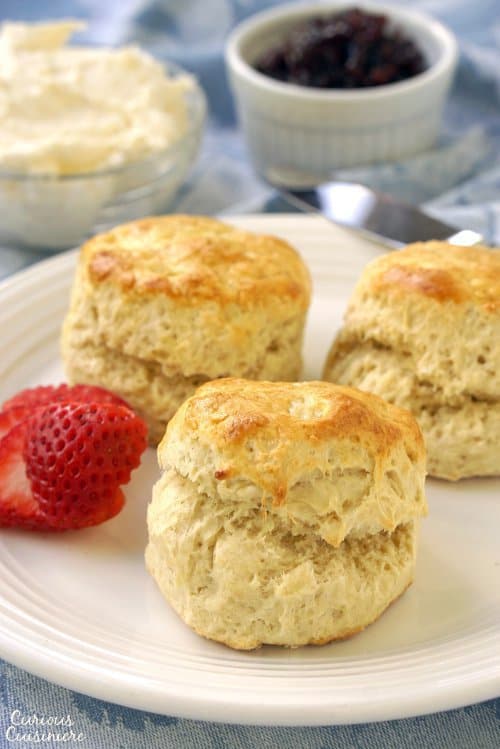
An authentic British Scone is a perfect accompaniment to your warming cup of tea, particularly if you have some clotted cream and jam to serve it with!
What is a scone?
When you hear the word "scone" do you think of a fancy British tea-time spread? Or do you think of the sugar-dusted pastries in the Starbucks display case that you might be tempted to grab to go along with your morning coffee?
Authentic British scones aren't eaten for breakfast. Rather, they are served with tea as a light snack for "cream tea" in the mid-morning or with afternoon tea. (Not to be confused with "high tea," which includes more savory nibbles.)
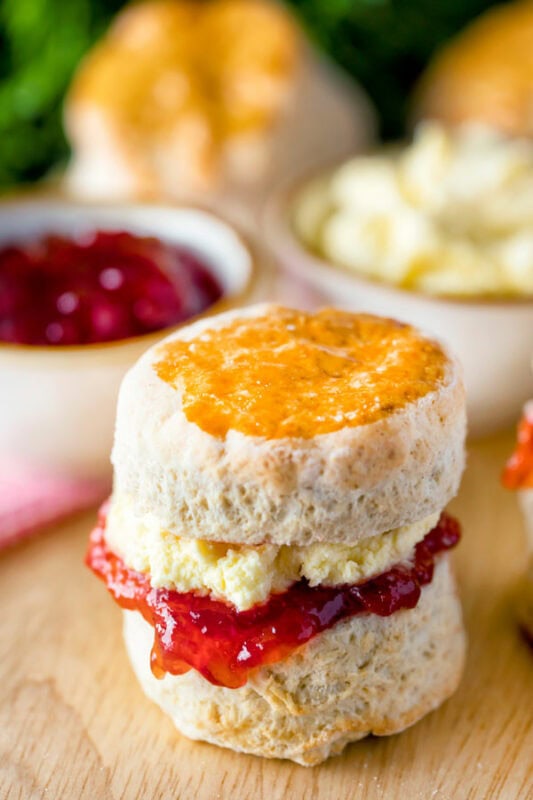
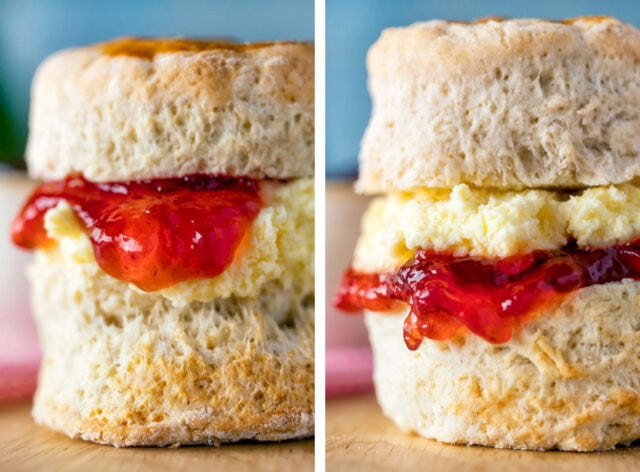
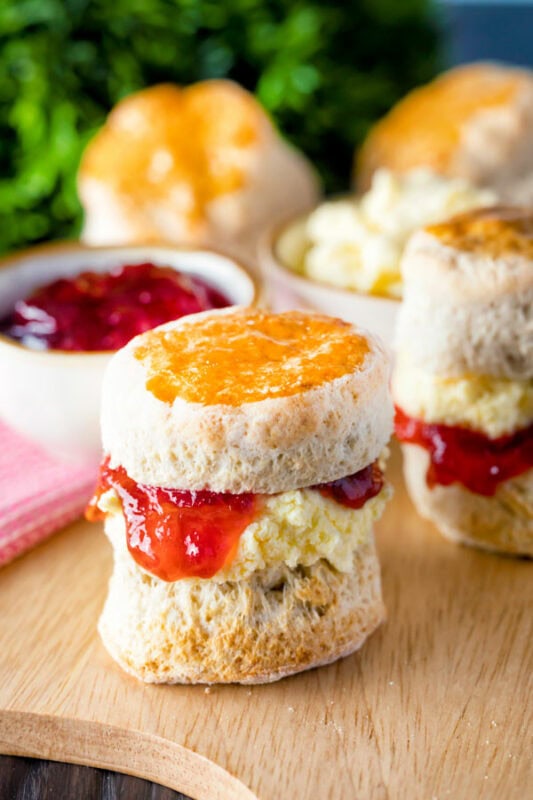
British scones are small nibbles that are fairly plain on their own but are classically eaten with jam and clotted cream, making for a real treat.
Is a scone a biscuit?
When you first try an authentic British scone, you might be tempted to think of it as a biscuit. (Unless, of course, you're from the southern US, where biscuit-making is an art. No real scone would fool a Southerner as a biscuit, that's for sure.)
But, you can't deny that the two are similar.
The basic ingredients for biscuits and scones really are the same: flour, leavening, a little salt, some fat, milk, and maybe a little sugar. The process too is similar: cut the fat into the dry ingredients, add the liquid, roll, and bake.
The difference comes down to a subtly in texture and how they are served.
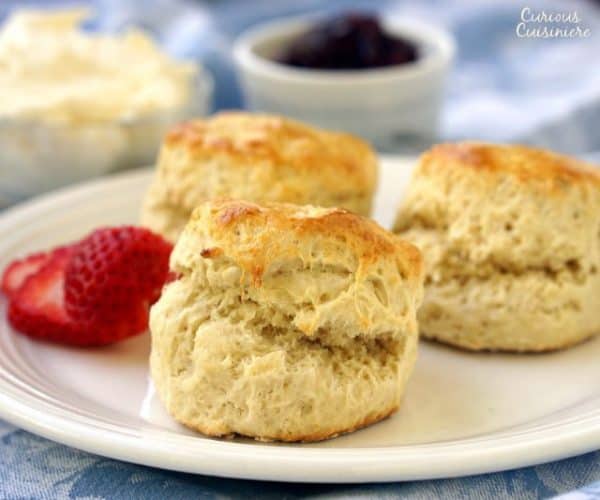
British scones are denser, slightly drier, and more crumbly than biscuits. They typically contain much less butter than biscuits as well.
While biscuits most likely originated from the British scone, they have been transformed and now are the scone's buttery cousin. Because of the extra butter, biscuits should be light and fluffy with tender layers.
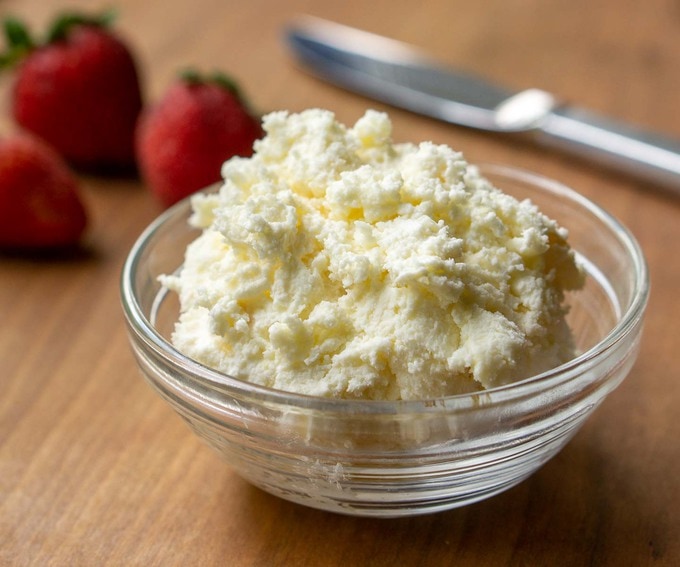
While scones are spread with jam and clotted cream (which you can make yourself as oven clotted cream or as slow cooker clotted cream), biscuits more commonly find themselves in savory applications, like with sausage gravy or an egg and bacon.
What is the difference between an American scone and a British scone?
If you walk into a coffee shop in the States, you're bound to come face to face with some tasty treat labeled "scone". It will probably be sweet, most likely filled with any number of sweet add-ins, and possibly even covered with a sugary glaze.
It might be biscuit-like in texture or it might be cakier, depending on the establishment. And, it probably will be about the size of your hand.
By now you know better.
These are not traditional British scones! They're too big, too sweet, and too stand-alone. Not to mention all the flavor add-ins that are unheard of when it comes to a traditional scone. (Which might get some raisins tossed into the batter, but that's about as crazy as things get.)
Besides, when was the last time you ventured to put jam on your American scone? (As if it needed the extra sugar.)
Ingredients and substitutions
Scone dough is made from simple ingredients that you probably keep your pantry stocked with. So, you can have a batch of scones turned out dangerously fast.
- Flour - Basic all-purpose flour is what we want here.
- Sugar - Just a little.
- Baking powder - You will use way more than you think you should for this amount of flour. That helps get the high rise.
- Salt
- Butter - Use slightly cold butter for best results.
- Milk - We prefer whole milk, but any will do.
- Egg wash
How to make English scones
All the differences aside, if you can make biscuits, then you can make scones.
To make them you first mix the dry ingredients. Then rub in the butter until it is evenly distributed and the consistency of the mixture is sandy. Then add the milk until you get a slightly sticky dough.
Once the dough comes together, you knead it just a couple times on the counter. Then you press it flat and cut out your scones.
Place them on your lined baking sheet, brush with egg wash, then they are ready for the oven!
The one difference we take between making biscuits and making scones is that for scones, we use our hands to massage the butter into the dry ingredients. Doing this creates a fine, sandy consistency that helps give the scones their classic texture. (For biscuits we cut the butter into the dry ingredients, which leaves larger chunks of butter in-tact, creating those tasty, buttery layers.)
How to store and reheat
British scones will keep well in an air-tight container on the counter for 2-3 days. If you plan to keep them longer than that, we recommend freezing them.
To reheat your scones, we recommend putting them in a low oven (300F) or toaster oven for 5-10 minutes.
Can I freeze scones?
Yes! These work wonderfully frozen, either before or after baking.
To freeze the scone dough and bake it later, cut out your scones from the dough and then place the rounds of dough on a baking sheet. Place the whole sheet in the freezer and freeze until solid. Once the rounds are solid, you can remove them from the baking sheet and put them in an airtight container or sealable bag in the freezer until you are ready to bake them.
To bake from frozen, simply put the frozen rounds on a baking sheet and bake per the recipe instructions. You may find that you need to bake them for an extra 5 minutes or so, but keep an eye on them.
To freeze them after baking, let them cool completely before freezing in an airtight container. If you have a lot to freeze, we would recommend freezing them in a single layer first (like you did for the dough rounds) before transferring them to the long-term storage container.
From baked and frozen, simply let the scones thaw to room temperature before reheating.
These scones will stay good in the freezer for 3 months.
Why did my scones not rise?
If you didn't get the lofty scones that you were hoping for there are a few things to check.
- Is your baking powder fresh? It should be less than 6 months old for best performance.
- Did you overwork the dough? Make sure you're stirring and kneading it as little as possible to get it to come together.
- Did you twist the cutter? This is a big one. You need to press the cutter straight down and pull it straight up. If you twist the cutter, even a little, you will seal the edges and the rise will be less than optimal.
Why do my scones taste off?
Occasionally we have readers comment that their scones taste metallic or bitter. Here are some things to check:
- Double check that you used baking powder and not baking soda. It is an easy mistake to make!
- Did you use a US teaspoon measure or weigh your baking powder? Teaspoon measures in different countries are different sizes and in this case even a slight difference can make a big taste difference.)
- Did you mix your dry ingredients? It could also be that the baking powder didn't get mixed in well enough.
- Are you sensitive to baking powder's flavor? Some people are. If this is the case, you can dial back the baking powder in the recipe. You just may not get as high of a rise.
With the high amount of baking powder in the traditional scone recipe, seemingly little things can make a bit impact on the flavor!
Whether you call it a biscuit or a scone, these tasty treats are great for breakfast or for an afternoon nibble.
Just don't forget the jam and clotted cream!
Authentic British Scones

An authentic British Scone is the perfect accompaniment to your warming cup of tea, particularly if you have some clotted cream and jam to serve it with!
Ingredients
- 2 c (250 g) unbleached all-purpose flour
- 2 tablespoon (27 g) sugar
- 4 teaspoon (8 g) baking powder*
- ½ teaspoon (2 g) salt
- 3 tablespoon (42 g) unsalted butter, cold
- ⅔ c (158 ml) milk
- 1 egg yolk beaten with 1 tablespoon milk, (to glaze)
- Strawberry jam, (to serve)
- Clotted cream, at room temerature (to serve)
Instructions
- Preheat your oven to 425F.
- In a medium bowl, mix the flour, sugar, baking powder, and salt until well combined.
- Add butter. Rub the mixture together with your fingers to break up the butter, until the mixture resembles fine breadcrumbs.
- Add the milk slowly, mixing as you add, using enough of the milk to get your dough to come together with no lumps remaining. (Your dough should be quite sticky. If a good consistency is not achieved with the listed amount of milk, continue adding until your dough reaches a good consistency.)
- Spoon the dough out until a well-floured surface. Generously dust the top of the dough and knead the dough 2-3 times to coat it with flour and smooth the surface. Press the dough into a round that is roughly 1 inch thick.
- Using a well-floured cookie cutter, cut the dough into 2 inch circles. (Be sure to press the cookie cutter straight down and up. Twisting the cookie cutter will impact the amount of rise you get on your scones.)
- Place the rounds onto a greased and floured baking sheet. Brush them gently with the egg yolk and milk mixture.
- Bake the scones for 12-15 minutes, until golden and firm.
- Remove the baked scones from the oven and let them cool for 30 minutes (if you can resist). If you like softer scones, cover them with a clean tea towel as they cool.
Notes
FREEZING:
This scone batter freezes well. We like to freeze pre-cut rounds of dough for easy baking (just thaw and bake as directed).
Alternately, freeze the baked scones and reheat in a low oven for 5-10 minutes after thawing on the counter.
*A note on baking powder:
The baking powder has been a point of hot debate for this recipe. First, make sure you are using baking POWDER, not baking SODA. You will get a metalic taste with that much baking soda. Second, we are using US teaspoons here, not UK teaspoons. (Yes, they have a different volume.) Finally, we know the packages of baking powder say that 1 teaspoon is equal to 4-4.8g (depending on your brand), however we (and multiple testers) have weighed our baking powder and always come up with somewhere between 2-3g per teaspoon. When we weighed the amount of baking powder we used in the recipe it came to 8g. So, if you are having trouble with the recipe tasting metallic or are sensitive to the flavor of baking powder, we'd suggest going with 8g of baking powder. We can't explain the difference in weight, but we are certain about what we used.
Interested in info on WEIGHT measurements? Have a look at our ingredient conversion guide.
Nutrition Information:
Yield:
10Serving Size:
1 sconeAmount Per Serving: Calories: 71

Sarah founded Curious in 2010 as a way to save her recipe creations and share culinary experiences. Her love for cultural cuisines was instilled early by her French Canadian Grandmother. Her experience in the kitchen and in recipe development comes from over 10 years working in professional kitchens. She has traveled extensively and enjoys bringing the flavors of her travels back to create easy-to-make recipes.
I cannot tell you how many times I've made these and in how many different ways. These are my secret now when I visit friends lol
Thanks for sharing Christina! So glad you and others have been enjoying them!
Can you use whole wheat? We love them with white flour too!
Hi Renee. Yes, you could use whole wheat flour in these. The dough will likely take less whole wheat flour than all purpose flour, so just add it slowly until the dough looks right. Enjoy!
Hi Sarah,
You are a Star!
This recipe is a winner. Much appreciated. Since
Vitamin C Sources Are Recommended For Immunity Especially During These Times, I Grated The Zest Of 3 Oranges To The Dry Ingredients And Spread It. The Dough Then Needed Slightly More Milk, And I Added 1 Extra Teaspoon Baking Powder To Rise And 1 Teaspoon Extra Sugar To Counter The Baking Powder Taste. So Yummee And Soft scones,
Regards and stay protected.
Mimona. Cape Town. South Africa
So glad you enjoyed the scones Mimona! Thanks for sharing your twist! Orange sounds like a lovely addition.
Your recipe would be more authentic if you used a lower protein flour like US cake flour and bake for 10 mins.
Thanks for your suggestion Fiona. We'll give it a try!
Sarah, I made these last weekend for my wife for Mothers Day (with the kids help) and they were excellent, (the scones, not the kids.......OK the kids as well). Being a 'dad' home baker, I was a bit wary of breaking up the soft butter in the mix (thinking surely there's no way it can mix in properly), but I trusted the directions and it worked out great. My nine year old even made a berry compote from scratch. Thanks, I have now subscribed and will try to make something a little more extravagant, we'll keep you posted. Take care.
So glad to hear! What a nice Mother's Day treat!
Hello! I just made these and they didn't really puff up like in the photo. Not sure what I did wrong.
Hi Wendy. The most common cause of this is twisting the cutter when cutting out the scones. Twisting will seal the edges and impact the rise.
Hi, My husband and I lived in Ireland for 2 years and we loved the scones. I found your recipe hoping to make these for him, and they taste great and authentic, but mine came out like tiny mini scones, they didn't rise much at all. Also, I used a 2" round cutter and went up and down like the recipe said, versus twisting it in the dough, but they came out like tiny little discs. I'm wondering what I did wrong? I love to bake and would love to make these again but have them look like "real" scones lol. Any suggestions? Thank you
Hi Megan. The rising can be a bit tricky. Typically this problem comes from twisting the cutter, which you said you were careful about. It is possible that your baking powder is bad, but unlikely. The only other troubleshooting tip would be if your oven wasn't hot enough. Do you use an oven thermometer?
I'm American (MN) and I grew up eating biscuits and gravy and we also smeared butter on them and sometimes jam!! Some around here do butter and honey. I've never tried British scones with the clotted cream and I want to sometime. For some reason anything British intrigues me!!
Biscuits and gravy was a staple of my childhood! Hope you enjoy the scones!
Ciao,
sono Italiana, volevo fare questa ricetta, ma non si traducono correttamente le unità di peso per poter fare questi pasticcini mi potreste aiutare? Per ( 2 C di farina cosa si intende?) Grazie
Ciao Maria.
2 C di farina = 240 g
3 Tbsp di burro = 42.5 g
2/3 C di latte = 158 ml
Buon appetito!
Thank you Sarah. I just tried it and it’s well received by my hubby. I am an amateur in baking and I think it turned out relatively well - not dense and hard but not triple raised baking. I added raisins to part of my dough and hubby likes that more as he eats it on its own.
What a great idea to add raisins. Yes, the rise on these can be a bit tricky. We're glad you enjoyed them!
Hello, I am curious if I can make these with ham and cheese? I have been dying for a good scone.
Hi Amanda. We’ve never tried it, but I would imagine adding a bit of finely chopped ham and shredded cheese would be quite tasty in these scones. If you give it a try let us know what you do and how they turn out! Enjoy!
When I visited London England on a fam trip with American Airlines several years ago, we stopped at the Four Seasons for high tea, and they served scones with lemon curd on the side. Delicious. It's difficult in the US to find a scone that is not triangular and firm. Most are Nothing like the scones in London. But I did finally find fluffy scones nearby at a donut shop called S&S. They actually make them like tender like biscuits and add cranberries or peaches or blueberries. They are not cut into triangles. Wonderful.
What a great trip! Glad you found us!
Question can I add small pieces of fresh blueberries or strawberries in to the mix ,would that make a difference
Hi Susan, While we haven't tried adding fruit to these scones, I would think that adding some finely chopped pieces shouldn't be a problem. I would just make sure they're not too juicy, so you don't mess with the liquid content of the recipe too much. If you give it a try, stop back by and let us know what you did and how they turn out!
Those scones are to die for - thanks for the recipe. I was wondering if I could switch the all-purpose flour for self-raising?? I have a packet of self-raising and not sure what to do with them. Thanks
Hi Tasha. Glad you enjoyed the scones. 1 cup of self-rising flour is roughly equivalent to 1 level cup of all-purpose flour, plus 1 1/2 teaspoons baking powder and 1/4 teaspoon salt. So, if you substitute 1 cup of self-rising flour for 1 cup of all-purpose in this recipe, omit the salt and decrease the baking powder by 1 1/2 tsp.
Thank you Sarah- I love the taste just like the British scones in Devonshire where we went.
May i ask- what color should the bottom of the scone be? Mine was brown but not hard or burnt.
I wondered if it's due to the sheet i slightly buttered or maybe i shouldn't do it all especially on parchment. A bit sprinkle of flour, could perhaps suffice. Besides that , it turned out just like yours. I made clotted cream from scratch using raw cream which is unpasteurized, baked at 180F for 12 hrs overnight and skimmed the surface. And voila, just like the real Devon cream!
Hi Cha. The bottom of our scones typically are just a light golden brown. We use a greased and floured baking sheet, but if you're using parchment, a little flour should be fine. Glad you enjoyed the scones and cream!
@Cha, are you using whole milk in this recipe?
ExPat Scottish Girl here. Your scone recipe is absolutely delicious, and truly authentic! They taste just like scones from the UK, a real taste of home. Thanks for sharing!
So glad you enjoyed the recipe! Thanks for sharing!
I have an old English recipe I asked for at an old coaching house in Mere, England on my first trip there in 1981. The only difference I can see is your recipe calls for milk and the other one calls for buttermilk. I always use this recipe and love the scones. One thing I will try is allowing my scones to rest before I bake them. I also use self rising flour. Life is good. Afternoon tea makes it better.
How fun! Thanks for sharing! Afternoon tea does make everything better!
Made them per your recipe and they turned out great. Thanks for sharing!
So glad you enjoyed the scones!