
Fesenjan (Persian Pomegranate Chicken Stew)
Fesenjan is a delicious Persian chicken stew flavored with walnuts and pomegranate. It's a comforting dish for a cold day and perfect to make ahead too.
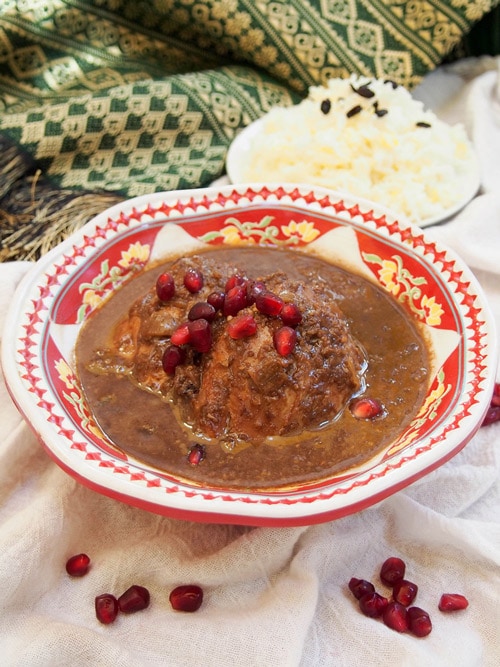
If you are looking for a filling dish for fall/winter that's just that bit different, this Persian chicken stew is a great choice. The sauce is rich from ground walnuts and with an unusual sweet-tart flavor from pomegranate molasses.
Fesenjan (pronounced FESEN-joon) is a classic Persian dish that deserves to be better known.
Where is Fesenjan from?
Khoresh-e Fesenjān, or fesenjan for short (sometimes spelled fesenjoon), is a stew (khoresh) from Iran.
It is believed to originate from the Gilan region near the Caspian sea and has been around since the Persian empire.
The Gilan region is known for its ducks, and so it's no surprise that this dish is sometimes made with duck.
Chicken, as used here, is also popular. Or you can find it made with meatballs. You will also find variations with fish or vegetables, but these are less common.
As with many traditional recipes, the ingredients vary. Onion, ground walnuts and pomegranate syrup (also called pomegranate molasses) are in virtually all versions.
Some also add aromatic spices and maybe some garlic.
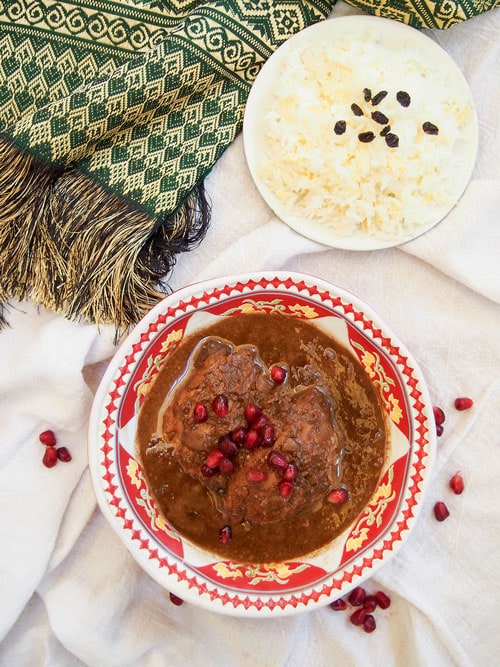
Pomegranate in Persian cooking
Pomegranates are believed to have originated in Iran and have taken on broad cultural significance in the region.
They were considered a royal fruit in ancient Greece. And, within Persian culture, symbolize immortality and fertility.
Pomegranates have religious significance in both Islam and Christianity as well.
Tehran, the capital of Iran, hosts a pomegranate festival every year in October, which celebrates the fruit.
Iran is the largest exporter of pomegranate in the world and second-largest producer. And, believe it or not, there are over 700 varieties of pomegranate, varying from very tart to sweeter.
Iranian cuisine uses pomegranate in all forms - the fresh fruit, as juice and as pomegranate syrup/molasses.
The fruit are often part of the Persian Yalda festival, which celebrates the shortest day of the year in December. You may also find them as part of the "haft seen" for Nowruz.
Fesenjan may indeed be served around that time if the weather is cooler. It is often considered a special occasion dish.
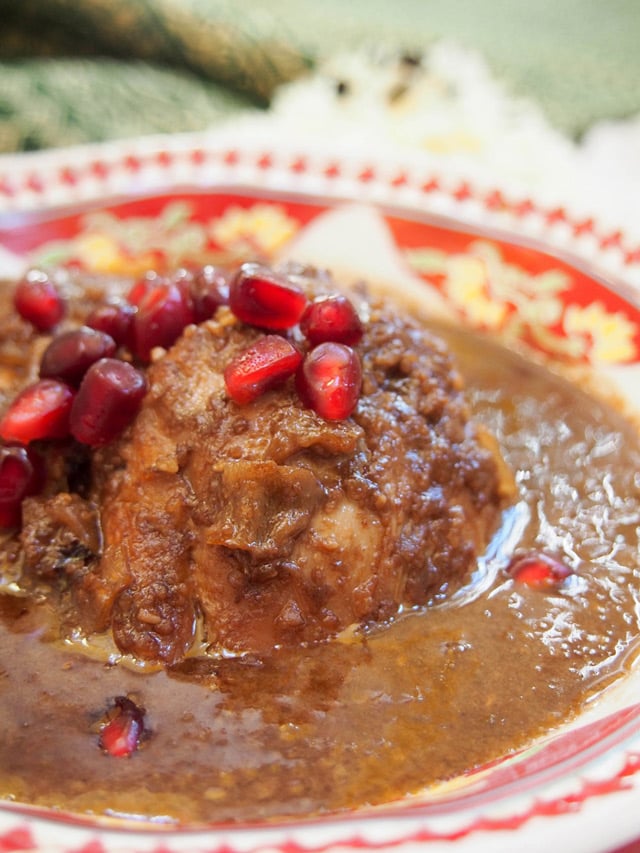
What is pomegranate molasses?
Pomegranate molasses, or pomegranate syrup, is made by reducing pomegranate juice down until it is a thick syrup.
Since pomegranates can vary in how sweet or tart they are, so too can pomegranate molasses. Some brands are also thicker than others.
As a result, how sweet or tart fesenjan is can vary depending on the pomegranate molasses that you use. Some people also prefer it a bit sweeter and may add a little sugar along with the other ingredients if the pomegranate is not as sweet.
As well as being used in this stew, pomegranate molasses is used in other Persian dishes, such as for a glaze and in salads. It is also used in Turkish cooking, such as in kisir, a Turkish bulgar salad.
Using walnuts in this Persian chicken stew
Walnuts are also popular in Persian cooking.
They used to be traded along the Silk Road route and appear in dishes like salads as well as Persian walnut cookies (nan-e gerdui).
The key to using walnuts in this dish is that you need to cook them long enough to release some of their natural oils. This gives them a more rounded, slightly sweet flavor to balance out the tartness of the pomegranate.
You do need a lot of walnuts for this dish, since they are ground, so this is not exactly a low calorie meal. But, walnuts are rich in antioxidants an a great source of those good Omega-3s, so the slight indulgence is worth it.
What to serve with fesenjan
This dish is typically served with rice, a popular Persian side.
Here you might serve steamed white rice, saffron rice or a more complex Persian rice dish with tahdig (a kind of crisp topping taken from the bottom of the pan).
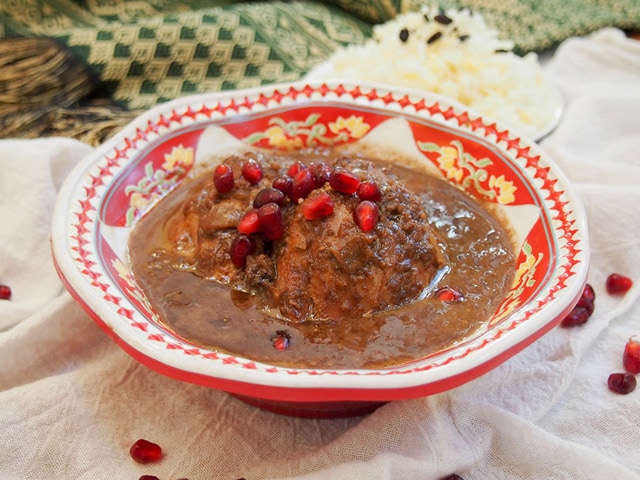
Fesenjan may not be as well known in the West, but I can completely understand why it's so popular in Iranian culture. It's hearty and comforting and has a deliciously different flavor that is easy to enjoy.
Fesenjan (Persian Pomegranate Chicken Stew)
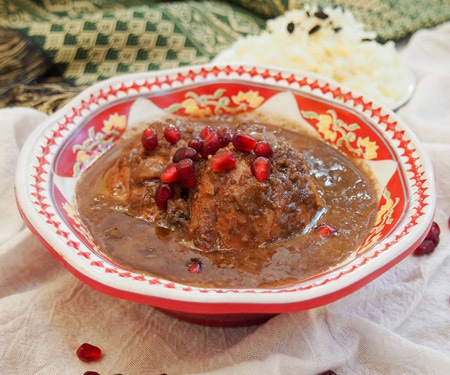
Fesenjan is a delicious Persian chicken stew flavored with walnuts and pomegranate. It's a comforting dish for a cold day and perfect to make ahead too.
Ingredients
- 1 ½ lb chicken thighs - on the bone*
- 1 cup walnuts (100g)
- 2 tablespoon vegetable oil
- ½ large onion, diced
- ½ cup light stock (eg: chicken)**
- Salt and pepper, to taste (may not need salt, depending on your stock)
- ½ cup pomegranate molasses (syrup, or a little less, if it is very thick)
- Fresh pomegranate arils (seeds), if desired, to top
Instructions
- Remove the skin from the chicken and trim any excess fat.
- Put the walnuts in a food processor and grind until they are relatively fine, like breadcrumbs.
- Warm the oil in a pan wide enough to hold all of the pieces of chicken in a single layer and brown the chicken on all sides. Remove the chicken from the pan and set aside.
- Add the diced onion to the pan and cook a few minutes, stirring now and then until softened.
- Add the ground walnuts and cook a minute or two to toast slightly.
- Add the stock to the pan, stir to mix and season with a little salt and pepper to taste.
- Return the chicken to the pan. Press the chicken pieces under the sauce and bring it to a simmer. Cover and reduce the heat a little. Simmer for around 20 minutes until you see oils coming to the surface a little.
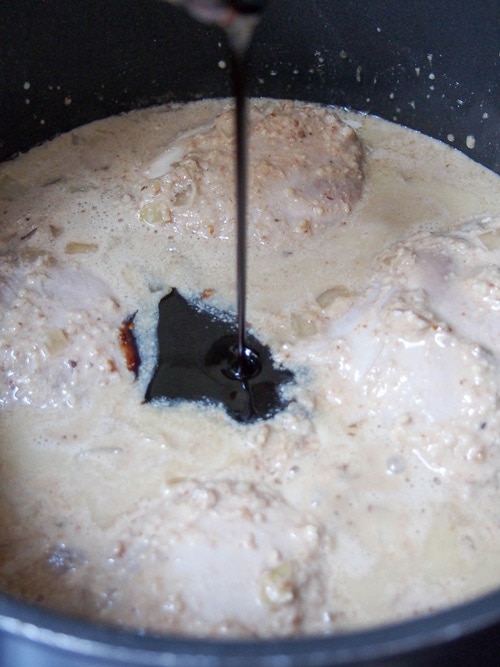
- Add the pomegranate molasses slowly, stirring as you add until the desired color and flavor is reached.*** Mix well and simmer gently for an additional 10 minutes. (Take care not to let the mixture burn on the bottom of the pan.)
- Serve, topped with fresh pomegranate arils (seeds), if you like, for decoration.
Notes
*You can use boneless chicken thighs, if you prefer, but the meat on the bone adds to the flavor.
**I initially made this with ¾ cup of stock rather than ½ cup. This ensures the chicken is better submerged as it simmers, but I think gives a little too much sauce in the end, so it needs a bit of time uncovered to allow it to reduce before adding the pomegranate molasses. Choose whichever way you prefer.
***It can be worth adding around ¾ of the pomegranate molasses and mixing before adding the rest. The stew should be a fairly deep brown color and you should have a good sweet-tart flavor. Add the rest/more to taste. If it is very tart, you can add a little sugar to balance it out, but it shouldn't be needed.
You can make the dish ahead and reheat. You can either make it up to just before you add the pomegranate molasses, or make it completely. If the latter, just take care re-heating as the pomegranate molasses can burn if it gets too hot.
Recommended Products
As an Amazon Associate and member of other affiliate programs, We earn from qualifying purchases.


Caroline lived and traveled various places before settling in Cambridge, MA. She still fits in some travel with her family, but often settles for traveling through food instead. She shares her recipes at CarolinesCooking.com, where there's plenty of international inspiration using seasonal ingredients, as well as creative recipes for all to enjoy. Caroline is originally from Scotland, where she grew up hiking and skiing, both things she still loves to do when her two young boys give her a chance. You can follow along with her cooking adventures on Facebook, Instagram, Twitter, and Pinterest.

I’ve always loved ordering fesenjen whenever we are at a Persian restaurant. I was so excited to see this recipe and it came out beautifully! Love the flavors and as usual with your recipes, very easy to put together.
Glad you enjoyed the Fesenjan!
Thanks for this recipe! Made it yesterday for a dinner party and it was a big hit. Everyone loved it and asked for the recipe. I love it, too. Wonderful flavors. Will be making this again!
Glad you and your guests enjoyed it!