Authentic British Scones
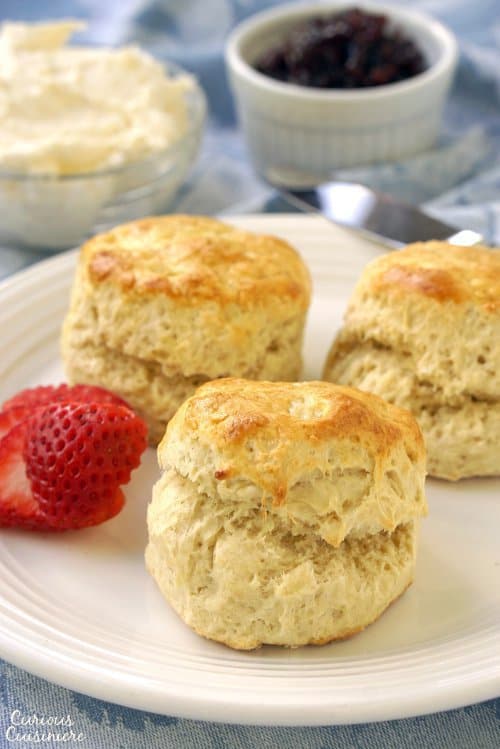
An authentic British Scone is a perfect accompaniment to your warming cup of tea, particularly if you have some clotted cream and jam to serve it with!
What is a scone?
When you hear the word "scone" do you think of a fancy British tea-time spread? Or do you think of the sugar-dusted pastries in the Starbucks display case that you might be tempted to grab to go along with your morning coffee?
Authentic British scones aren't eaten for breakfast. Rather, they are served with tea as a light snack for "cream tea" in the mid-morning or with afternoon tea. (Not to be confused with "high tea," which includes more savory nibbles.)
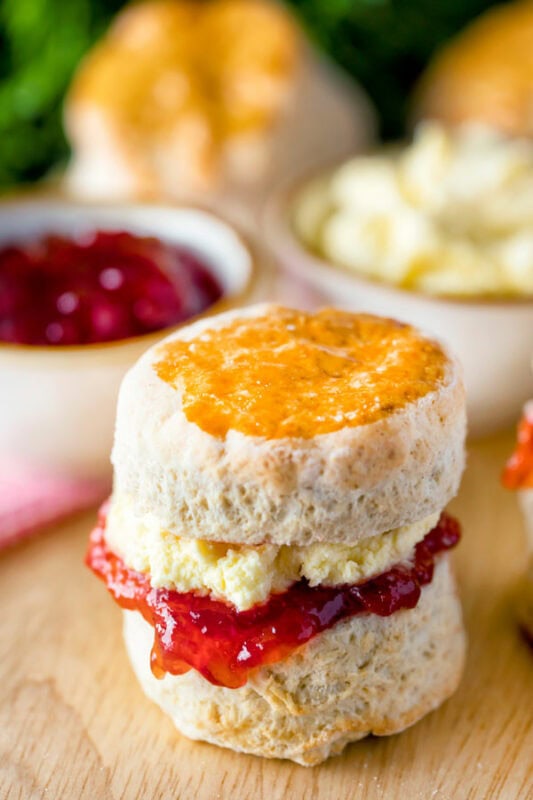
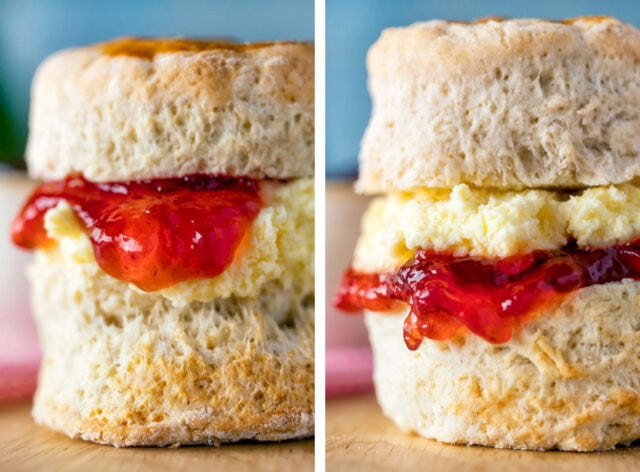
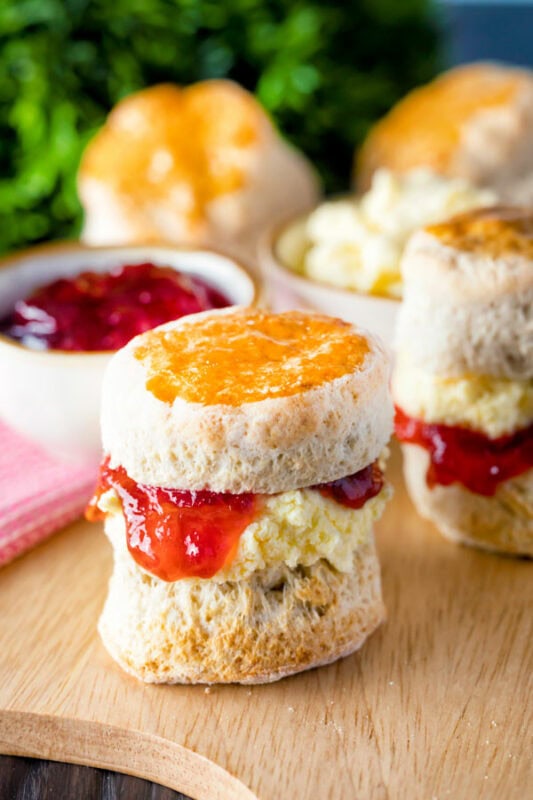
British scones are small nibbles that are fairly plain on their own but are classically eaten with jam and clotted cream, making for a real treat.
Is a scone a biscuit?
When you first try an authentic British scone, you might be tempted to think of it as a biscuit. (Unless, of course, you're from the southern US, where biscuit-making is an art. No real scone would fool a Southerner as a biscuit, that's for sure.)
But, you can't deny that the two are similar.
The basic ingredients for biscuits and scones really are the same: flour, leavening, a little salt, some fat, milk, and maybe a little sugar. The process too is similar: cut the fat into the dry ingredients, add the liquid, roll, and bake.
The difference comes down to a subtly in texture and how they are served.
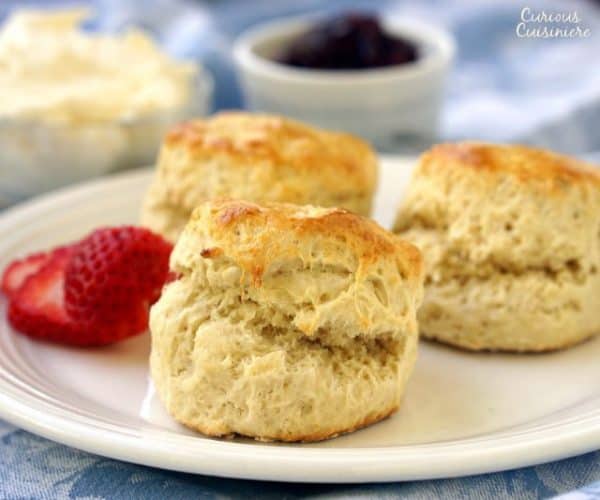
British scones are denser, slightly drier, and more crumbly than biscuits. They typically contain much less butter than biscuits as well.
While biscuits most likely originated from the British scone, they have been transformed and now are the scone's buttery cousin. Because of the extra butter, biscuits should be light and fluffy with tender layers.
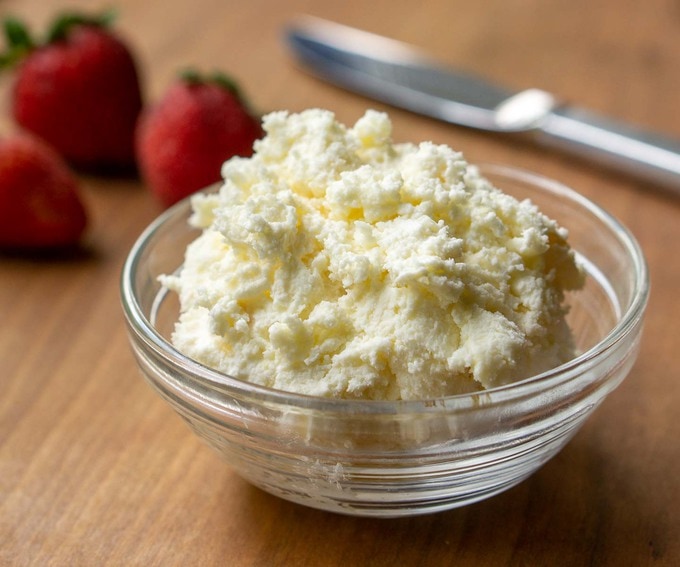
While scones are spread with jam and clotted cream (which you can make yourself as oven clotted cream or as slow cooker clotted cream), biscuits more commonly find themselves in savory applications, like with sausage gravy or an egg and bacon.
What is the difference between an American scone and a British scone?
If you walk into a coffee shop in the States, you're bound to come face to face with some tasty treat labeled "scone". It will probably be sweet, most likely filled with any number of sweet add-ins, and possibly even covered with a sugary glaze.
It might be biscuit-like in texture or it might be cakier, depending on the establishment. And, it probably will be about the size of your hand.
By now you know better.
These are not traditional British scones! They're too big, too sweet, and too stand-alone. Not to mention all the flavor add-ins that are unheard of when it comes to a traditional scone. (Which might get some raisins tossed into the batter, but that's about as crazy as things get.)
Besides, when was the last time you ventured to put jam on your American scone? (As if it needed the extra sugar.)
Ingredients and substitutions
Scone dough is made from simple ingredients that you probably keep your pantry stocked with. So, you can have a batch of scones turned out dangerously fast.
- Flour - Basic all-purpose flour is what we want here.
- Sugar - Just a little.
- Baking powder - You will use way more than you think you should for this amount of flour. That helps get the high rise.
- Salt
- Butter - Use slightly cold butter for best results.
- Milk - We prefer whole milk, but any will do.
- Egg wash
How to make English scones
All the differences aside, if you can make biscuits, then you can make scones.
To make them you first mix the dry ingredients. Then rub in the butter until it is evenly distributed and the consistency of the mixture is sandy. Then add the milk until you get a slightly sticky dough.
Once the dough comes together, you knead it just a couple times on the counter. Then you press it flat and cut out your scones.
Place them on your lined baking sheet, brush with egg wash, then they are ready for the oven!
The one difference we take between making biscuits and making scones is that for scones, we use our hands to massage the butter into the dry ingredients. Doing this creates a fine, sandy consistency that helps give the scones their classic texture. (For biscuits we cut the butter into the dry ingredients, which leaves larger chunks of butter in-tact, creating those tasty, buttery layers.)
How to store and reheat
British scones will keep well in an air-tight container on the counter for 2-3 days. If you plan to keep them longer than that, we recommend freezing them.
To reheat your scones, we recommend putting them in a low oven (300F) or toaster oven for 5-10 minutes.
Can I freeze scones?
Yes! These work wonderfully frozen, either before or after baking.
To freeze the scone dough and bake it later, cut out your scones from the dough and then place the rounds of dough on a baking sheet. Place the whole sheet in the freezer and freeze until solid. Once the rounds are solid, you can remove them from the baking sheet and put them in an airtight container or sealable bag in the freezer until you are ready to bake them.
To bake from frozen, simply put the frozen rounds on a baking sheet and bake per the recipe instructions. You may find that you need to bake them for an extra 5 minutes or so, but keep an eye on them.
To freeze them after baking, let them cool completely before freezing in an airtight container. If you have a lot to freeze, we would recommend freezing them in a single layer first (like you did for the dough rounds) before transferring them to the long-term storage container.
From baked and frozen, simply let the scones thaw to room temperature before reheating.
These scones will stay good in the freezer for 3 months.
Why did my scones not rise?
If you didn't get the lofty scones that you were hoping for there are a few things to check.
- Is your baking powder fresh? It should be less than 6 months old for best performance.
- Did you overwork the dough? Make sure you're stirring and kneading it as little as possible to get it to come together.
- Did you twist the cutter? This is a big one. You need to press the cutter straight down and pull it straight up. If you twist the cutter, even a little, you will seal the edges and the rise will be less than optimal.
Why do my scones taste off?
Occasionally we have readers comment that their scones taste metallic or bitter. Here are some things to check:
- Double check that you used baking powder and not baking soda. It is an easy mistake to make!
- Did you use a US teaspoon measure or weigh your baking powder? Teaspoon measures in different countries are different sizes and in this case even a slight difference can make a big taste difference.)
- Did you mix your dry ingredients? It could also be that the baking powder didn't get mixed in well enough.
- Are you sensitive to baking powder's flavor? Some people are. If this is the case, you can dial back the baking powder in the recipe. You just may not get as high of a rise.
With the high amount of baking powder in the traditional scone recipe, seemingly little things can make a bit impact on the flavor!
Whether you call it a biscuit or a scone, these tasty treats are great for breakfast or for an afternoon nibble.
Just don't forget the jam and clotted cream!
Authentic British Scones

An authentic British Scone is the perfect accompaniment to your warming cup of tea, particularly if you have some clotted cream and jam to serve it with!
Ingredients
- 2 c (250 g) unbleached all-purpose flour
- 2 tablespoon (27 g) sugar
- 4 teaspoon (8 g) baking powder*
- ½ teaspoon (2 g) salt
- 3 tablespoon (42 g) unsalted butter, cold
- ⅔ c (158 ml) milk
- 1 egg yolk beaten with 1 tablespoon milk, (to glaze)
- Strawberry jam, (to serve)
- Clotted cream, at room temerature (to serve)
Instructions
- Preheat your oven to 425F.
- In a medium bowl, mix the flour, sugar, baking powder, and salt until well combined.
- Add butter. Rub the mixture together with your fingers to break up the butter, until the mixture resembles fine breadcrumbs.
- Add the milk slowly, mixing as you add, using enough of the milk to get your dough to come together with no lumps remaining. (Your dough should be quite sticky. If a good consistency is not achieved with the listed amount of milk, continue adding until your dough reaches a good consistency.)
- Spoon the dough out until a well-floured surface. Generously dust the top of the dough and knead the dough 2-3 times to coat it with flour and smooth the surface. Press the dough into a round that is roughly 1 inch thick.
- Using a well-floured cookie cutter, cut the dough into 2 inch circles. (Be sure to press the cookie cutter straight down and up. Twisting the cookie cutter will impact the amount of rise you get on your scones.)
- Place the rounds onto a greased and floured baking sheet. Brush them gently with the egg yolk and milk mixture.
- Bake the scones for 12-15 minutes, until golden and firm.
- Remove the baked scones from the oven and let them cool for 30 minutes (if you can resist). If you like softer scones, cover them with a clean tea towel as they cool.
Notes
FREEZING:
This scone batter freezes well. We like to freeze pre-cut rounds of dough for easy baking (just thaw and bake as directed).
Alternately, freeze the baked scones and reheat in a low oven for 5-10 minutes after thawing on the counter.
*A note on baking powder:
The baking powder has been a point of hot debate for this recipe. First, make sure you are using baking POWDER, not baking SODA. You will get a metalic taste with that much baking soda. Second, we are using US teaspoons here, not UK teaspoons. (Yes, they have a different volume.) Finally, we know the packages of baking powder say that 1 teaspoon is equal to 4-4.8g (depending on your brand), however we (and multiple testers) have weighed our baking powder and always come up with somewhere between 2-3g per teaspoon. When we weighed the amount of baking powder we used in the recipe it came to 8g. So, if you are having trouble with the recipe tasting metallic or are sensitive to the flavor of baking powder, we'd suggest going with 8g of baking powder. We can't explain the difference in weight, but we are certain about what we used.
Interested in info on WEIGHT measurements? Have a look at our ingredient conversion guide.
Nutrition Information:
Yield:
10Serving Size:
1 sconeAmount Per Serving: Calories: 71

Sarah founded Curious in 2010 as a way to save her recipe creations and share culinary experiences. Her love for cultural cuisines was instilled early by her French Canadian Grandmother. Her experience in the kitchen and in recipe development comes from over 10 years working in professional kitchens. She has traveled extensively and enjoys bringing the flavors of her travels back to create easy-to-make recipes.
These are amazing. I make them all the time for my family as "healthy biscuits" since they only have a few tablespoons of butter in them compared to the 8-12 tablespoons of butter in most biscuit recipes.
This is the point where I'd add notes on how I modified the recipe, but this is the first one in a very very long time that I haven't changed a single thing.
Various modifications I've (totally intentionally) tried:
-No sugar, still edible but with far less caramelization and less depth of flavor.
-No salt, very little noticeable difference
-No butter (replaced with milk), ehh. Tougher, less flavor. Its only like 3 T, just use the butter
-Dairy milk v Almond Milk, both work perfectly well, very little difference
-More sugar to try and make a sweet biscuit (with a jam filling): it wasn't bad but I wouldn't do it again. Too much sugar in these scones gives them a cloying taste on your tongue.
All in all, this is a fantastic recipe and I should probably stop looking for ways to change it (other than doubling the recipe, which works perfectly well!)
If there's one essential part: DO THE EGG WASH. They look gorgeous.
Thank you so much for sharing your notes Kaitlyn! We're so glad you and your family enjoy them!
These British scones are scrumptious! We are enjoying them with clotted cream and jam. Also,easy to make. Thanks for this wonderful recipe.
So glad yo uenjoyed them!
Made this recipe today. They were so tasty. I used fine pastry flour, and bakewell cream. Came out perfect. Ate mine with homemade clotted cream,marionberry jam, and enjoyed with a mug of chai tea.
Delicious! We're so glad you enjoyed them!
Very tasty scone with a good rise. I always use King Arthur Flour which has a higher protein so I’ve found I generally need more liquid. I also bake at altitude which presents problems.
These were light and fluffy! I can only get clotted cream at Whole Foods since my favorite British cafe/store closed. I can never eat a scone without it.
I will definitely use this recipe again, thank you!
Hi Michelle. So glad you enjoyed them. Have you tried our clotted cream recipe? Then you can make your own whenever you like!
Hi Sarah, I love the traditional English scone with currents. When I try your recipe how can I get the scone to bake without falling over & not giving that nice straight shape. Any hints? I am baking 50 of them for an English Tea & I’d like them perfect.Help!
Hi Nancy. We find that scones are picky about how you cut them. Be sure to press the cutter straight down and straight up, don't twist it. That always works for us to get a nice high, straight scone.
I would disagree that British scones are denser. Some are, but It all depends how someone prefers to make them. For instance, a British scone can also be made with self-raising flour. I guess the alternative in the USA would be to use extra baking powder. I’ve make mine this way. It gives them a very light texture. Also a scone is supposed to have a line around the middle, which is pulled apart, not cut, in order to divide the two half’s. That’s achieved by how the pastry is rolled out and folded. As buttermilk is by product of making butter, cheese and clotted cream, which are traditionally served with English scones, the buttermilk is often used in the recipe. Nothing ever went to waste.
Thanks for sharing Denise. You are right, it very much depends on who is making the scone or biscuit.
Hello, Thank you for the wonderful recipe. The scones were perfect and so delicious. I am Southern and know how to make a proper biscuit which isn't make with "less butter than a scone" because biscuits aren't made with any butter at all or I should say a Southern biscuit that is. I know other regions might use fats other than lard or butter for that matter due to a number of reasons or concerns. King Arthur makes them with butter too. In the South biscuits are traditionally made with lard and self rising flour, which is why I am writing to ask about the protein content of the flour English use to make scones. Do the English use a Winter wheat flour for a more tender crumb like an American Self rising flour like (Lily White SFR 9%/ King Arthur SRF 8.5%) or a product more similar to our APF @11%? And thank you for the recipe and please do not take the fat debate (lard versus butter) seriously. No one loves butter more than I and I am sure you make a very fine biscuit using butter. :)) Kathryn
Hi Kathryn, thanks for your comment. Now that we have access to lard, we have discovered that it makes a wonderful biscuit! 🙂 As for your question, we asked a friend who is currently in the UK and he said that most people there make their scones from self rising flour, which differs from US self rising flour in that it doesn't contain salt. The protein content in the flour is typically 9.8 or 9.9%. Happy baking!
They come out perfect all the time thank you for this recipe, my family loves these . I pair them with some homemade strawberry jam and its a treat.
So glad you enjoy them Angela!
I made these for Easter to go with some homemade cultured butter. It was delightful! Very lightly sweetened, flaky, and crisp on the outside, such a perfect snack. Eat them warm too...so so good.
So glad you enjoyed them!
I tried this recipe and loved it! I made sure to add a little more sugar to compensate for the extra flour being used when rolling out the dough, and it was perfect.
Glad you enjoyed it!
@Bentley, l know this is the best
I tried this recipe for the scones yesterday abs honestly I would not recommend it. They turned out dry like a stone and unbeatable. I was a bit disappointed. I followed the recipe from A to Z.
Hi Nena. Just checking, did you add the milk? The recipe states to add milk until you get a sticky dough.
@Sarah Ozimek, yes, I did.
Hmm, then you may have needed a little more milk. Different flours take liquid differently, which is why we specified that the dough should be sticky.
The scones were absolutely amazing, although I had to use about 3/4 cup milk as originally the dough was too dry to come together
So glad you enjoyed the scones Cera! Different flours do take liquid differently, so we're glad you added until your dough reached the right consistency.
I think the recipe is written incorrectly, I can taste the baking powder in my scones. Disappointed
Hi Vivian. We're sorry you had trouble. Are you sure you didn't use baking soda instead? That would cause a flavor. Otherwise, some people are just more sensitive to the flavor of baking powder. We have made these many times, as have our recipe testers and many readers, and the amount is correct. That being said, you can always reduce the amount. You may get a bit less rise, but that's worth it if you prefer the flavor of the scones.
@Vivian,
Try aluminum free. Sorry if that isn't helpful I just had that issue and wanted to share in case it helps.
This recipe is a good classic British scone recipe. I found them a bit dry though and the amount of milk was not enough. The dough was super crumbly and would not come together. 3/4 cup milk and 5 tablespoons of butter worked better for me.
The dough should actually be quite sticky. As the instructions state, you should add enough milk to reach a good dough consistency. Glad you found what worked for you!
Great recipe! They turned out lovely. My recipe made 8 but my cutter was a bit bigger.
So glad you enjoyed the scones Allison!