Cooked Eggnog (With or Without Alcohol)
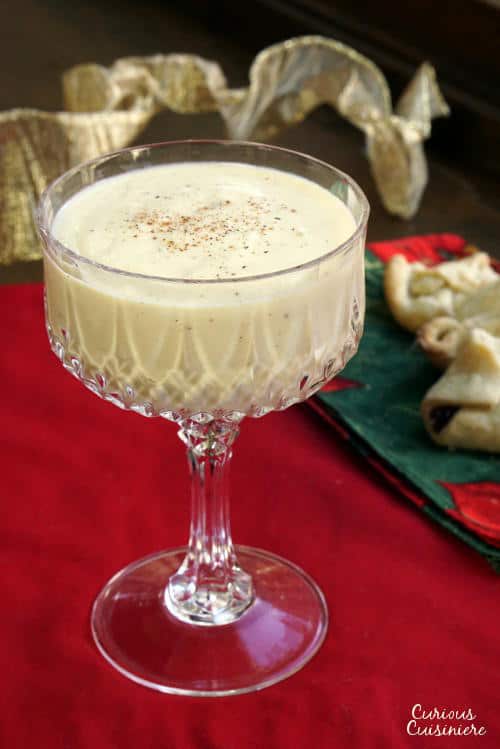
This recipe for Homemade Cooked Eggnog can be served with alcohol or non-alcoholic, making it the perfect Holiday drink for everyone!
Where did eggnog come from?
Eggnog literally means 'eggs inside a small cup'. This was a phrase that, at one point, was used to toast to one's health.
We first find mention of eggnog as a drink in the early 19th century in both America and Britain. (In Britain the common name was an 'egg flip'.)
Since there was no refrigeration at that time in England, eggnog was a drink of the upper class, reserved for those who could get eggs and milk and have a way to keep them from going bad.
The drink most likely originated from a hot British drink that was a mixture of eggs, milk, and ale, called posset.
Nog was the common name at that time for a strong ale. The egg and ale of posset over time became known as 'egg-nog'.
When the recipe for posset (egg-nog) came to the States, the liquor changed from ale to brandy or rum (which was readily available from the Caribbean). Even though the liquor changed, the name 'egg-nog' stuck.
What is eggnog made of?
Come the Christmas season, I always begin to crave eggnog. It's just one of those festive holiday indulgences that I love. But, it is an indulgence: heavy cream, eggs, loads of sugar.
The real deal is incredibly tasty. How can it not be with all that richness and sugar?
When we make our own homemade eggnog, we like to stray a bit from the traditional recipe in order to lighten things up a bit. We replace the heavy cream with 2% milk. And we dial the sugar down so that you can really taste the nutmeg.
Cooked eggnog
You make traditional eggnog by whisking egg yolks together with brandy (bourbon or rum), nutmeg, and heavy cream (and/or whole milk). Then, you beat the whites from the eggs to frothy. These frothy egg whites get gently mixed into the milk and liquor mixture to give the drink a thick texture.
While, nowadays, the risk of salmonella from uncooked eggs is very slim, we like to make cooked eggnog, because it helps us lighten the recipe up a bit.
When you make a cooked eggnog, you are basically making a custard that you then thin to a drinkable consistency.
Our non-alcoholic cooked eggnog recipe
Making cooked eggnog and starting with a custard also allows us to make our eggnog non-alcoholic.
We start by making a basic, thin nutmeg custard. As the custard cools, it will thicken up just enough to need a little extra liquid mixed into it before serving.
You can choose to add your favorite eggnog liquor or milk to thin your cooked eggnog out to the perfect consistency for you!
Cheers!
Cooked Eggnog (With or Without Alcohol)
This recipe for Homemade Cooked Eggnog can be served with alcohol or non-alcoholic, making it the perfect Holiday drink for everyone!
For best results, eggnog should be chilled at least 2 hours before serving.
Ingredients
- 4 c 2% milk
- ½ teaspoon nutmeg
- 6 egg yolks
- ⅓ c white sugar
- 1 tablespoon cornstarch*
- ½ teaspoon pure vanilla extract
- ¼ teaspoon salt
For Serving
- Brandy, bourbon or rum (to taste)
- Milk (to taste, for non-alcoholic eggnog)
Instructions
- In a large saucepan, heat milk and nutmeg over medium heat, until it begins to steam and froth slightly around the edges. (About 15-20 min.) Do not let it boil!
- In a medium bowl, beat the egg yolks with the sugar.
- Slowly pour or ladle about half of the warm milk over the egg yolks, mixing constantly as you add with a wire whisk. Once the milk has been incorporated, slowly pour the (now warm) egg mixture into the saucepan (still over medium heat) whisking as you add and whisking to combine. Heat the mixture for 5 min, whisking often, until it begins to steam slightly again.
- Put the cornstarch in small bowl. Ladle a little of the warm custard mixture over the cornstarch and mix until the cornstarch has dissolved. Pour the cornstarch mixture into the pot, stirring well.
- Continue to heat your custard mixture over medium heat, whisking often to keep the milk from sticking to the bottom and the eggs from clumping. Reduce the heat as necessary to keep the mixture just below simmering. Heat until your mixture coats the back of a spoon and reaches 160° on a food thermometer, roughly 15 min.** (Keep in mind the eggnog will thicken considerably as it cools.)
- Stir in the vanilla and salt.
- Taste your eggnog (carefully- it will still be very hot) for sweetness and nutmeg flavor. Add more sugar or nutmeg, if you desire.
- Remove the eggnog from heat and carefully strain it through a fine mesh sieve to strain out any lumps that might have formed. Pour the strained eggnog into a heatproof pitcher or jar with a lid.
- Refrigerate for 2 hours, or until cooled completely.
To Serve
- Fill your glass ⅔ full with the eggnog mixture. Add your desired liquor or milk to thin the eggnog to your desired consistency.
- Serve garnished with a sprinkle of nutmeg.
Notes
* This recipe makes a very thick eggnog once it has cooled, which is our preference. If you like your eggnog thinner, you can reduce the cornstarch a bit.
** If you choose to make a smaller batch than our recipe calls for or if you use a very wide pot, your cooking time may be shorter.
This recipe was updated December 2016. We've made it even better! Enjoy!
Nutrition Information:
Yield:
4Serving Size:
1 gAmount Per Serving: Calories: 382

Sarah founded Curious in 2010 as a way to save her recipe creations and share culinary experiences. Her love for cultural cuisines was instilled early by her French Canadian Grandmother. Her experience in the kitchen and in recipe development comes from over 10 years working in professional kitchens. She has traveled extensively and enjoys bringing the flavors of her travels back to create easy-to-make recipes.
I would like the taste of the alcohol without the actual alcohol which i cannot have (sober 15+ years:). What step could i add it and heat it enough to remove the alcohol while retaining the flavor? Is it possible?
Hi Tierney. First off, congratulations! For best results, we would simmer the alcohol on its own, let it cool, and then add it as the recipe calls for, just for serving. We're no expert in when the alcohol would technically be removed by cooking. However Taste of Home references an experiment done by nutritionists which showed that after 2.5 hours of simmering only 5% of the alcohol was left in a dish. (Find it here.) You'd likely need to do more research to find our what amount of simmering you would be comfortable with.
@Tierney Logan, first of all I'd like to say congratulations on sobriety, it's an amazing accomplishment. Secondly, have you ever tried using rum extract? It gives great flavor without adding all of the booze. Just a thought. Happy holidays!
This is my first time making eggnog and it turned out great. 15 minutes on the stove was a bit too long for me, 6 minutes was the sweetspot. I made a small test batch and followed the directions to a T, but the eggs ended up "cooking" even with the lowest burner setting and constant stirring. But after the trial and error, my second batch came out great. I put a little bourbon in mine before refrigerating and it came out VERY thick, which I prefer.
Great easy recipe, I especially like that there isn't a need for cream because I rarely have that on hand.
Hi Joe. Glad it turned out well for you! Making a smaller batch would be a reason that the cooking time would need to decrease. We will add a note about that.
Your recipes are thoroughly thought out and very well presented. Congratulations on a job well done!
Thank you John!
Made this tonight it is amazing can’t wait to drink it in the morning with my home made from scratch cinnamon rolls. Might add this to the tradition.
So glad you enjoyed the eggnog Tabatha! Merry Christmas!
I am constantly thought about this, thank you for putting up.
Enjoy!
I'm British born and bred and I'd never even heard of eggnog until I set foot on US soil. It may well have origins in England, but it's definitely not a British thing. I don't know of any Brit who would traditionally have this at Christmas.
Hi Frances. From what we can tell from records, the historic drink that eggnog is thought to have evolved from, the 'posset', was a pre-16th century British drink that evolved into a cream and citrus dessert in its native location. It is thought that when the original posset concept was brought to America, it evolvd into the 'egg-nog' concept in the upper class. So yes, you are correct, eggnog would better be classified as American than British. Thank you!
Made this Christmas Day and it was awful. I followed the directions exactly, with the exception of using fat free milk instead of 2%. The milk took forever to froth, like close to an hour, and got this nasty skin on top of it that I kept peeling off because it kept getting stuck in the wisk. Close to an hour and a half later it was finally ready to taste. It tasted like bad eggs and sour milk. No amount of extra sugar or vanilla could save it and the whole pot went down the garbage disposal. I made sure not to boil the milk so I know it wasn't curdled and I kept the pot on medium heat the whole time.
Hi Kelly. We're sorry you had trouble with this recipe. It is important to use at least 2% milk for this eggnog, as you need some fat in this drink to make it thicken properly. Also, as stated in the recipe, you were just looking for the milk to barely start frothing around the edges of the pot in step 1, so if you were waiting for the entire pot to fully froth, that could be why it took so long. We give time estimates in the recipe instructions so you know about how long things should be taking, if it's taking much longer than that, it is an indication that something isn't working right. Is is also possible that you used a pot that was too small. A large saucepan is helpful to get more surface area in contact with the heat from the burner. Too small of a pot could also cause the milk to take too long to heat properly.
You didn't give a recipe for uncooked egg nog. Someone told me a long time ago that the whiskey would cook the eggs so it did not need to be heated. Is that true that whiskey can " cook" the eggs?
Yes Winston. As stated, this is a recipe for "cooked" eggnog, not uncooked. Popular tradition is that the whiskey will "cook" the eggs. But, it is hard to say if the alcohol can actually kill salmonella bacteria, if it is present is the eggs, so many people find it better to be safe (and make cooked eggnog).
Thanks for sharing this Eggnog recipe. I will surely try it.
We hope you enjoy it!