Feijoada (Brazilian Black Bean Stew)
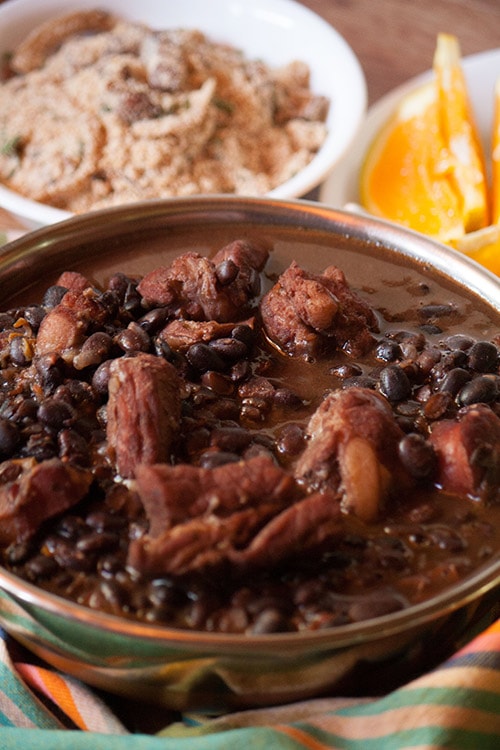
Brazilian Feijoada is a black bean and pork stew that Brazilians often serve topped with farofa, toasted cassava flour. Many call this comfort food the national dish of Brazil.
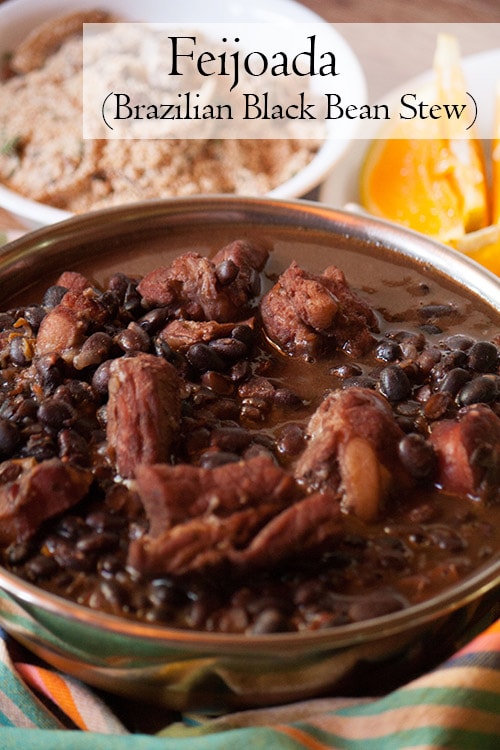
Feijoada, a popular Brazilian dish, owes its name to its main ingredient, black beans (feijão). It is a rich stew traditionally made from different parts of the pig, such as feet, ears, and bacon, as well as other smoked meats. (But don't worry, I have some substitutions for you if you're not up to cooking with pig ears and feet!)
Brazilian cuisine
Brazilian cuisine is very regionalized, each region has its own typical dishes. This is the result of a mixture of different European, Indigenous, and African ingredients and influences.
In the northeast region of Brazil, there is a great influence from African cuisine.
However, in the northern region, there is a greater influence from the Natives, where the use of cassava and fish come into play in many of their dishes.
In the southeast region of Brazil, there are diverse dishes linked to the Bandeirantes (bandits) that include ingredients like corn, beans, and pork.
In the southern region, Italian cuisine has a great influence on dishes such as polenta and pizza. And we also see the influence of German cuisine.
The history of feijoada
Some historians say that African slaves created feijoada (pronounced fay-jwa-da). After feasts given by the owners of the plantations, the slaves would pick up the leftovers and mix them with black beans, making a new stew.
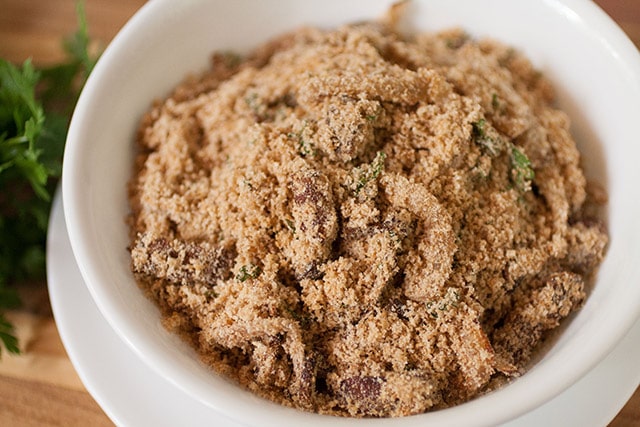
This new dish they served with farofa (fried cassava flour with bacon) and orange slices.
Other historians say that a similar dish was consumed in the north of Portugal, where its main ingredients were white or red beans and pork.
Whichever the story is, feijoada is a symbol of the fusion within Brazilian gastronomic culture. It is a Brazilian icon.
Ingredients and substitutions
This is such a great dish for big groups. It is easy to make and very cost-effective. To make feijoada there are some easy-to-find and traditional ingredients you may need to substitute for.
Beans: Dry black beans are the preference here. You can also use canned, but you will need to reduce the amount of water.
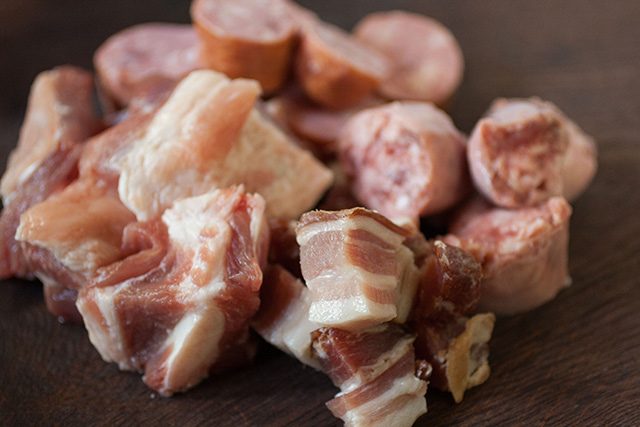
The meat: Traditional feijoada is made with pig's ear, feet, and snout along with Brazilian sausage and carne seca (salted dried beef).
For our recipe, we are using bacon, pork ribs, and 2 kinds of sausages, Polish sausage, and linguica.
Our original version of this recipe called for Mexican chorizo, which is the most widely used substitute for Brazilian sausage (which is quite hard to find outside of Brazil). But when I've tested it, it still doesn't quite give the same flavor to this stew that you would find in a truly authentic Brazilian feijoada.
Chorizo is often very oily as well. I do recommend you cook it first in a separate pan, drain the oil, and then add the cooked sausage with the rest of the ingredients.
[A note from Sarah: we have a friend from Brazil who has found that, when in the US, a Polish sausage gives this dish a flavor closer to what she grew up eating. So we have adjusted our recommendations in the recipe below accordingly.]
Aromatics and seasonings: Onion, garlic, tomatoes, bay leaves, salt, and pepper bring the flavors of the stew together.
How to make feijoada
While feijoada may seem like an intimidating dish, it is fairly straightforward and most of the time it requires is hands-off.
The night before: Your preparation for feijoada must start the night before, by soaking the beans. (This is very important to achieve the proper texture in the stew.)
Day of: Cook or brown the meat, in batches and set aside.
Start the aromatics sauteing, then add the soaked beans, meat, water, and other ingredients.
Bring the mixture to a simmer and cook until the beans are soft.
How to make feijoada in a slow cooker
You can also make feijoada in a slow cooker. After sauteing the aromatic vegetables and browning the meat, add all the ingredients to the slow cooker and cook on low for 10 hours.
Tips for making the best feijoada
Sauteeing your meat separately may seem like a waste of time, but it allows the flavors of each to set. It also allows any excess fat to render out, so you don't end up with it in your stew.
Taste your meat before you add it to your stew. If any of the meat you are using is very salty, cut back or skip adding extra salt. You can always add more towards the end to taste. But it is hard to remove the salt once it is in there.
When do Brazilians traditionally eat feijoada?
Brazilians usually eat feijoada on Wednesdays and Saturdays when restaurants traditionally offer it on their menus and families prepare it in social gatherings.
All social classes eat feijoada since it is such a low-cost dish.
In some parts of Brazil, they only serve feijoada during the winter months. However, in Rio de Janeiro this dish is served all year round.
How to serve Brazilian feijoada
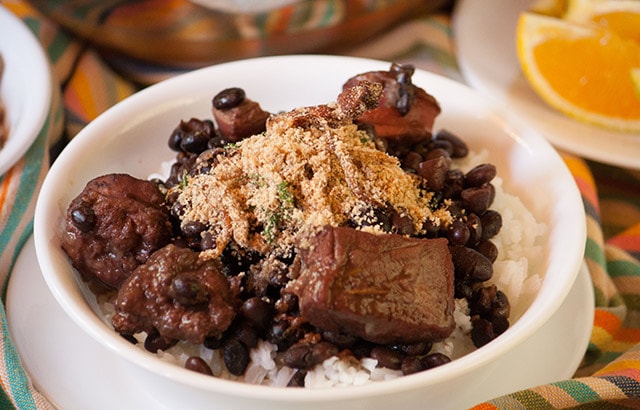
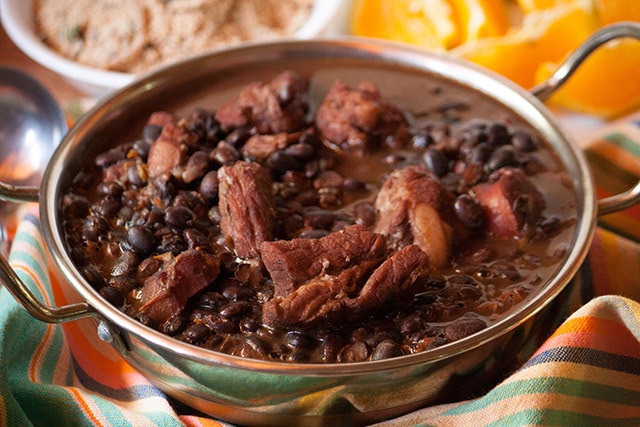
Feijoada is traditionally served with farofa, rice, and orange slices.
While making farofa to serve with feijoada is an extra step, it is so worth it. I definitely recommend you serve this feijoada with farofa.
What to serve with feijoada
If you are up for a challenge, serve a feijoada completa (complete feijoada) meal.
Feijoada completa starts with fried cassava as an appetizer.
Then, the main dish, is feijoada, white rice, fried plantains, farofa (fried cassava flour with bacon), and sliced oranges.
Drinks can be fresh juice, caipirinhas, or beer.
To finish up, serve some fruit compote or this simple and delicious Romeu e Julieta.
How to store and reheat leftovers
Any leftovers, I like to freeze in individual portions for easy reheating on the stovetop or in the microwave. The stew keeps well in the freezer for up to 3 months.
Brazilian Feijoada (Black Bean Stew)
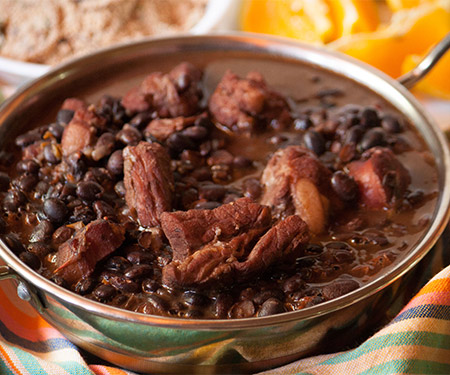
Brazilian Feijoada is a black bean and pork stew that is often served with farofa, toasted cassava flour.
**Since we're using dried beans, you will need to soak them overnight before cooking the stew. **
Ingredients
- 1 pound dry black beans (soaked overnight)*
- 1 tablespoon olive oil
- 4 ounces slab bacon (rind removed), diced
- 1 pound pork ribs, cut into individual ribs
- 1 lb Polish sausage, sliced**
- 1 smoked sausage (roughly 7 oz), such as linguica or kielbasa, sliced
- 1 large onion, chopped
- 4 cloves garlic, minced
- 3 tomatoes, diced
- 1 teaspoon salt
- 1 teaspoon ground black pepper
- 3 bay leaves
- water
- white rice (for serving)
- farofa (for serving)
Instructions
- In a large bowl with water, soak beans overnight.
- When you are ready to make your stew, in a large heavy-bottom soup pot, over medium heat, add the oil and bacon. Cook until crisp and transfer to a plate.
- Use the same saucepan to brown ribs and sausages in batches. Set each aside as cooked.
- If needed, add more oil to the pan. On medium-high, sauté onion, and garlic until soft and translucent, about 5 minutes. Add tomatoes and cook for another 3 minutes.
- Drain and rinse the soaked beans. Add them to the pot along with the ribs, bacon, sausages, salt, pepper, and bay leaf. Cover with water (about 8 cups).
- Bring the mixture to a boil and reduce the heat to low. Cover and let it cook for 2 to 2 and a half hours, or until the beans are soft.
- If the stew is too liquidy, uncover the saucepan and continue to cook for another 20 minutes to allow some of the liquid to evaporate.
- Serve with white rice and sprinkle some farofa on top.
Notes
* 1 pound dry beans = 2 cups dry beans = 6 cups cooked beans (Feel free to substitute 6 cups of drained, canned beans if desired. However, if substituting canned beans, you will need to reduce the amount of water to 3-4 cups since the beans will not absorb much water as they cook.)
** The flavor of feijoada relies on a mixture of Brazilian meats that can be tricky to find outside of the country. Our original recipe called for 2 (11 oz) Mexican chorizo sausages, however, a friend from Brazil let us know that, in the US, the sausage that gives the closest flavor to what she grew up with is the Polish sausage.
Nutrition Information:
Yield:
10Serving Size:
1Amount Per Serving: Calories: 620

Lizet is Bolivian and lives in Paraguay. Through friends and travel she has developed her love of food. From Africa to Asia, Europe to the Americas, there is always something new to try when you come to dinner. You can find more of Lizet's tasty creations on her website ChipaByTheDozen.com. You can also find her on Instagram and Facebook.



This is wonderful! I just made it tonight to freeze for my husband's lunches. I can't wait for him to try it!
So glad you enjoyed it!
Pork side or back ribs?
Hi Karina. Either should work just fine.
As a truly Brazilian I'm a feijoada lover. Feijoada reminds me of my childhood, so many memories of parties and get together. In Brazil when we meet with friends or family the chosen dish is always feijoada or 'churrasco', as we called in Portuguese Barbecues.
I live in West Virginia and I was having difficulties finding in the local markets truly rice, beans, and farofa (cassava flour) to cook an authentic Brazilian Feijoada. Then I came across this website shivoomarket.com where could find all the ingredients that I needed. Thanks for sharing this amazing recipe!!!
Thank you for sharing! Glad you found our recipe!
If you substitute canned beans, 8 cups of water is WAY too much! I spent two hours longer than cooking time waiting for the water to boil down. I eventually had to ladle half of it out and re-season the pot. 3-4 cups of water would be plenty.
Thank you for your note. And sorry for not clarifying. We will update the recipe.
I had Feijoada when I went to Brazil many years ago and have yearned for it ever since. I can buy smoked pig feed in my neck of the woods. Wish I could buy pig snout...I'm having a new range delivered this week and I have been looking for recipes for things I crave. I'm going to try this first with fingers crossed that it is similar to what I was once served. One question. I will make it with the choriso from the Mexican tienda not far from me because supermarket choriso is no substitute for the real thing. I'll check back in later this week with a review.
Hi Liz. I'm not sure what your question is, but do let us know what you think!
Additional question, sorry. The Mexican chorizo in the stores comes in 16 ounce sizes as does the keibasa here. Is that a correct amount for this recipe or should I reduce both?
Thanks a million, sorry about that.
@K, use 2 chorizos from the 16 ounce package (cook it separetly and drain the fat before adding it to the rest of the ingredients).
Use 1 (14-16 ounce) Kielbasa.
I have a question for you. The mexican chorizo, are you referring to the harder spanish chorizo or are you talking about the stuff you can easily get at the grocery store that gets crumbly when you cook it? Thanks for the help. I can't wait to make it.
@K, the one that gets crumbly.
Dear Sarah I don't have any bay leaves can I still make the stew? No access all out of money.
Hi Davey. You can omit the bay leaves in this recipe if you don't have them. They just help add another layer of flavor. Enjoy!
Hi.. black bean is same as a black soy bean. ??
Hi Mimi. No, not black soy beans, just standard black beans.
I have visited Brazil several times, love the food. My last visit, a colleague of mine too me to a local restaurant on a Saturday, lunch hour. We had Feijoada, it was wonderful. and her Uncle who has won Carnival two times, was playing for the visitors salsa music. It was a magical day !!. Chris
That is such a lovely memory! Thanks so much for sharing!
@Christine
I wonder if it may have been samba?
Samba is the carnival music.
It is a very good dish, but it does not taste like our feijoada. The Mexican chorizo changes the final flavor. It needs to be replaced by something else.
I'm sure every family has their own way of making it. What do you typically use in yours?
portuguese black pork chorizo makes it perfect
Sounds delicious!
Question: we don't cook the beans separately? We just cook them once with all the ingredients?
Yes, the beans will cook in the stew. Enjoy!
If using canned beans instead, do you still add all the water and simmer for 2 hours? Will the beans still exist after or will they just cook down to a paste?
Hi Stally, If using canned beans you can reduce the water and cook just until the beans are tender and meat is cooked.
The traditional feijoada needs collard greens too..perfect combination..
True, traditional feijoada needs collard greens. And also, orange slices. My wife is Japanese Brazilian, I had the best feijoada in Ipanema, rio de janeiro.
Yum. Thanks for sharing!
I had searched high and low for this recipe, because our son loved his father's cooking. Unfortunately his father passed away several years ago. My heart is warmed now for him because now I can get to cook this dish for him today.
Michelle. Thank you so much sharing. We are glad you found us, and we hope your son enjoys the stew.