Peruvian Ceviche
Peruvian ceviche is a mixture of flavors, salty and spicy, sweet and sour, that makes this dish unique and loved all over the world.
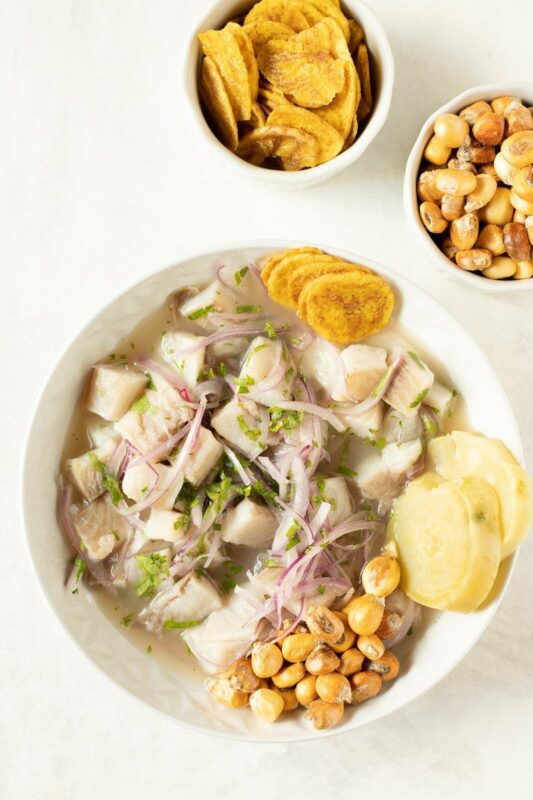
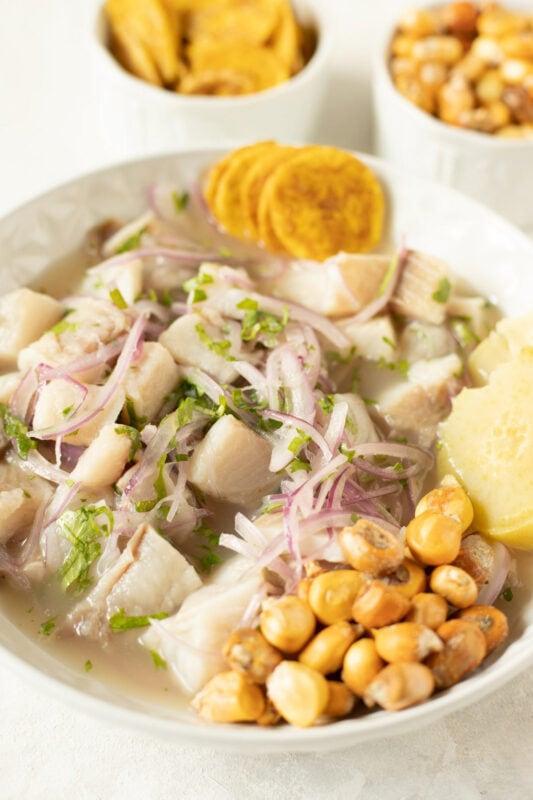
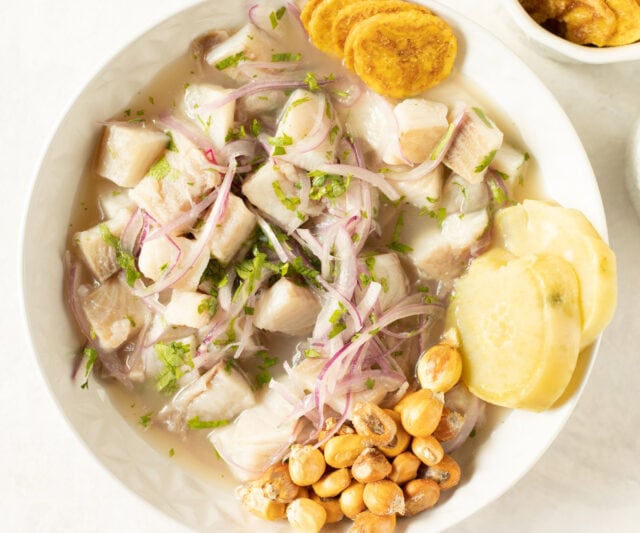
The ingredients in the recipe for this fish ceviche include pieces of raw fish marinated in lime juice, as well as thinly sliced onion. The dish is served with sweet potato slices, small portions of toasted corn, and plantain chips.
The history of ceviche
Ceviche was declared a National Cultural Heritage in 2004. Throughout history, it has been a dish of pride for all of Peru.
In fact, its popularity led to Ceviche Day people celebrate every June on the 28th.
There is no accurate historical record of the origin of ceviche. Food historians believe that between the 2nd and 5th centuries, on the Peruvian coast, the Mochica culture prepared a dish based on fresh fish, which was cooked with the juice of a local fruit called tumbo.
This preparation likely began on the high seas when, in the middle of their work, the fishermen cut up the fish and cooked it in their boats, taking advantage of the salt water.
Little by little, the dish evolved and people added more ingredients.
In the time of the Incas, the fish were macerated with chicha de jora, an Andean alcoholic drink.
With the conquest, it was the Spaniards, who added two ingredients: onion and sour orange juice to "cook" the ceviche.
Then, in the middle of the 20th century, sour oranges were replaced with lime, giving it that characteristic flavor that we love so much. From this marinade, the milky juice (leche de tigre) that the fish released was obtained.
Later, sides such as sweet potato, onion, lettuce, and chopped cilantro, were added to the dish. These made it stand out in Peruvian gastronomy.
Where do you find ceviche?
Although ceviche is a dish from the Peruvian coast, the other two regions also prepare it.
In the mountains and the jungle, they don't use sea fish, but river species such as trout or maiden. These have different flavors because they are freshwater fish. They add charapita chili (typical of the Amazon), cocona juice (tropical fruit) or aguaymanto (Peruvian groundcherry), instead of lime juice. They accompany the dish with cassava.
What makes Peruvian ceviche different?
Peruvian ceviche has a characteristic that you won't find in ceviches from other countries. This is the use of leche de tigre (tiger's milk).
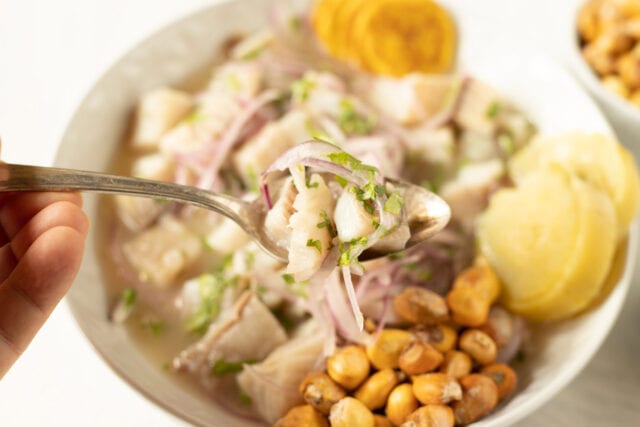
Other features are the use of red onion cut into plumas (feathers), and the fish, cut into bigger pieces (1-½ inches).
What fish to use in Peruvian ceviche?
Most Peruvian households use species such as bonito, mackerel, tuna, sardines, or anchoveta (called blue fish due to the external coloration of their skin and whose dark-colored meat is considered more nutritious due to the higher concentration of omega-3, proteins, and minerals).
Less abundantly used are white fish, such as sole, parakeet, sea bass, hake, cojinova, and cheetah, among others. But initially, chefs in restaurants preferred these white fish because of their better texture and their appearance for serving.
For this recipe, I used tilapia, because living in a landlocked country, that's my only option.
The really important thing is that the fish is fresh and boneless.
What are other ingredients in Peruvian fish ceviche?
Onion: Use red onions. The primary reason to use red onions cut into feathers is simply because the result is visually appealing and more uniform than other methods. The trick is only to use the outer leaves of the onion and to slice the onions lengthwise rather than horizontally.
Ají limo: Or lemon drop pepper, is used for ceviches in Perú. Habanero can be a replacement to use in this recipe.
Lime juice: It is highly recommended to use freshly squeezed lime juice to make ceviche. Don't replace it with lemon juice.
Leche de tigre: Tiger's milk is what gives life to Peruvian ceviche.
Other more common ingredients are celery, garlic, cilantro, ginger, and salt.
What is leche de tigre?
At first, leche de tigre (tiger's milk) was simply the leftover juice from the ceviche. However little by little, it gained fame and its own name until it became a new recipe.
It is whitish in color and slightly thick. That characteristic white color is what has earned it the name of milk.
People attribute restorative and aphrodisiac properties to it.
Leche de tigre is generally served in a glass and consumed as if it were a drink. And it's now part of the ceviche recipe.
How to prepare ceviche
Start by chopping and cutting all your ingredients, and squeezing the lime juice.
I recommend making your own fish stock, it only takes 8 minutes, and you'll get the Peruvian fish stock flavor. Once the stock is cooling, prepare the onions.
Soak the onions in cold water and keep them in the fridge while preparing the rest.
Make leche de tigre, and then mix everything with the fish.
My Peruvian friend said he likes to marinate ceviche for only 5 minutes before serving it. Personally, I like to wait 15 minutes.
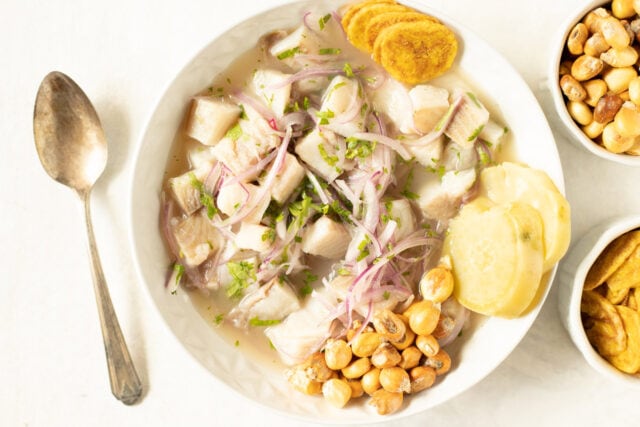
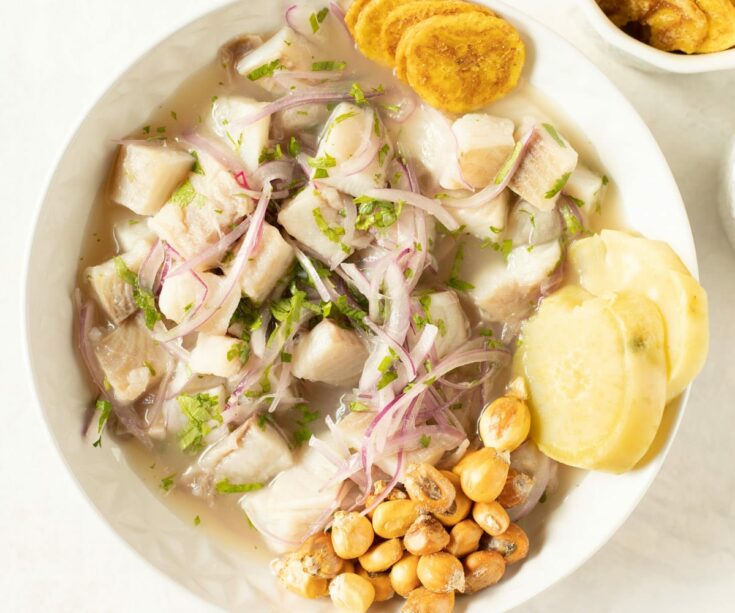
In Perú, ceviche is eaten with slices of cooked sweet potatoes, toasted chulpi corn, cooked fresh white corn, and plantain chips
Peruvian Ceviche
Peruvian ceviche is a mixture of flavors, salty and spicy, sweet and sour, that makes this dish unique and loved all over the world.
Ingredients
For the ceviche
- 2 lbs fresh fish, divided (sea bass, grouper, tilapia)
- 1 large red onion, outer part cut into feathers (center reserved for stock and leche de tigre below)
- salt, to taste
- 1 ¼ cup fresh lime juice
- 1 cup leche de tigre (see below)
- 1 cup cilantro, chopped (reserve the stems for below)
For the fish stock
- 2 cups water
- ¼ cup chopped fish (reserved from above)
- Red onion (use the center of half an onion from above)
- 1 garlic clove
- 2 inches piece of ginger, sliced
- 1 celery stalk
- Cilantro stem (use half of one bunch)
For the leche de tigre
- ¼ cup chopped fish (reserved from above)
- Red onion (use the center of half an onion from above)
- 1 garlic clove
- 2 inches piece of ginger, sliced
- 1 celery stalk
- Cilantro stem (use half of one bunch)
- ½ habanero chili
- 1 teaspoon salt
- ¼ cup fresh lime juice
- 1 cup fish stock (from above)
- 2 ice cubes
To serve, if desired
- Slices of cooked sweet potatoes
- Plantain chips
- Toasted corn
Instructions
Get ready
Chop and cut all your ingredients and squeeze the lime juice. For the onion, cut it in half, lengthwise. Remove the center of each half. A half center is used for both the fish stock and the leche de tigre.
Slice the outer part of the onions lengthwise into thin feathers and soak them in cold water. Keep them refrigerated until the last step.
Cut the fish into cubes of 1.5 inches. Leave the thinner slices to use for the fish stock and the leche de tigre.
For the fish stock
In a medium size pot, simmer ¼ c of fish, ½ onion center, garlic, ginger, celery, cilantro stems, and water for about 8 minutes. Let it cool and strain.
For the leche de tigre
In a blender or food processor, blend together ¼ cup of fish, ½ onion center, garlic, ginger, celery, cilantro stems, salt, habanero, lime juice, fish stock (that you just made), and ice cubes. Strain and reserve.
For the ceviche
To a large bowl add the remaining fish pieces and sprinkle with salt. Mix.
Add lime juice, and leche de tigre reserved from above.
Mix well and refrigerate for at least 5 - 15 minutes. (I prefer 15 minutes.)
To serve
Drain the water from the onions, rinse, and add to the fish along with the cilantro. Mix and serve with cooked sweet potato slices, plantain chips, and toasted corn, as desired.
Notes
Ceviche is best served the same day, but it keeps well in the refrigerator for up to 3 days.
Recommended Products
As an Amazon Associate and member of other affiliate programs, We earn from qualifying purchases.

Nutrition Information:
Yield:
10Serving Size:
½ cupAmount Per Serving: Calories: 262

Lizet is Bolivian and lives in Paraguay. Through friends and travel she has developed her love of food. From Africa to Asia, Europe to the Americas, there is always something new to try when you come to dinner. You can find more of Lizet's tasty creations on her website ChipaByTheDozen.com. You can also find her on Instagram and Facebook.