Easy French Cassoulet and Tannat Wine from Uruguay
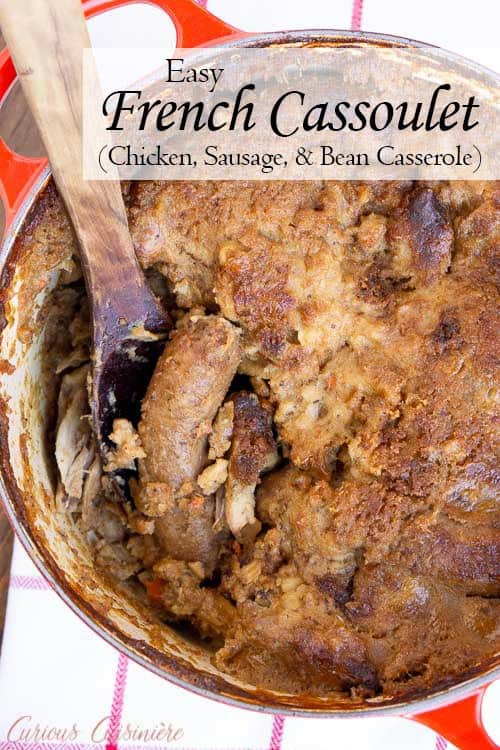
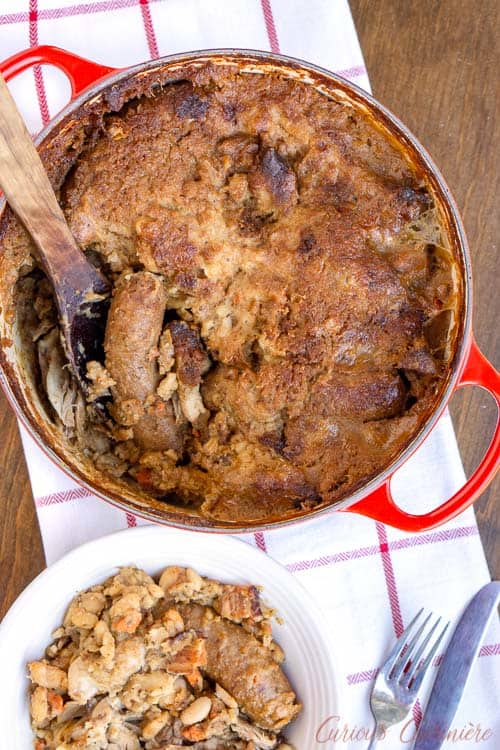
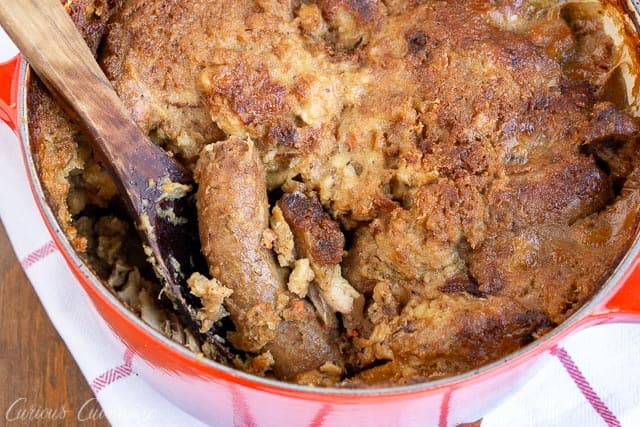
Our easy French cassoulet recipe takes all the rich flavors of traditional cassoulet in a dish that is easy to make in just a few hours. This cassoulet is a chicken, white bean, and Italian sausage casserole that is slow-cooked and wonderfully flavorful. True comfort food.
We served our French cassoulet with a Tannat wine from Urugyay. Why Uruguay? Read on to see the connection between Uruguay and cassoulet.
 What is cassoulet?
Cassoulet (pronounced 'ka-SOU-lay') is a hearty, slow-cooked casserole from the southwest of France.
It is a peasant dish from the regions of Gascony and Languedoc.
Being peasant food, recipes vary greatly from region to region. Peasants use what they have on hand to feed their families.
There are three staple ingredients that make a dish a cassoulet:
- meat
- some type of pork
- beans
What type of meat is in cassoulet?
Preserved goose or duck (confit) are common meats to find in cassoulet, as well as mutton. You may also find cuts of pork and, more-commonly nowadays, chicken.
Keep in mind that cassoulet is a slow cooking dish, so it is the perfect way to use those more tough or gamey meats that wouldn't be as appetizing if cooked quickly on their own.
Now, since we don't have a lot of goose, duck or mutton hanging around, for our easy cassoulet, we're using chicken thigh quarters seared in duck fat (but you could just as easily use butter). The thigh and leg meat is rich and flavorful, and the duck fat is our tribute to the more traditional meats.
What kind of sausage is in cassoulet?
Traditionally, cassoulet will include pork in the form of sausage and/or bacon.
For the sausage, Toulouse sausage is the most traditional. (Toulouse is a city in South France, in the Gascony region.)
Toulouse sausage is a simple garlic and black pepper seasoned pork sausage that has a coarse grind, so it has a really nice, meaty texture.
If you can't find Toulouse sausage, any good garlic pork sausage or Italian sausage (sweet, not hot) works perfectly well.
What kind of beans are used in a cassoulet?
The most common (we would almost say, essential) beans to use in cassoulet are a white bean (haricots blanc). Often lingot beans are the particular bean that is called for in French recipes. These beans are small, white, and creamy when cooked.
Navy beans are a great substitute for lingots. Cannellini beans would work as well, as long as you can find them dried. Using canned beans in this slow-cooking recipe would turn them to mush.
How to make traditional cassoulet?
It is easy to be intimidated by the traditional recipe for cassoulet.
Traditionally, this dish takes days to prepare and a day to cook. Most traditional recipes look something like this:
- Soak your beans for 24 hours
- Prepare a duck confit (slow cook duck thighs and legs in fat until they are fall-off the bone tender)
- Par-cook your beans with aromatics
- Saute bacon and sear sausage
- Layer the beans, meats, and seasonings in a casserole with stock
- Top with a breadcrumb crust
- Cook for 4-6 hours removing it from the oven 7 times during cooking to break the crust and let more fat and juices seep to the top
As you can tell, this process takes at least three days, plus most of a day to prepare the final dish.
Is it worth it?
It our opinion, YES!
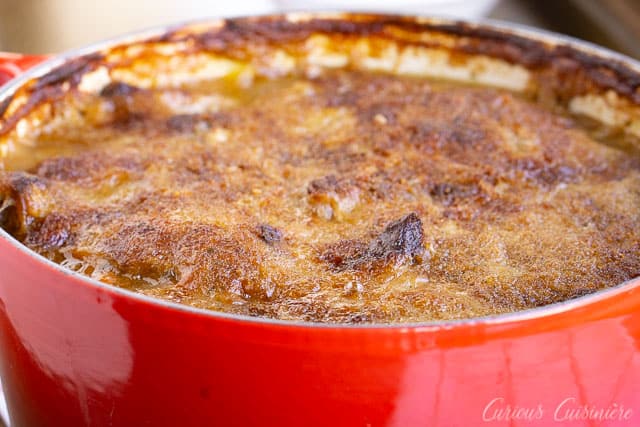
Our easy cassoulet recipe
However, to make this comfort food dish more accessible to our everyday lives and menu, we have made a few adjustments to make it easier to prepare and easier to source the ingredients.
First, as we mentioned, we're using chicken thigh quarters instead of duck. We're also using a sweet Italian sausage.
We got rid of the confit step all together. And, we simply cook our (pre-soaked) beans while we sear and saute our meats.
Then, everything gets layered into the Dutch oven and cooked for 3 hours, checking occasionally to be sure it's not too dry, and to break up any crust that has formed.
The result is a rich, hearty, and very satisfying dish that only takes 4 hours to make from start to finish. It's still not a 30 minute meal, but it can be made ahead, and the extra time is definitely worth it.
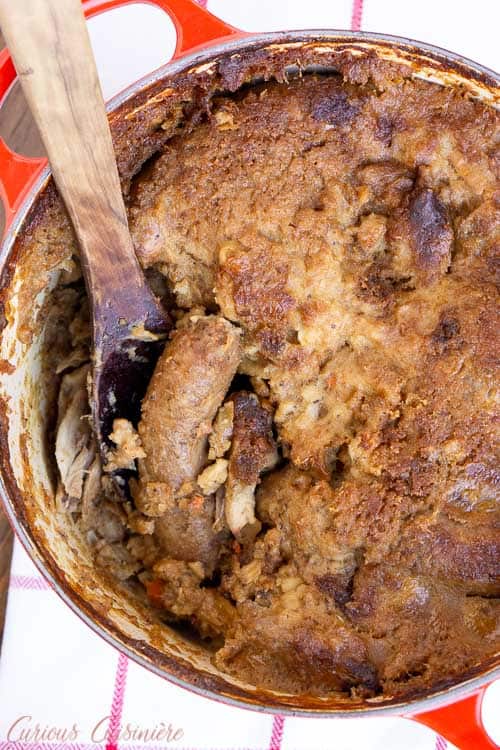
What do you serve with cassoulet?
Nothing.
Really, cassoulet is a rich and filling dish on it's own that doesn't need any accompaniments.
If you must have a first course, a salad is a nice light complement. And, for dessert, again, something light, maybe fruit-based would be a nice end to the meal.
What wine goes with cassoulet?
You really want to know what to serve with cassoulet?
Wine!
Cassoulet calls for a full-bodied red to go with its meaty richness. A wine from South France is always a great option: like Côtes du Rhône or Lauguedoc regions.
However, today, we're pairing our cassoulet with a wine from a different part of the world entirely: a Tannat form Uruguay.
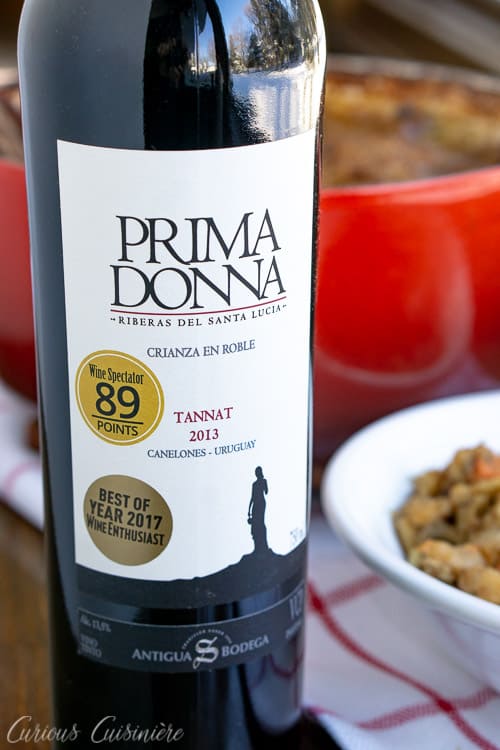
DISCLOSURE: We received samples of the Tannat wine mentioned below. As always, all opinions are our own.
Why a wine from Uruguay with a French dish?
Although we're talking about a wine from Uruguay, the Tannat grape is a French varietal, from the same area in France that cassoulet hails from.
So, how did this grape get to Uruguay?
In the middle of the 1800s Uruguay saw a large influx of French immigrants. (Nearly 50 % of their immigrants at that time were French.) And, one particular immigrant in the late 1800s brought the Tannat grapes with him. The vines took well (although changing slightly in flavor with the tropical climate) and it has become the country's top varietal.
Tannat Wine
Uruguay is most known for their production of red wine from these Tannat grapes. This grape that originally comes from South-West France is now considered the "national grape" of Uruguay.
Tannat wines from Uruguay are characterized by being lighter in body and with softer tannin than Tannat from other regions (like France).
We received samples of Tannat wine from Antigua Bodega Uruguay, a family run winery going back to 1928. Their vineyards sit on a unique piece of land that is surrounded by stone quarries of ping granite, which are wonderful for growing grapes and lend their flavor to the wines.
We found their 2013 Tannat to be quite fruity on the nose with notes of blackberry and raspberry. After 15-20 minutes to let the wine open up, we found a smooth and earthy wine with a bit of chalkiness and the blackberry carrying through.
The fat and meaty protein in the cassoult are the perfect match for a Tannat. Even with the softer tannins of the Tannat from Uruguay, we found the pairing to be spot on. The fat from the dish smoothed the edges of the wine, brought out the dark berry notes, and gave it an incredibly clean finish.
This was a wine and pairing that we enjoyed immensely, and we are excited to try out more wines from Uruguay in the future!
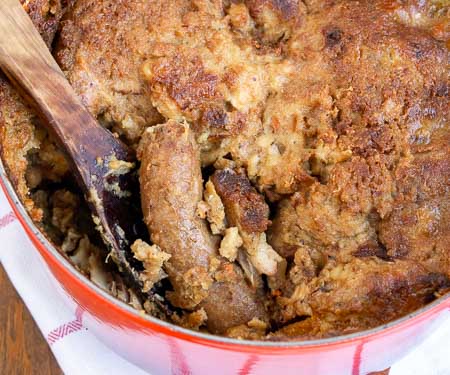
French Cassoulet (Chicken and Bean Stew)
Ingredients
- 1 lb dry navy beans, soaked overnight in salt water and drained
- 2 tablespoon duck fat (or unsalted butter)
- 4 chicken leg quarters (legs and thighs)
- 1 lb sweet Italian sausages (pork)
- ½ lb thick cut bacon, diced
- 2 carrots, diced
- 1 onion, diced
- 1 stalk celery, diced
- 4 cloves garlic, minced
- 3-4 c chicken stock (we prefer low sodium)
- 2 teaspoon parsley
- 1 teaspoon thyme
- 2 bay leaves
- ½ teaspoon salt
- 1 c breadcrumbs
Instructions
- Place the soaked and drained beans in a medium pot and cover with 2 inches of water. Cover the pot and bring the beans to a boil. Reduce the heat and simmer until the beans are just barely tender, 20 minutes.
- While the beans are cooking, heat the duck fat in a 5-6 quart Dutch oven.
- Over medium high heat, sear the chicken leg quarters until golden brown on both sides. Remove the chicken from the Dutch oven and set aside on a plate.
- Sear the sausages until golden brown. Remove and set aside.
- Add the diced bacon and cook until crisp. Remove and set aside.
- Remove about half of the fat from the Dutch oven. Add the diced carrots, onion, celery, and garlic. Sauté until softened and lightly golden.
- Add 2 cups of chicken stock to the veggies in the Dutch oven and deglaze the pan, scraping up any stuck bits with a wooden spatula.
- Preheat your oven to 325F.
- Drain the beans from their cooking liquid and add them to the Dutch oven. Add the parsley, thyme, bay, salt and cooked bacon. Mix well.
- Return the sausages and chicken to the pot, nestling them as evenly as possible among the beans. Add as much of the remaining stock to the dish so that you can see moisture peeking through the ingredients at the top.*
- Sprinkle the breadcrumbs over top of the dish and place it in the oven, uncovered to bake for 1 hour.
- After 1 hour, remove the dish from the oven and press down any breadcrumbs that haven’t been moistened. If the dish looks too dry on top, you can add a bit more chicken stock (or water). Return the dish to the oven to bake, uncovered for another 1 hour.
- After the second hour, again remove the dish from the oven and break up the top crust to moisten the breadcrumbs. Return the dish to the oven to bake, uncovered, for 1 final hour.
- After 3 hours of cooking time, remove the dish from the oven and let it rest, uncovered for 20 minutes.
- Serve warm.**
Notes
If you're excited to start trying more wines from Uruguay, have a look at these wonderful pairings for wines from Uruguay from our fellow Wine Pairing Weekend comrades.
- Pinny at Chinese Food and Wine Pairings presents Uruguay's Bodega Garzon Tannat Paired with Lamb Skewers and Beef Short Ribs.
- Camilla from Culinary Adventures with Camilla gives us Brined Quail with a Numbered Bottle of Tannat.
- Cindy from Grape Experiences provides Taste Uruguay: 1752Gran Tradicion Montevideo 2017 and Pasta with Caruso Sauce.
- David from Cooking Chat stirs up BBQ Baked Steak Tips with Wine from Uruguay.
- Wendy from A Day In The Life On The Farm presents Food and Wine of Uruguay: Chivito Sandwiches Paired with Garzon Cab Franc.
- Jeff from FoodWineClick! offers up Picturing Uruguay with Lentil Stew & Aguara Tannat.
- Jane from Always Ravenous stirs up Discovering Uruguayan Wine Paired with a Winter Plate.
- Steven from Steven's Wine And Food Blog shares Tannat and Brazilian Feijoada.
- Linda from My Full Wine Glass asks Meatless in Uruguay -Is that Possible?
- Nancy from Pull That Cork offers Uruguay: a Wine and Food Sampler.
- Gwendolyn from Wine Predator shares Uruguay: Influenced by Immigrants Plus 7 Fun Facts.
- Jennifer from Vino Travels presents Bodega Garzón Tannat with Sausage Stew.
- Martin of ENOFYLZ Wine Blog writes A Taste of the Food and Wine of Uruguay
- Rupal from Syrah Queen is ready with Tannat - The National Grape of Uruguay.

Sarah founded Curious in 2010 as a way to save her recipe creations and share culinary experiences. Her love for cultural cuisines was instilled early by her French Canadian Grandmother. Her experience in the kitchen and in recipe development comes from over 10 years working in professional kitchens. She has traveled extensively and enjoys bringing the flavors of her travels back to create easy-to-make recipes.
Stagnari is a very distinct terroir, in fact there is a quarrry nearby because the soil is so stony!
Yes, it was so interesting to taste their wine!
I love a good cassoulet and have made it a number of times. I agree it's worth the effort, but it is a chore! For that reason, when I see it on a (good) restaurant menu, I'll often order it. Let them do all the hard work! Of course, it's perfect with Tannat!
I don't think we've ever seen cassoulet on a restaurant menu, but if we did, we'd definitely have to get it!
Looks ddeliicous! I've also been on a Cassoulet kick recently; must be the season!
It definitely is the season! Pure comfort food!
So homey and comforting. The perfect winter dish and the perfect wine with which to pair it.
Thanks Wendy!